10 Best AI Learning Resources in 2026: Platforms Redefining How We Learn
Vipin Kumar
|
 23 January, 2026
AI-powered learning in 2026 has moved well beyond early experimentation. The best AI learning resources in 2026 go far beyond basic automation and content generation, offering structured knowledge, adaptive learning flows, and deeper understanding. Increasingly, modern AI learning platforms no longer exist only to answer questions; instead, they guide learners through concepts in a logical, contextual, and outcome-oriented way. This evolution reflects a broader shift in how learners and institutions now perceive learning. At the same time, learning today is increasingly continuous, self-directed, and integrated into daily workflows rather than confined to classrooms or formal courses.
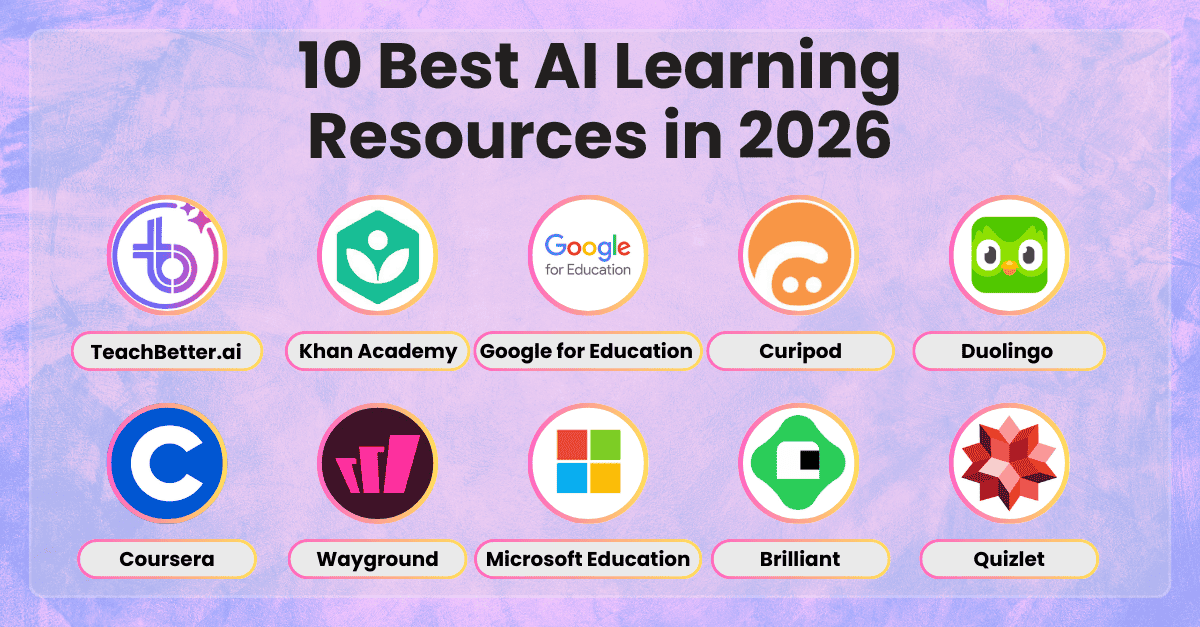
As a result, educators and organizations now measure the value of AI in learning by reliability, structure, and long-term impact rather than novelty. The most successful platforms in 2026 are those that balance intelligence with intentional design, ensuring that learning remains meaningful rather than overwhelming. This guide brings together the 10 best AI learning resources in 2026, highlighting platforms that combine intelligence, structure, and real-world learning impact.
What Defines a High-Quality AI Learning Resource Today
Not every AI-powered platform qualifies as a high-quality learning resource. In 2026, thoughtful design clearly separates effective AI learning tools from ineffective ones. Strong platforms prioritize clear learning objectives, structured progression, and contextual relevance rather than unrestricted content generation.
High-quality AI learning resources demonstrate an understanding of how people actually learn. They introduce concepts gradually, reinforce ideas through practice, and offer explanations that prioritize clarity over complexity. Importantly, they avoid creating dependency by encouraging reasoning, exploration, and application instead of simply delivering answers.
Why Choosing the Right AI Learning Platform Matters
With the rapid expansion of AI tools, learners and institutions face an abundance of choices—but not all choices lead to better learning outcomes. Selecting the right AI learning platform directly shapes how learners absorb, retain, and apply knowledge. Poorly designed tools can fragment learning, create cognitive overload, or encourage surface-level understanding. By comparison, the right platforms bring consistency and coherence to the learning experience.
In 2026, choosing AI learning resources is less about adopting the newest technology and more about aligning with platforms that demonstrate pedagogical maturity. The most impactful tools are those that support learning as a process—not a transaction.
The platforms listed below represent the 10 best AI learning resources in 2026, selected based on learning depth, adaptability, reliability, and long-term relevance.

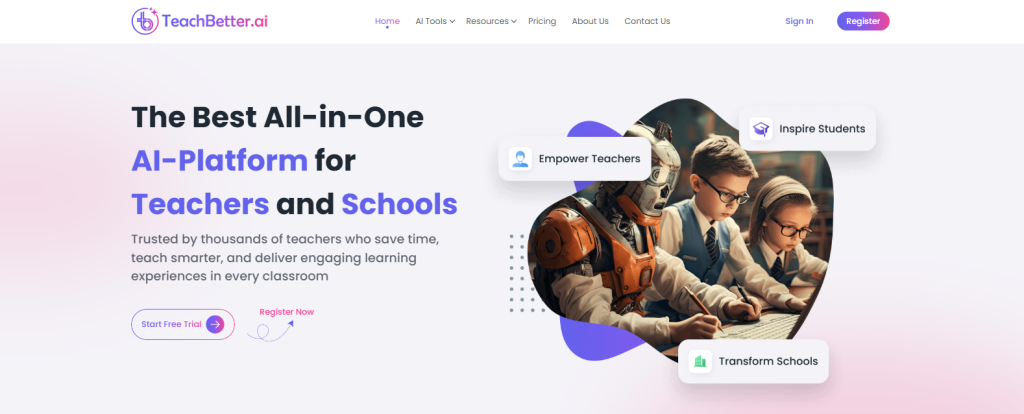
TeachBetter.ai stands as a purpose-built AI learning ecosystem and ranks among the best AI learning resources in 2026 for structured knowledge creation, application, and assessment. Instead of functioning as a generic conversational AI, the platform follows clearly defined learning workflows that mirror real-world educational processes.
The platform emphasizes contextual intelligence and actively aligns learning outputs with objectives, formats, and progression standards. This makes TeachBetter.ai less about isolated content generation and more about enabling coherent, end-to-end learning experiences.
Core Learning Capabilities
TeachBetter.ai offers 100+ interactive simulations, AI-driven lesson creation, assessments, worksheets, concept explanations, interactive activities, presentation generation. These capabilities work together as an integrated system, allowing learning content to remain consistent, connected, and purposeful.
A key strength of the platform is its ability to link abstract concepts with real-life applications. By grounding learning in practical scenarios, TeachBetter.ai supports deeper understanding and improves long-term retention rather than short-term recall.
Why It Stands Out in 2026
Notably, TeachBetter.ai stands out due to its education-first architecture that prioritizes structure, clarity, and responsible AI usage. As a result, the platform delivers guided, curriculum-aware outputs instead of open-ended responses designed specifically for learning environments.
In 2026, this intentional design positions TeachBetter.ai as one of the most comprehensive and reliable AI learning platforms—particularly for users seeking depth, consistency, and pedagogical integrity in AI-powered learning.

2. Khan Academy
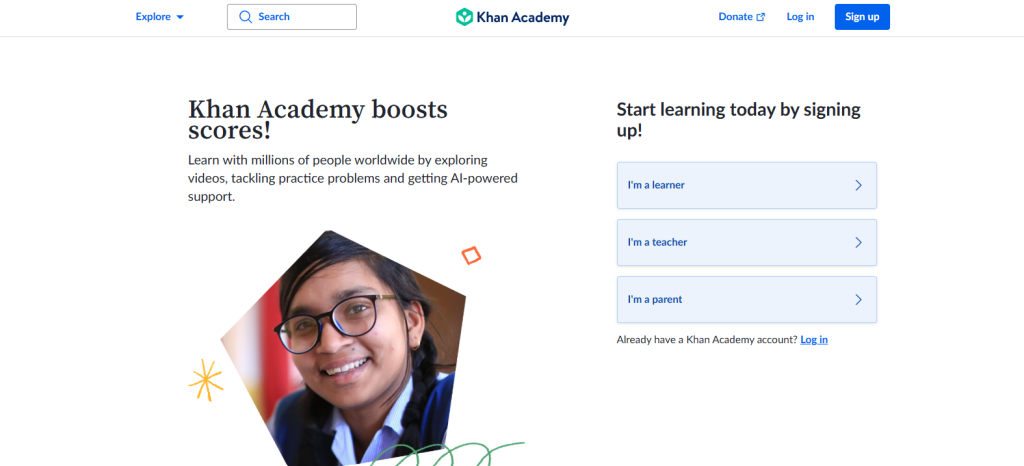
Khan Academy delivers structured, curriculum-aligned content across mathematics, science, economics, and computing and remains globally trusted. It has established itself as a reliable resource for foundational and conceptual learning.
The platform’s design emphasizes clarity, logical progression, and accessibility, making it suitable for a wide range of learning needs. Its nonprofit model reinforces a strong focus on educational value rather than commercial experimentation.
Core Learning Capabilities
Khan Academy integrates an AI-powered tutor that provides guided hints, step-by-step explanations, and adaptive practice experiences. This intelligent support helps learners identify gaps and resolve misunderstandings at the moment they occur.
The platform follows a mastery-based progression model, requiring conceptual understanding before advancement. This approach reduces learning gaps and reinforces strong foundations across subjects.
Why It Stands Out in 2026
Khan Academy continues to stand out in 2026 because of its disciplined and responsible use of AI. Rather than over-automating learning, it uses AI to reinforce proven educational principles.
Its strength lies in combining high-quality content with adaptive support, making it especially effective for independent, self-paced learning focused on long-term understanding.

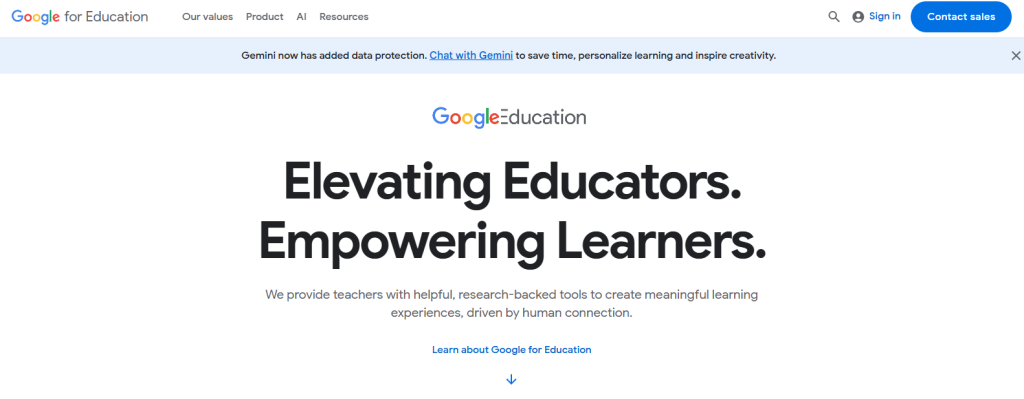
Google for Education provides a digital learning infrastructure that supports academic workflows, collaboration, and content distribution at scale. It provides the foundational systems used by institutions to manage learning operations efficiently.
Rather than positioning itself as a teaching intelligence platform, Google for Education focuses on reliability, scalability, and seamless integration across devices and environments.
Core Learning Capabilities
The platform includes AI-assisted organization, document intelligence, feedback suggestions, and workflow automation. Tools such as Docs, Slides, Forms, and Classroom work together to support content creation, sharing, and collaboration.
Its ecosystem-based approach enables smooth management of learning activities, reducing operational friction and improving access to learning materials.
Why It Stands Out in 2026
Google for Education stands out in 2026 as a foundational layer within broader learning ecosystems. Its value lies not in deep instructional design but in enabling large-scale, connected learning environments.
When combined with specialized AI learning platforms, Google for Education provides the infrastructure that supports consistency, reach, and operational stability.

4. Curipod
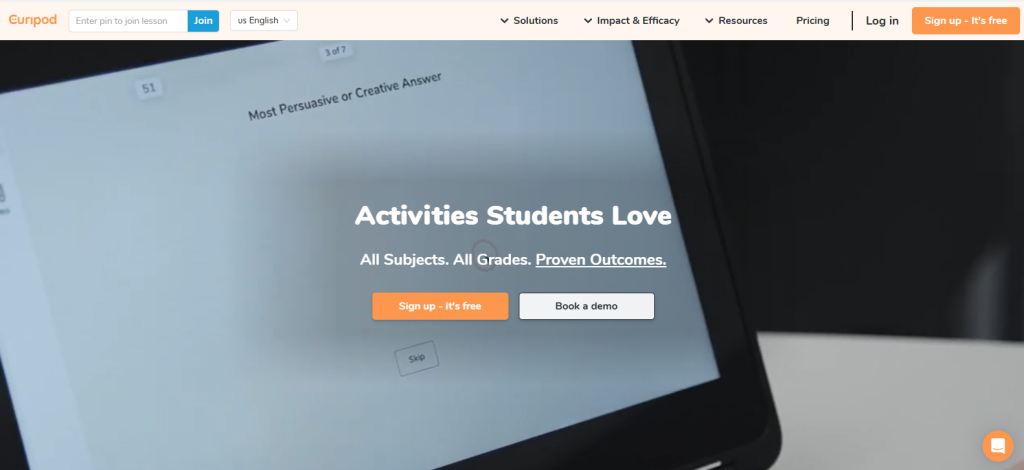
Curipod is an AI-powered interactive learning platform designed to help create engaging, discussion-driven lessons with minimal effort. Instead of focusing purely on content generation, Curipod emphasizes participation, interaction, and real-time engagement within structured learning experiences.
The platform positions itself as a bridge between instructional design and classroom interaction. By combining AI with interactive slide-based lessons, Curipod supports learning environments where engagement and concept clarity take priority over static content delivery.
Core Learning Capabilities
Curipod uses AI to generate interactive lessons, discussion prompts, polls, reflections, and activities aligned with learning objectives. The platform enables quick creation of visually engaging content while embedding opportunities for participation and feedback throughout the lesson flow.
In addition, Curipod supports real-time interaction, allowing facilitators to gather responses, spark discussions, and adapt pacing dynamically. This approach keeps learning active and responsive rather than one-directional.
Why It Stands Out in 2026
In 2026, Curipod stands out for its focus on interactive learning by design, not just AI-assisted content creation. The platform uses AI as an enabler for engagement rather than a shortcut for planning.
By prioritizing participation, clarity, and structured interaction, Curipod offers a more learning-centric alternative to lightweight content-generation tools, making it a valuable component of modern AI-powered learning ecosystems.
5. Duolingo
Duolingo is an AI-driven language learning platform designed to make skill acquisition engaging, accessible, and habit-forming. The platform relies on a gamified structure that breaks language learning into short, manageable interactions and encourages regular practice.
The platform prioritizes consistency over intensity in skill-based learning. By combining behavioral design with artificial intelligence, Duolingo transforms language learning into a continuous, low-friction experience rather than a time-bound academic task.
Core Learning Capabilities
Duolingo uses AI to personalize lesson difficulty, repetition frequency, and exercise formats based on performance and engagement patterns. The system continuously assesses learner performance in the background and adapts content dynamically without interrupting flow.
The platform also employs spaced repetition and micro-assessments to reinforce vocabulary, grammar, and comprehension. These mechanisms ensure that previously learned material is revisited at optimal intervals, improving long-term retention and fluency.
Why It Stands Out in 2026
In 2026, Duolingo continues to stand out as one of the most effective AI-powered platforms for skill-based learning. Its strength lies in sustaining engagement over long periods, which is critical for language acquisition.
By combining adaptive intelligence with strong product design, Duolingo remains a benchmark for how AI can support daily practice, consistency, and incremental progress in learning.

6. Coursera
Coursera is a large-scale online learning platform that delivers courses, certifications, and degree programs from universities, academic institutions, and industry leaders worldwide. It operates at the intersection of education and professional development.
The platform is designed to support structured, outcome-oriented learning across a wide range of disciplines, including technology, business, science, and humanities. Its scale and institutional partnerships position it as a key player in advanced and lifelong learning.
Core Learning Capabilities
Coursera uses AI-driven recommendations to guide users toward relevant courses, credentials, and learning pathways based on goals, prior activity, and skill gaps. This helps reduce choice overload and creates more intentional learning journeys.
The platform also integrates automated assessments, peer evaluations, and progress tracking to support structured learning at scale. AI assists in aligning content difficulty and sequencing to learner intent rather than offering purely linear consumption.
Why It Stands Out in 2026
In 2026, Coursera stands out as a strong choice for advanced, academic, and career-oriented learning. Its value lies in combining AI-driven personalization with rigorously designed content from credible institutions.
Rather than replacing traditional education models, Coursera complements them—making it particularly relevant beyond foundational education and into professional and higher-learning contexts.

7. Wayground
Wayground is an interactive learning and assessment platform designed to make practice, review, and evaluation engaging. It emphasizes participation and responsiveness through game-based mechanics and real-time interaction.
The platform is commonly used for reinforcing concepts and checking understanding, transforming assessments from static checkpoints into active learning moments.
Core Learning Capabilities
Wayground uses AI to adapt question difficulty, analyze performance trends, and personalize practice experiences. These capabilities allow assessments to respond dynamically to how users are performing rather than applying uniform difficulty.
Gamification elements such as points, timers, and instant feedback increase motivation while keeping learners focused. The platform also provides performance insights that highlight strengths and areas needing reinforcement.
Why It Stands Out in 2026
Wayground stands out in 2026 for its ability to balance assessment with engagement. It is particularly effective in situations where quick feedback and sustained attention are critical.
By turning evaluation into an interactive experience, Wayground helps maintain momentum in learning while reinforcing understanding through repetition and feedback.

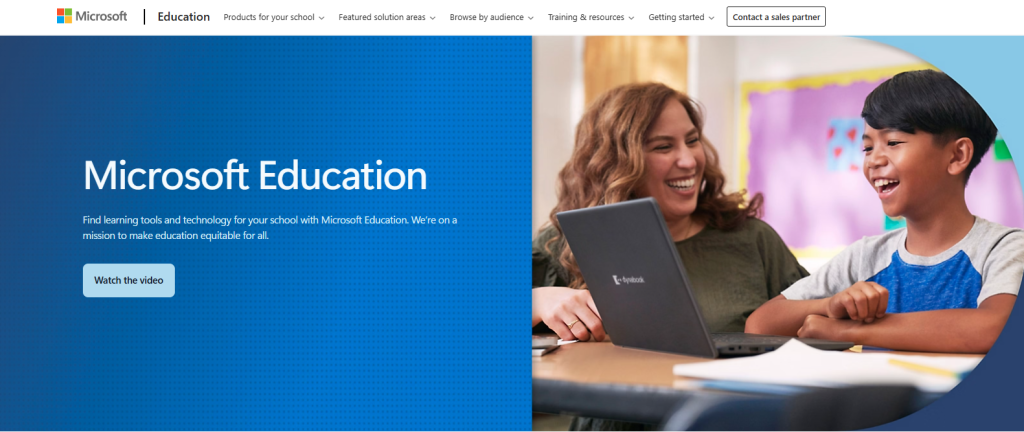
Microsoft Education supports large-scale, collaborative, and inclusive learning through an enterprise-grade learning ecosystem. It is built to integrate seamlessly with institutional systems and digital infrastructure.
The platform prioritizes accessibility, security, and compliance, making it suitable for diverse learning contexts and global deployment.
Core Learning Capabilities
Microsoft Education incorporates AI-powered reading tools, real-time translation, speech recognition, and assistive technologies. These features enable broader access to learning content across languages, abilities, and learning needs.
Collaboration tools and content-sharing capabilities further support distributed learning, ensuring continuity across devices and environments.
Why It Stands Out in 2026
In 2026, Microsoft Education plays a critical role in inclusive and large-scale learning ecosystems. Its focus on accessibility and compliance addresses requirements that many AI-first platforms overlook.
Rather than specializing in instructional intelligence, Microsoft Education excels as a reliable, scalable foundation for equitable access to learning powered by AI.

9. Brilliant
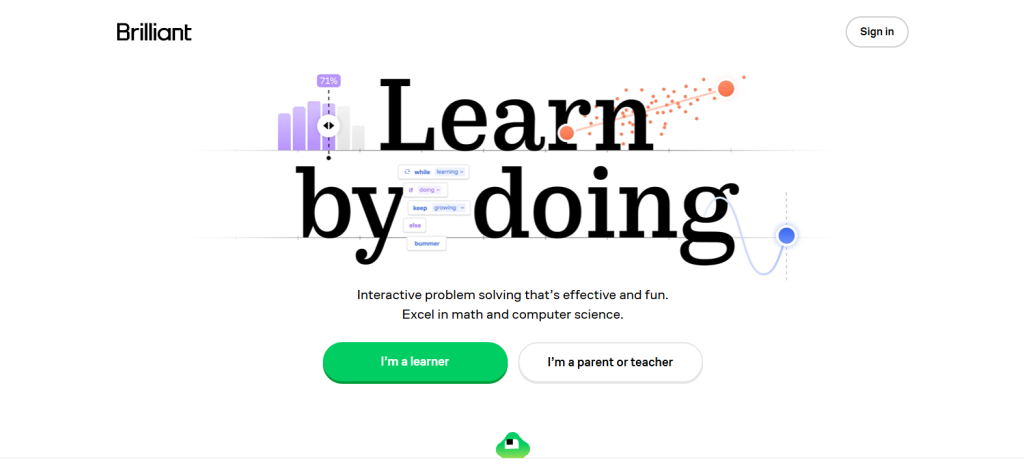
Brilliant is an interactive learning platform designed around problem-solving, logical reasoning, and conceptual discovery. Instead of relying on passive content consumption, the platform encourages active engagement through guided challenges and exploratory learning experiences.
The platform is particularly focused on mathematics, science, and analytical domains, where understanding how and why a solution works is more important than memorizing formulas or procedures. This makes Brilliant well-suited for learners seeking depth rather than speed.
Core Learning Capabilities
Brilliant offers hands-on challenges that guide learners step by step through complex problems in mathematics, physics, computer science, and related fields. Each concept is introduced through interactive problem-solving rather than explanatory lectures alone.
The platform emphasizes intuition-building and reasoning by encouraging experimentation, pattern recognition, and incremental discovery. Feedback is embedded directly into the learning flow, allowing learners to refine their thinking as they progress.
Why It Stands Out in 2026
In 2026, Brilliant is widely regarded as one of the strongest platforms for developing deep analytical and critical thinking skills. Its guided exploration model helps learners internalize concepts rather than rely on shortcuts.
By prioritizing understanding over memorization, Brilliant continues to stand out as a learning platform that aligns closely with how complex reasoning skills are actually built and retained over time.

10. Wolfram Alpha
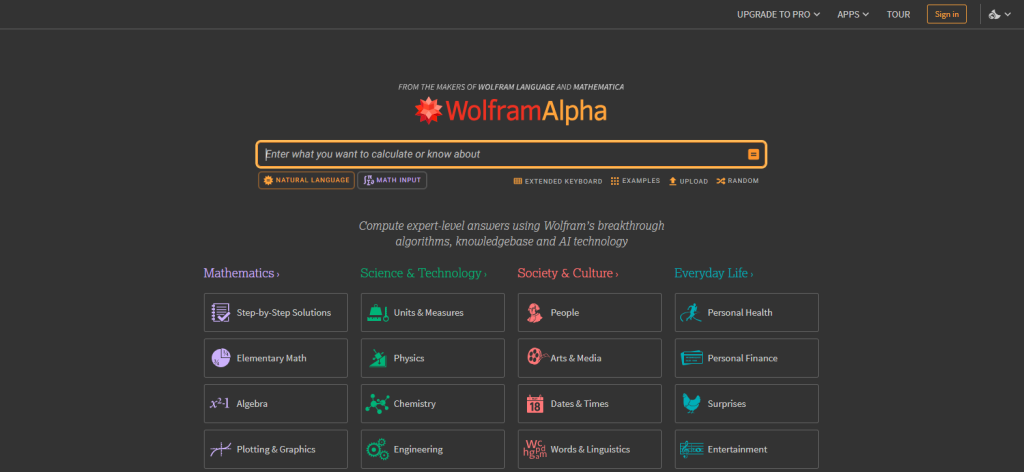
Wolfram Alpha is a computational intelligence engine designed to deliver structured answers, precise calculations, and data-driven insights across mathematics, science, engineering, and general knowledge domains. Unlike conversational AI systems, it is built around formal computation and verified data sources.
The platform operates as a knowledge engine rather than a learning course provider, focusing on accuracy, logic, and mathematical rigor. This makes it especially valuable for advanced exploration and technical inquiry.
Core Learning Capabilities
Wolfram Alpha supports the exploration of mathematical, scientific, and factual queries by showing transparent computational steps and visualizations. Users can examine not only final answers but also the processes used to derive them.
Its ability to manipulate equations, generate graphs, and analyze datasets enables deeper investigation of complex problems. This transparency supports learning by making abstract calculations more concrete and traceable.
Why It Stands Out in 2026
In 2026, Wolfram Alpha remains unmatched for precision and computational reliability. Its strength lies in verification-based learning, where correctness and logical consistency are paramount.
Rather than replacing reasoning, Wolfram Alpha reinforces it—making the platform a powerful companion for advanced inquiry, validation, and deep analytical exploration.
How AI Learning Resources Are Reshaping Knowledge Acquisition
AI learning platforms are fundamentally changing how knowledge is acquired and internalized. Rather than consuming static content, learners now interact with systems that respond to their inputs, adapt to their pace, and adjust explanations based on context. This dynamic interaction enables learning to become more personalized and responsive.
Another significant shift is the emphasis on real-world application. In particular, many AI learning resources in 2026 focus on connecting abstract ideas with practical scenarios, helping learners understand not just what a concept is, but why it matters and how it can be used. This approach improves retention and encourages critical thinking.
Over time, these changes are redefining learning as an active, iterative process. AI-supported learning is no longer about completing modules or lessons—it is about continuously refining understanding through exploration, feedback, and reflection.
The Future Direction of AI Learning Platforms
Looking ahead, AI learning platforms are expected to become more proactive and anticipatory. Instead of reacting only to user inputs, future systems will identify learning gaps, suggest targeted pathways, and adapt content in real time. As a result, this evolution will further blur the line between learning support and learning strategy.
Ultimately, the future of AI learning platforms will be defined by their ability to support depth, clarity, and long-term understanding. Tools that respect the complexity of learning—and design for it thoughtfully—will remain relevant well beyond 2026.
Final Perspective: AI as a Foundation for Better Learning
Ultimately, AI’s true contribution to learning lies not in speed or scale alone, but in its ability to support thoughtful, structured understanding. The best AI learning resources in 2026 are those that enhance focus, reduce friction, and encourage meaningful engagement with knowledge.
As AI becomes increasingly embedded in learning systems, the responsibility shifts toward choosing platforms that prioritize quality over convenience. When applied intentionally, AI does not simplify learning—it strengthens it, making learning more adaptive, resilient, and future-ready. Choosing the best AI learning resources in 2026 is ultimately about prioritizing platforms that support clarity, structure, and meaningful understanding over speed or novelty.

Vipin Kumar, Co-Founder, TeachBetter.ai
Vipin Kumar is building TeachBetter.ai to create intuitive AI tools that simplify teaching and enhance learning outcomes. With prior experience at global technology companies, he brings a deep understanding of scalable systems, user needs, and practical digital solutions. His mission is to make AI adoption in education easy, affordable, and truly impactful for teachers everywhere. He is committed to creating AI solutions that save time, boost creativity, and empower educators to focus on what matters most—teaching.
Read other articles authored by Vipin Kumar here.