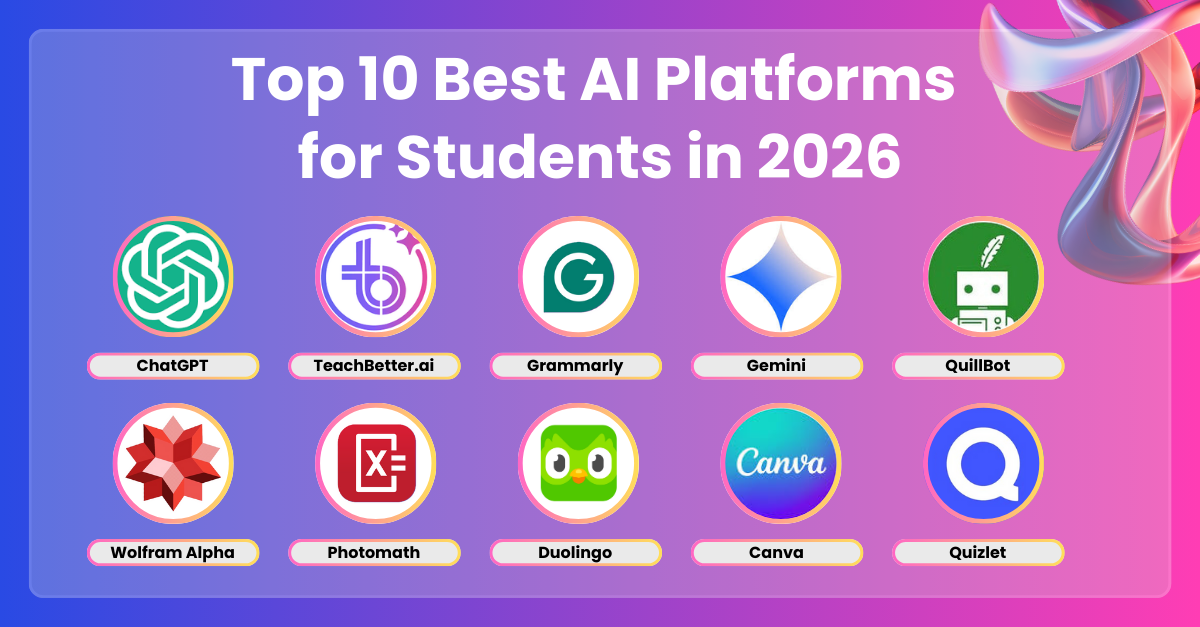
Top 10 Best AI Platforms for Students in 2026
Vipin Kumar
|
 11 December, 2025
Learning in 2026 has evolved far beyond textbooks, tuition centers, and digital classrooms. Students today are surrounded by intelligent systems that help them understand concepts, solve doubts, research topics, create projects, practice skills, and prepare for exams — all at their own pace.
But with hundreds of AI apps entering the market, students and parents often feel overwhelmed.Which platforms genuinely support learning? Which ones improve clarity, boost productivity, and build confidence?
This guide highlights 10 carefully selected best AI platforms for students in 2026, representing the most popular, trusted, and impactful tools across learning, writing, math, research, creativity, and language development.
Each platform is explained with clear pros, cons, and ideal use cases, helping you build a practical AI-powered study stack.

1. ChatGPT by OpenAI — The Universal AI Tutor
ChatGPT continues to be one of the world’s most widely used study assistants. Students rely on it for conceptual explanations, summaries, essays, programming help, and revision notes. Its conversational ability makes complex topics feel simple and accessible.
🟢 Pros:
- Exceptional at breaking down difficult subjects into simpler explanations.
- Offers a wide variety of learning styles — examples, analogies, stepwise reasoning, visual prompts.
- Generates essays, outlines, notes, flashcards, and study guides instantly.
- Multilingual support helps non-English medium students learn comfortably.
- Always available — ideal for late-night doubts and revision sessions.
🔴 Cons:
- Not aligned to CBSE/ICSE/IB/IGCSE curricula.
- Requires good prompting skill for accurate, structured answers.
- Can overwhelm younger students with overly detailed explanations.
- Responses must be verified for factual accuracy.
🌟 Ideal For:
Students in Grades 6–12 who want a flexible, powerful AI study partner for daily homework, assignments, conceptual understanding, and creative writing.

2. TeachBetter.ai — The most comprehensive and affordable AI Learning Companion
TeachBetter.ai is a purpose-built platform designed specifically for school-going children, unlike general AI assistants. It focuses on concept clarity, doubt solving, safe AI research, visual simulations, structured practice, and homework support — making it ideal for real academic learning.
The platform includes 20+ AI tools, safe web/image/video search for learning, presentation generators, practice modules, and an upcoming library of 100+ interactive science and math simulations.
🟢 Pros:
- Age-appropriate Concept Explainer with relatable examples and stories.
- Doubt Solver breaks down maths, physics, chemistry, and social science problems step-by-step.
- 100+ simulations make abstract topics easy to visualize.
- Safe, ad-free AI-powered research for text, images, and videos.
- Students can generate presentations, assignments, and project reports with high clarity.
- Supports 80+ languages — ideal for multilingual learners and parents.
- Designed explicitly for CBSE, ICSE, IB, IGCSE, and State Boards.
🔴 Cons:
- Mobile app in development (web-first platform).
- Students may need a brief onboarding period to explore all tools.
🌟 Ideal For:
K–12 students needing a safe, structured, curriculum-aware learning companion for doubt solving, concept learning, exam preparation, and project creation.
Also ideal for parents who want visibility into their child's learning progress.

3. Grammarly — The AI Writing Mentor for Academic Excellence
Grammarly is the most widely used AI writing assistant among students for polishing essays, assignments, debates, and applications.
🟢 Pros:
- Corrects grammar, punctuation, clarity, and tone in real time.
- Teaches writing through explanations — improving long-term skill.
- Highlights plagiarism in advanced plans — helpful for higher grades.
- Supports emails, essays, reports, and creative writing.
🔴 Cons:
- Not a subject-learning tool.
- Over-correction may weaken a student’s personal writing style.
- Best features require the premium version.
🌟 Ideal For:
Students in Grades 8–12 preparing essays, English assignments, project reports, debate scripts, or college applications.

4. Google Gemini — Real-Time Research & Learning Partner
Google Gemini enhances research and subject understanding through AI-powered summarization, document analysis, and reasoning.
🟢 Pros:
- Great for research in social sciences, science, and current affairs.
- Summarizes PDFs, webpages, and handwritten notes quickly.
- Strong image reasoning helps interpret diagrams, charts, maps, and graphs.
- Integrates seamlessly with Google Docs, Sheets, and Classroom.
🔴 Cons:
- Not mapped to school curriculum structure.
- Quality depends on prompt clarity.
- Requires critical thinking to interpret results.
🌟 Ideal For:
Students doing projects, reading comprehension, academic research, and preparing long-form assignments.

5. QuillBot — The Paraphrasing & Summarizing Powerhouse
QuillBot is popular among students for rewriting content clearly, summarizing long notes, and polishing assignment language.
🟢 Pros:
- Excellent for rewriting textbook explanations more simply.
- Built-in summarizer helps condense long chapters or readings.
- Multiple writing styles: formal, simple, expand, shorten.
- Attractive for students who struggle with wording clarity.
🔴 Cons:
- Risks misuse if students rewrite without understanding.
- Does not explain concepts — only rewrites text.
🌟 Ideal For:
Students creating revision notes, rewriting textbook paragraphs, or simplifying long explanations for easier understanding.

6. Wolfram Alpha — The Precision Engine for Math & Science
Wolfram Alpha is the gold standard for computational accuracy in mathematics, chemistry, physics, statistics, and engineering.
🟢 Pros:
- Reliable for complex equations — calculus, algebra, trigonometry.
- Provides graphs, constants, chemical equations, and scientific data.
- Step-by-step reasoning supports conceptual clarity.
- Trusted globally for academic and competitive exam preparation.
🔴 Cons:
- Not suited for essays or theoretical explanations.
- Some advanced features require a Pro subscription.
🌟 Ideal For:
Students from Grade 9 onward who need reliable solutions and deep STEM learning support.
7. Photomath — The Instant Math Doubt Solver
Photomath is one of the best tools for quickly solving math problems using OCR scanning.
🟢 Pros:
- Step-by-step solutions make learning more effective than simple answer generation.
- Excellent for algebra, geometry, and early calculus.
- Works offline for basic topics.
- Perfect for homework help and last-minute exam preparation.
🔴 Cons:
- Students may misuse it as a shortcut rather than a learning aid.
- Struggles with advanced or multi-step word problems.
🌟 Ideal For:
Students in Grades 6–12 needing quick, reliable math doubt-solving suppor
8. Duolingo — Fun, Gamified Language Learning
Duolingo uses AI-driven gamified learning to help students master English and foreign languages.
🟢 Pros:
- Engaging lessons with streaks, rewards, and challenges.
- AI-powered conversations improve fluency and pronunciation.
- Builds vocabulary and grammar gradually.
- Suitable for all age groups, including beginners.
🔴 Cons:
- Not aligned to the school syllabus.
- Gamification may distract some learners.
🌟 Ideal For:
Students improving English or learning global languages like Spanish, French, and German.
9. Canva for Education — Creativity for Assignments & Presentations
Canva allows students to create professional-looking presentations, posters, charts, and infographics.
🟢 Pros:
- Thousands of education-focused templates.
- Encourages creativity and visual communication skills.
- Ideal for school exhibitions, project work, and presentations.
- Collaborative design features for group assignments.
🔴 Cons:
- Not a concept-learning tool — purely creative.
- Requires basic design sense to create polished visuals.
🌟 Ideal For:
Students making school projects, model diagrams, timelines, and visually appealing assignments.

10. Quizlet — Smart Flashcards & Personalized Practice
Quizlet helps students memorize key terms, dates, formulas, and definitions using AI-driven flashcards and quizzes.
🟢 Pros:
- Great for active recall and spaced repetition techniques.
- Millions of pre-built study sets across subjects.
- AI automatically generates quizzes and tests.
- Suitable for competitive exam vocabulary.
🔴 Cons:
- Public flashcards may contain errors.
- Doesn’t build deep conceptual understanding.
🌟 Ideal For:
Students studying languages, biology, humanities, or preparing for memory-heavy exams.
Final Thoughts: Building the Perfect AI Study Stack for 2026
Students in 2026 now learn through a wide ecosystem of AI tools — much like teachers who increasingly depend on the platforms highlighted in our blog - Top 10 AI Platforms for Teachers in 2025. Tools such as ChatGPT, Gemini, Photomath, Wolfram Alpha, Grammarly, Canva, and Quizlet each excel at one specific part of the learning journey. They simplify explanations, strengthen practice, support writing, or make projects more creative.
But managing so many apps creates its own challenge: fragmented learning. Constant switching for explanations, doubt solving, research, writing, and presentations leads to lost focus and unnecessary cognitive load. This is where TeachBetter.ai becomes transformative.
Instead of scattering learning across multiple tools, TeachBetter.ai brings everything together into one structured, curriculum-friendly environment. Students can understand concepts, solve doubts step-by-step, explore simulations, conduct safe AI research, revise topics, and even build assignments — all without leaving the platform. For students who want clarity, continuity, and confidence in their daily studies, TeachBetter.ai is more than an assistant — it is a unified, AI-powered companion built for real academic success.

Vipin Kumar, Co-Founder, TeachBetter.ai
Vipin Kumar is building TeachBetter.ai to create intuitive AI tools that simplify teaching and enhance learning outcomes. With prior experience at global technology companies, he brings a deep understanding of scalable systems, user needs, and practical digital solutions. His mission is to make AI adoption in education easy, affordable, and truly impactful for teachers everywhere. He is committed to creating AI solutions that save time, boost creativity, and empower educators to focus on what matters most—teaching.
Read other articles authored by Vipin Kumar here.