AI in Education Has Transformational Potential, But It Requires Teacher-First AI Platforms, Not Generic AI Chatbots
Binit Agarwalla
|
 7 February, 2026
Teacher-first AI in education has transformational potential—but only if it respects how teachers actually work. For most educators, AI entered classrooms as noise, not support.
ChatGPT links on WhatsApp groups. YouTube videos claiming “AI will replace teachers.” Workshops that show impressive demos but leave educators wondering how any of it fits into their already overloaded day. Somewhere between excitement and anxiety, teachers were left asking a simple but profound question: Is this technology meant for us, or is it just another thing we’re expected to adapt to? This is why teacher-first AI in education must be designed around real classroom workflows, not abstract demos or generic chatbot capabilities.
That question is where the real conversation about AI in education must begin.
Why AI Feels Different — And Why It Truly Is
Education has seen technology waves before. Computers, smart boards, tablets, online content portals — each promised transformation. Most delivered incremental improvement at best. AI is fundamentally different, not because it is smarter software, but because it has the potential to change how teaching happens, not just what tools teachers use.
The reason AI matters now is simple: information is no longer scarce. Twenty years ago, memorisation was logical because access to knowledge was limited. Today, any student can access the world’s best explanations in seconds. Yet classrooms still operate as if information scarcity exists. This mismatch is the real crisis in education.
The future does not belong to students who memorise better. It belongs to those who understand concepts deeply, connect them to the real world, and apply them creatively. The responsibility of enabling that shift sits squarely with teachers — and that responsibility cannot be met without the right kind of technological support. This is exactly why teacher-first AI in education must focus on conceptual understanding and application, not just faster access to information.
The Fundamental Shift Education Must Make
Education must move from preparing students for exams to preparing them for life.
That means moving away from teaching that revolves around reading from textbooks, writing notes on the board, and expecting uniform outcomes. Instead, teaching must become multi-dimensional: stories to spark curiosity, real-world examples to build relevance, visuals to strengthen understanding, simulations to turn theory into experience, and assessments that reveal how each learner thinks — not just what they remember.
This sounds idealistic until one confronts reality. Teachers already work under enormous pressure. Asking them to do more, prepare more, or learn complex new technologies is neither fair nor realistic. This is precisely where most AI conversations collapse — they demand transformation without respecting teacher capacity. A teacher-first approach to AI in education acknowledges these constraints and designs support systems that fit into existing classroom realities.
The Biggest Mistake We’re Making with AI in Classrooms
The most common mistake schools make today is treating AI as an automation shortcut.
Generic chatbots are used to quickly generate worksheets, summaries, or presentations. They help in emergencies, but they do not transform teaching. More importantly, generic chatbots fail to mirror classroom workflows, guide pedagogy, or help teachers rethink how concepts should be taught.
When AI is used only to save time, it becomes disposable. When it is used to enhance thinking, it becomes indispensable.
Real transformation happens only when AI is embedded into the teaching process itself — lesson planning, concept explanation, assessment design, revision, reflection, and personalization — all aligned with curriculum and classroom realities. This mistake persists because most tools are not built with a teacher-first AI in education mindset—they prioritise speed over pedagogy.
Why Teacher-First AI in Education Is the Only Way Forward
A truly teacher-centric approach to AI in education recognises daily constraints, curriculum alignment, and the cognitive load teachers already carry. Teachers cannot be expected to jump between fifteen tools every day — one for content, another for visuals, another for videos, another for assessments, another for simulations. Not every teacher is equally tech-savvy, and mass adoption will never happen through fragmented systems.
For AI to truly scale in education, it must be teacher-first by design. That means no prompt engineering, no technical learning curve, no guesswork about how to use it. It must feel less like “using AI” and more like “teaching better.”
At TeachBetter.ai, this philosophy shaped every decision we made. We built an all-in-one platform that brings together lesson planning, concept explanation, quizzes, worksheets, presentations, reports, creative resources, and over 100 interactive simulations under one roof. The goal was not feature count — it was cognitive simplicity.
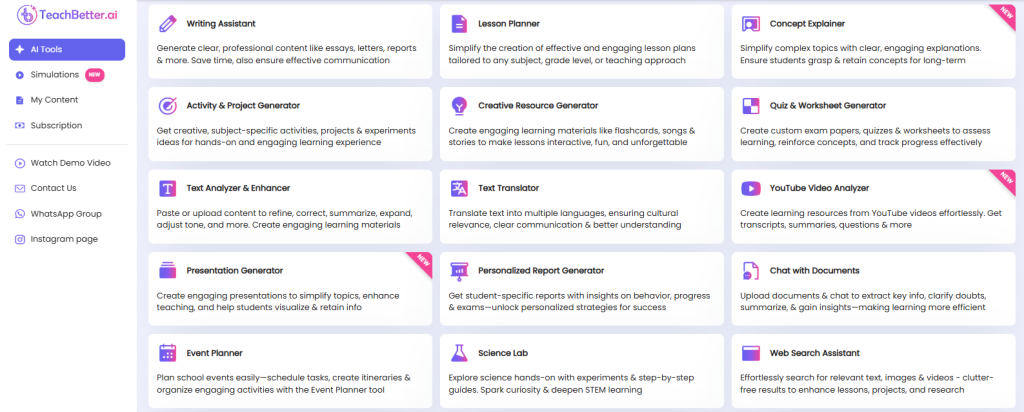
When teachers open the platform, they should immediately see how AI fits into their daily work, not wonder how to make AI work for them.
Beyond Automation: The Three Stages of AI Adoption
Through dozens of workshops and thousands of teacher interactions, one pattern has become clear. AI adoption happens in three stages.
The first stage is automation — using AI to do tasks faster. This is where most educators currently are. It saves time, but it does not change outcomes significantly.
The second stage is enhancement — using AI to improve the quality of teaching. Teachers start generating better explanations, richer examples, and more meaningful assessments. This is where real pedagogical value begins. This stage represents a critical turning point for teacher-first AI in education, where AI begins to actively improve how concepts are taught and understood.
The third stage is transformation — where AI enables personalization at a scale previously impossible. Individual feedback, adaptive learning pathways, continuous revision, and concept mastery become feasible without increasing teacher workload.
Skipping directly to transformation without supporting the first two stages creates resistance. True adoption must be gradual, respectful, and grounded in classroom reality.
Why Simulations and Multimodal Learning Matter
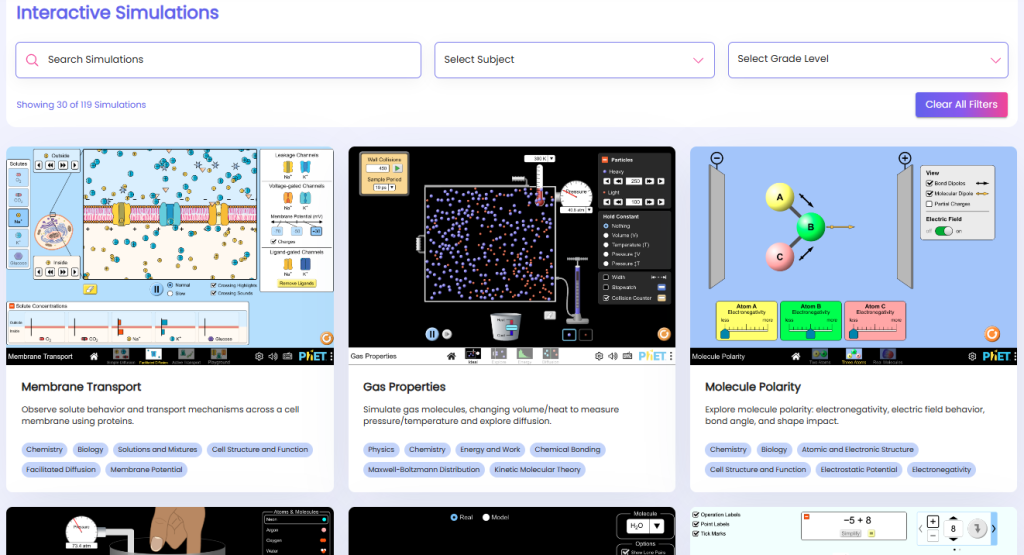
Conceptual understanding cannot be built through text alone. When students manipulate variables, visualize outcomes, and observe cause-and-effect relationships, learning becomes experiential.
Interactive simulations across Physics, Chemistry, and Mathematics allow abstract ideas to become tangible. They turn classrooms from spaces of passive listening into environments of exploration. When combined with stories, visuals, and real-world examples, they help students move from memorization to meaning.
AI’s real power lies not in replacing teachers, but in expanding what teachers can realistically do within limited time.
Inclusion, Affordability, and Scale Are Not Afterthoughts
In emerging markets, impact does not come from the most sophisticated tool. It comes from the most accessible one.
India’s digital revolution did not happen because technology was advanced — it happened because it was affordable and simple. AI in education must follow the same path. If tools are expensive, complex, or built only for elite institutions, they will never transform the system.
This is why affordability is not a pricing decision; it is an ethical stance. AI must be designed for scale, for diversity, for multilingual classrooms, and for teachers at every stage of their career — from new B.Ed graduates to educators with decades of experience. Without affordability and accessibility, teacher-first AI in education cannot scale beyond a privileged minority of schools.
The Real Question Schools Must Ask
The future of learning depends on teacher-first AI in education—AI that strengthens teaching, not shortcuts it. That debate is over.
The real question is whether we will use AI as a shortcut — or as a catalyst for deeper learning.
If we choose shortcuts, we risk hollowing out education. If we choose transformation, we have a rare opportunity to finally align classrooms with the realities of the world students are entering.
Teachers do not need more tools. They need better systems, not more pressure. What they need instead is intelligent support. And they do not need AI that replaces them — they need AI that amplifies their impact.
Teacher-first platforms like TeachBetter.ai point to what this future can look like: AI that fits naturally into teaching workflows, reduces cognitive load, and helps classrooms move beyond rote memorisation toward deep understanding and real-world application.
That is the future education deserves.

Binit Agarwalla, Founder, TeachBetter.ai
With over 15 years of seasoned expertise, Binit is a results-driven marketing leader specializing in B2B SaaS and B2C growth strategy - now channeling that experience into transforming education through TeachBetter.ai, an all-in-one AI platform built exclusively for teachers, students, and schools.
As the Founder of TeachBetter.ai, his mission is to simplify teaching and amplify learning by empowering educators with AI-driven tools that save time, enhance creativity, and make classrooms more engaging. TeachBetter.ai's vision is to make AI adoption in education simple, accessible, and affordable - helping every teacher leverage the power of AI without complexity or high cost.
Read other articles authored by Binit Agarwalla here.