Responsible AI in Education: Key Insights from Bharat Bodhan AI Conclave 2026 & TeachBetter.ai’s Strategic Participation
TeachBetter.ai
|
 19 February, 2026
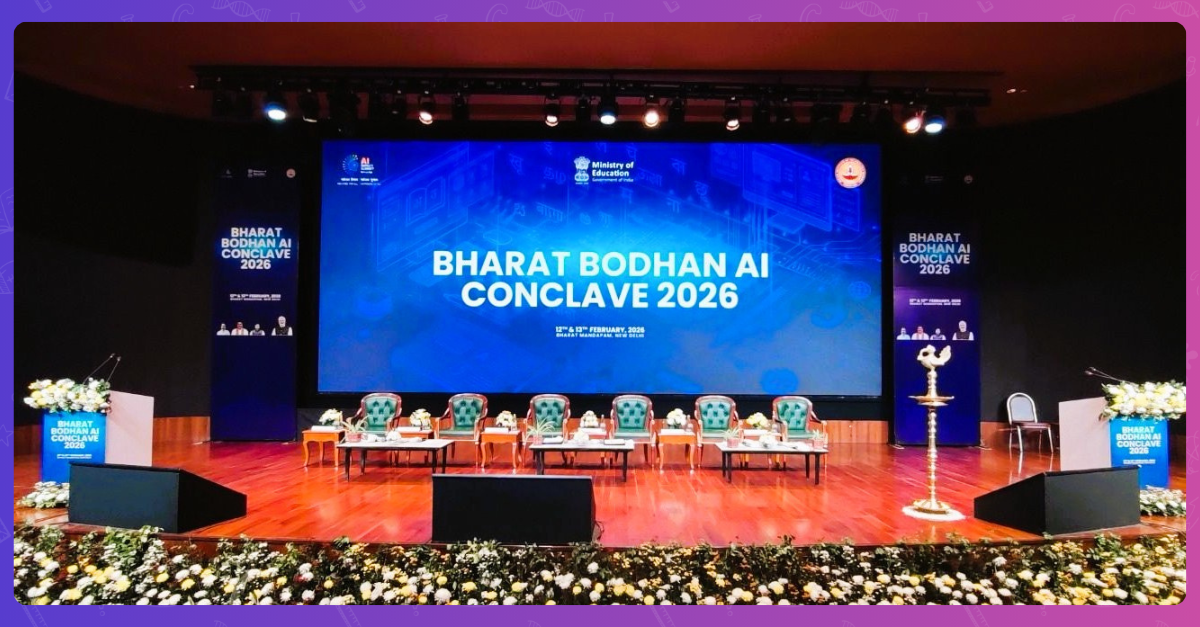
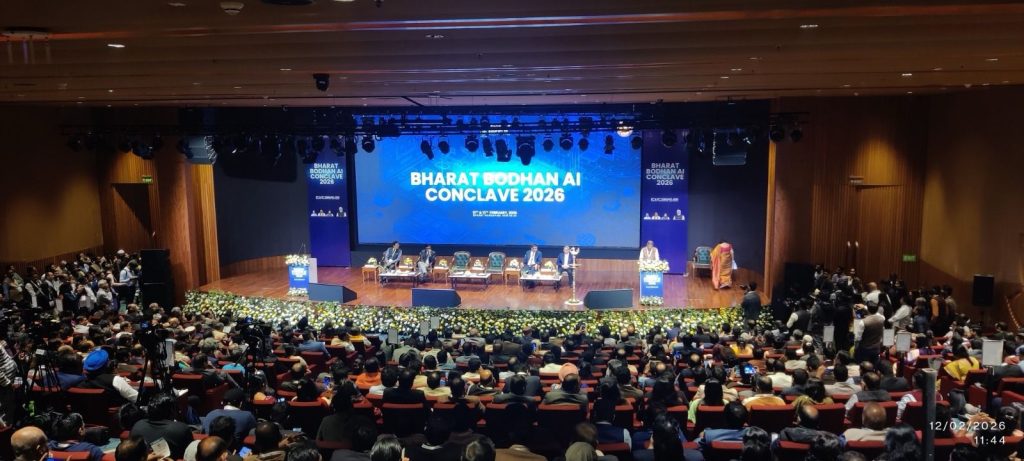
The Bharat Bodhan AI Conclave 2026, held on 12–13 February 2026 at Bharat Mandapam, marked a pivotal moment in India’s transition toward structured, responsible, and scalable AI adoption in education. Organised by the Ministry of Education, the conclave was designed as more than a conference — it served as a national convergence platform to map the AI-in-education landscape, identify systemic gaps, foster strategic collaboration, and accelerate the development of the Bharat EduAI Stack. This open and interoperable architecture aims to create a coordinated foundation for integrating and scaling AI-powered learning solutions across India’s diverse education ecosystem. The discussions made it clear that responsible AI in education is now central to India’s policy thinking, not a peripheral innovation agenda. Leaders repeatedly emphasized structured governance, transparency, and classroom accountability as foundational pillars for responsible AI in education at scale.
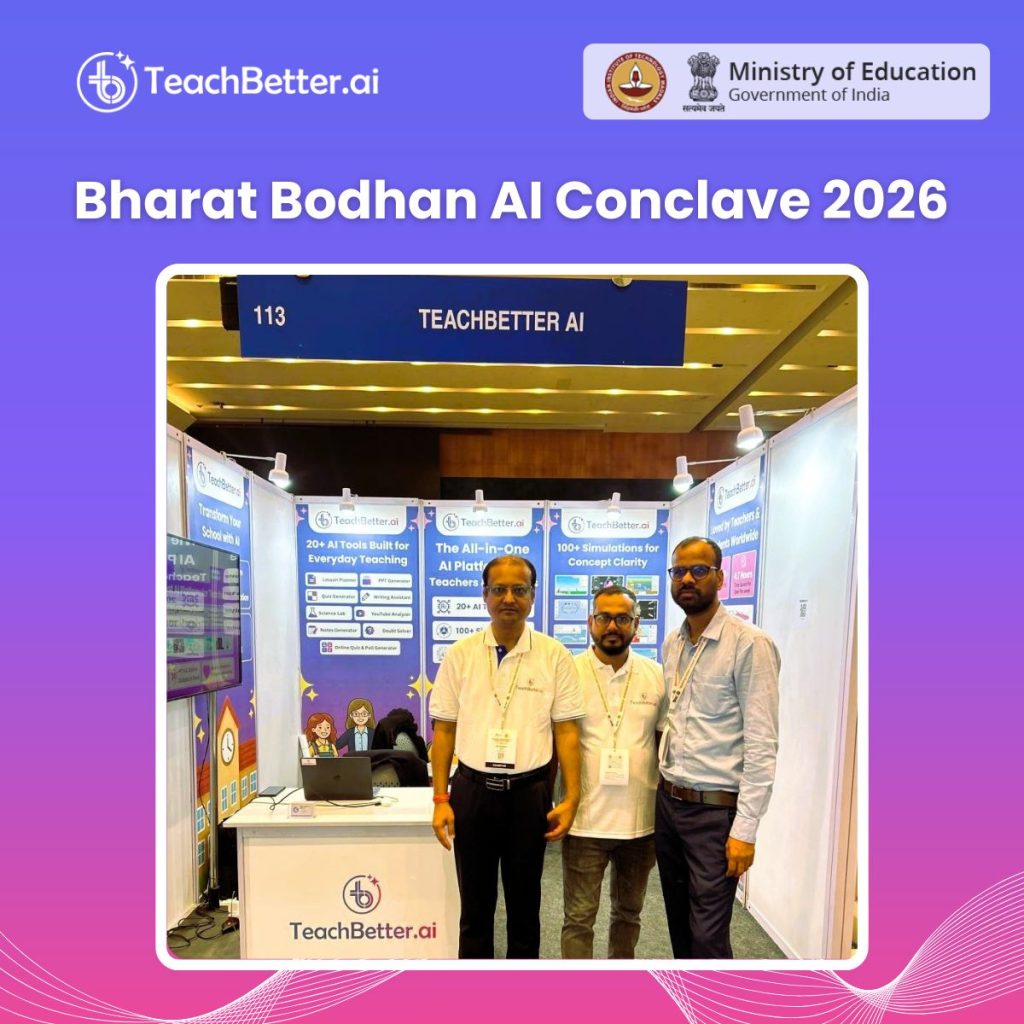
For TeachBetter.ai, participation went far beyond exhibition visibility.It represented strategic alignment with India’s evolving AI vision, particularly its focus on teacher empowerment, multilingual inclusion, and responsible technology deployment. Engaging in these national conversations reinforced our commitment to building classroom-ready AI tools. These tools are pedagogically grounded, ethically designed, curriculum-aware, and built to operate at both institutional and national scale.
A National Vision for AI-Driven Education
The conclave was inaugurated by Dharmendra Pradhan, who launched the Bodhan AI Centre of Excellence and articulated a clear and pragmatic vision for Artificial Intelligence in India’s education system. His message was unambiguous: AI must be scalable, ethical, interoperable, and deeply aligned with India’s educational priorities. AI was not framed as a replacement for traditional systems. The emphasis was on strengthening teacher capacity.These solutions aim to enhance student learning outcomes and ensure equitable access across regions and languages.
The official PIB release underscored a shared national resolve toward responsible AI-driven transformation in education. Across technical sessions and policy dialogues, the direction was consistent. India must move beyond isolated AI pilots and adopt coordinated, ecosystem-level platforms. These platforms should integrate seamlessly with governance structures and institutional workflows. Discussions focused on statewide AI systems, multilingual model deployment, teacher capacity-building frameworks, and governance dashboards capable of supporting large-scale implementation.
What stood out most was the maturity of the discourse. Policy leaders moved beyond treating AI as an experimental add-on. They now position it as a foundational layer of India’s Digital Public Infrastructure (DPI) for education. This infrastructure must be interoperable, scalable, and designed to serve millions of learners. The conversation has shifted from “Can AI be used?” to “How can it be responsibly scaled?” That shift signals a new phase in India’s education transformation.
Why Responsible AI in Education Matters for India
Responsible AI in education is not merely about deploying advanced algorithms in classrooms. It is about ensuring ethical safeguards, curriculum alignment, multilingual accessibility, and institutional oversight. India’s shift toward responsible AI in education signals a move from experimentation toward sustainable, long-term infrastructure planning.
The Scale and Energy of the Ecosystem
The scale of the Bharat Bodhan AI Conclave 2026 reflected the seriousness with which India is approaching AI integration in education. The event recorded approximately 3,100 registrations, including around 2,000 student participants and more than 600 institutional delegates. Nearly 120 exhibitors showcased AI-enabled innovations. Together, this made the conclave a true convergence point for India’s education and technology ecosystems.
Policymakers, directors from premier institutions, state education departments, philanthropic organizations, researchers, and startup founders were all present. Their participation created an environment of active collaboration rather than passive observation. Conversations extended far beyond tool demonstrations. They focused on interoperability standards, governance frameworks, teacher readiness, multilingual implementation strategies, and sustainable institutional integration.The discussions reflected a clear sense of urgency. Participants agreed that AI must move from fragmented experimentation to structured national implementation.
The diversity of stakeholders reinforced a critical insight: AI adoption in India cannot be vendor-driven or siloed. It must be systemic, curriculum-aligned, and embedded within public infrastructure. For platforms like TeachBetter.ai, this maturity brings both opportunity and responsibility. It allows meaningful participation in a national AI movement. However, it also requires building solutions that are secure, transparent, and academically aligned.
Read More: How Teachers Are Using AI to Redefine Education: Real Insights on the Top 10 Use Cases & the Future of AI in Education
TeachBetter.ai at the Conclave: Conversations That Matter
At the exhibition, TeachBetter.ai engaged directly with educators, institutional delegates, startup founders, and academic leaders — including interactions involving the Director of IIT Madras, Prof. V. Kamakoti. These conversations were grounded in practical classroom realities rather than abstract technological theory. Educators discussed the time required for lesson preparation. They pointed to the difficulty of creating curriculum-aligned content quickly. In addition, they stressed the need for multilingual support and relief from administrative workload.
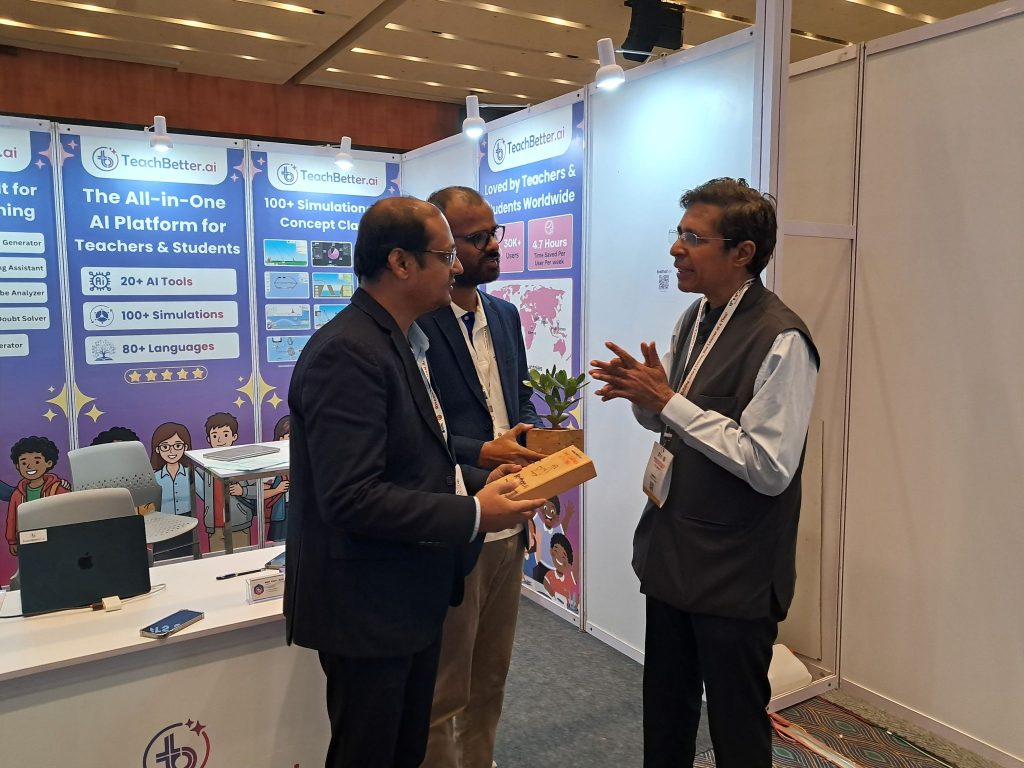
A clear pattern emerged from these discussions: educators are not seeking generic conversational AI tools. They are looking for structured, education-specific systems that deliver predictable, curriculum-sensitive outputs. Teachers and school leaders emphasized the importance of maintaining academic rigor, ensuring output safety, and retaining control over content refinement before classroom use. Stakeholders consistently emphasized reliability, contextual relevance, and institutional oversight as essential requirements.
In this context, TeachBetter.ai’s educator-first design philosophy resonated strongly. Our platform was designed to solve practical classroom challenges. It streamlines lesson planning, automates assessments, and generates personalized reports. It also creates contextual explanations that make complex ideas easier to grasp. As detailed in our innovation framework, the objective is to bridge textbook instruction with application-oriented learning. AI must support pedagogy, not replace it.
Aligning with the Bharat EduAI Stack Vision
A central theme throughout the conclave was the development of the Bharat EduAI Stack — an open, interoperable architecture envisioned to integrate and scale AI-powered solutions across India’s education ecosystem. The vision prioritizes coordinated infrastructure over fragmented innovation and systemic integration over isolated tool deployment. Rather than encouraging a proliferation of disconnected applications, the focus is on building platforms that can communicate with governance systems, align with curriculum frameworks, and operate within a shared digital public infrastructure.
TeachBetter.ai’s operational direction closely mirrors this national vision. Our platform is built on structured governance through role-based access control. It enables curriculum alignment and multilingual adaptability. Administrators actively review, refine, and manage AI outputs through a dedicated interface. These are not secondary features; they are core design decisions that drive scalability, institutional compatibility, and long-term accountability.
Equally important was the conclave’s emphasis on teacher empowerment. The discussions reinforced a critical principle: technology must augment pedagogy, not overshadow it. AI systems should strengthen instructional creativity, reduce cognitive and administrative load, and enable teachers to focus on mentoring and engagement. TeachBetter.ai continues to build with this philosophy at its core — ensuring that AI functions as a guided, intelligent assistant while teachers remain firmly in control of the learning process.
Strengthening Teacher Capacity Through Purpose-Built AI Tools
A key insight from the Bharat Bodhan AI Conclave 2026 was that teacher capacity drives learning outcomes. Sessions consistently showed that AI adoption will work only if it reduces workflow friction and strengthens instructional effectiveness without increasing complexity.
TeachBetter.ai has been developed precisely around this principle. Rather than positioning AI as a generic conversational layer, our platform integrates structured, education-specific tools designed to address real classroom needs — lesson planning, quiz and worksheet creation, concept simplification, and student performance reporting. These tools operate within pedagogical frameworks and curriculum standards, ensuring that AI outputs are not only efficient but academically sound.
During our interactions at the conclave, there was strong interest in AI systems that allow educators to retain instructional authority. Teachers want the ability to refine outputs, adjust parameters, and ensure contextual relevance before classroom deployment. TeachBetter.ai’s editor-based interface, structured input architecture, multilingual translation capabilities, and curriculum-aware configurations directly respond to these expectations. In this model, AI does not dictate instruction; it accelerates it — under the teacher’s guidance and control.
Why This Conclave Matters for India’s Education Future
The Bharat Bodhan AI Conclave 2026 represents a decisive structural shift in India’s approach to Artificial Intelligence in education. It signals a movement away from fragmented experimentation toward coordinated orchestration, and from isolated tool adoption toward long-term infrastructure planning. The depth of discussions made it clear that AI integration is no longer about deploying individual solutions — it is about building interoperable systems that can integrate with governance frameworks, curriculum structures, and institutional workflows at national scale.
By bringing policymakers, academic leaders, researchers, and technology innovators onto a unified platform, the conclave established a shared direction for the ecosystem. The consensus was unmistakable: AI must be inclusive by design, interoperable by architecture, and sovereign in capability. It must serve learners across socio-economic and linguistic contexts while enabling India to develop context-aware AI systems tailored to its educational realities. These principles form the foundation for sustainable transformation rather than short-term technological enthusiasm. The focus throughout the conclave reinforced that responsible AI in education must balance innovation with governance, ensuring that technology strengthens rather than replaces pedagogical intent.
For TeachBetter.ai, participating in this national dialogue was both validating and energizing. The discussions clearly reinforced that these challenges are central to India’s AI education agenda. We remain focused on reducing teacher workload, ensuring curriculum alignment, enabling safe AI access for students, and expanding multilingual support. They sit at the heart of India’s AI education agenda. The conclave reaffirmed that meaningful progress will come from platforms that combine technological capability with pedagogical responsibility, and we remain committed to building precisely that kind of educator-first AI ecosystem.
The Road Ahead for TeachBetter.ai
Our participation at the Bharat Bodhan AI Conclave 2026 represents far more than an exhibition milestone — it marks a strategic inflection point for TeachBetter.ai. Through discussions with policymakers, academic leaders, and educators, we gained a clear insight: hype will not drive the future of AI in education. Responsible, scalable implementation will.
As we move forward, our priority is to deepen the academic intelligence of our platform. This involves strengthening curriculum alignment across major Indian education boards — including CBSE, ICSE, IB, IGCSE, and state boards — so that every AI-generated lesson, quiz, worksheet, or explanation is contextually relevant, grade-appropriate, and academically sound. Curriculum alignment is not an enhancement layered onto the system; it is foundational to building institutional trust and long-term adoption.
Alongside expansion, we remain focused on strengthening the platform’s robustness and governance. This includes improving performance reliability, enhancing teacher control through structured editing environments, and continuously refining output quality through feedback-driven iteration. Responsible AI in education demands more than innovation — it requires disciplined architecture, transparent controls, and a strong commitment to safety and academic integrity.
India is building its AI future with deliberate intent — guided by interoperability, inclusivity, and sovereignty. TeachBetter.ai proudly contributes to this national transformation. We act not only as a technology provider, but as a long-term partner. Our goal is to build an educator-first AI ecosystem that simplifies teaching and strengthens India’s education system.