AI in School Education India: How Government Initiatives Are Shaping the Future of Classrooms
Vipin Kumar
|
 7 April, 2026
AI in school education in India is no longer a futuristic concept—it is rapidly becoming a core driver of how learning is delivered, personalized, and scaled across classrooms. The Ministry of Education is actively shaping this transformation through structured initiatives that aim to integrate artificial intelligence into curriculum, pedagogy, and classroom practices at scale.
What makes this shift particularly significant is that it goes far beyond introducing AI as just another subject. Instead, it reflects a system-wide transformation of the education ecosystem. This includes curriculum design, teaching methodologies, digital infrastructure, and teacher capability development. The intent is clear—to prepare students not just for exams, but for a future where AI will influence every aspect of work and life. This shift clearly highlights how AI in school education India is becoming a foundational priority for the country’s future.
However, while the policy direction is strong and forward-looking, the real challenge lies in execution. The key question educators and institutions must address is:
How do these initiatives translate into meaningful, practical classroom experiences that genuinely improve teaching and learning outcomes?
A Systemic Shift: AI as a Foundational Capability
India’s approach to AI in school education reflects a clear and deliberate strategic intent—AI is not being positioned as a niche or optional skill, but as a foundational capability that cuts across subjects, grade levels, and learning experiences.
This integration is visible across multiple layers of the education system. At the curriculum level, frameworks such as NCERT and CBSE are embedding AI concepts into formal learning pathways. At the pedagogical level, there is a growing emphasis on skill-based and application-oriented learning rather than rote memorization. On the infrastructure side, platforms like DIKSHA, SWAYAM, and PM eVidya are enabling scalable digital delivery, while teacher training initiatives are focused on building capacity to adopt these changes effectively.
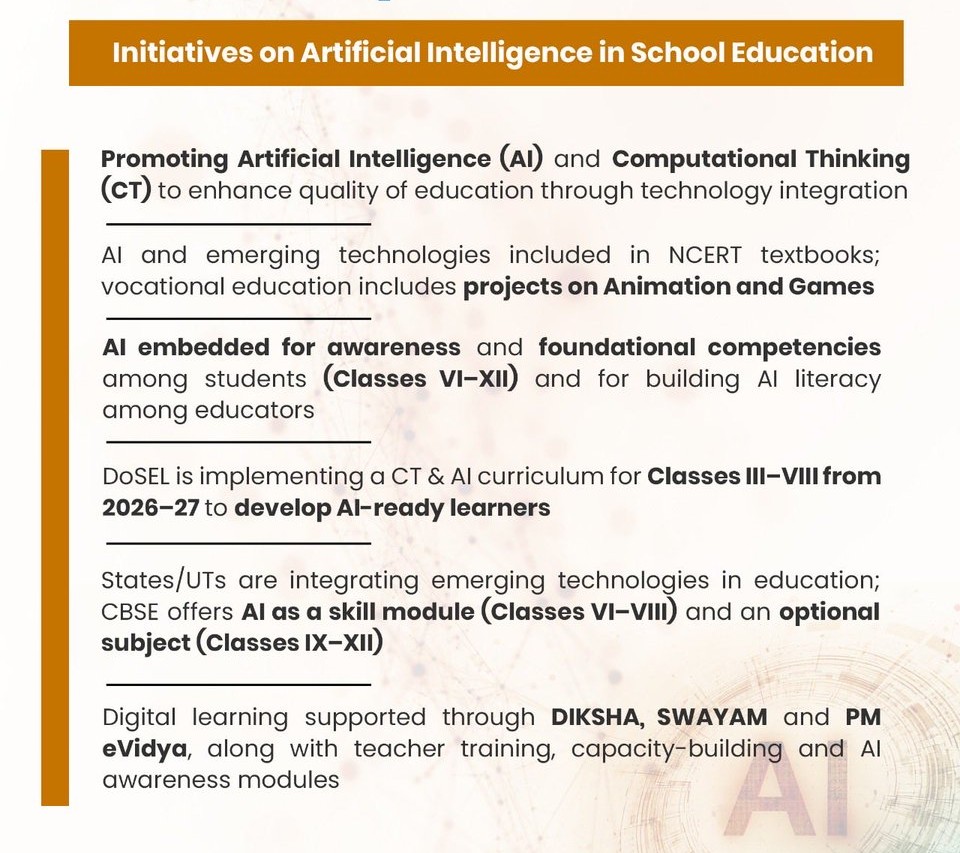
Together, these efforts signal a broader shift in Indian education. The system is moving from a content-heavy model to one that prioritizes skills, critical thinking, and real-world application. The focus is no longer just on what students learn. It is now on how they think, solve problems, and apply knowledge in dynamic contexts. This systemic transformation reinforces the importance of AI in school education India as a long-term national strategy.
1. AI and Computational Thinking: Redefining Cognitive Skills
At the core of the Ministry of Education’s AI initiatives is the integration of Artificial Intelligence (AI) with Computational Thinking (CT). This strategic approach aims to reshape how students think, analyze, and solve problems. Instead of focusing only on tools or coding, it emphasizes foundational cognitive abilities such as decomposition, pattern recognition, logical reasoning, and algorithmic thinking.
These skills are not limited to technical domains; they are universal problem-solving capabilities that apply across subjects and real-life scenarios. By embedding CT into school education, the Ministry is shifting the focus. It moves from knowledge consumption to structured thinking and analytical learning.
Why This Matters
This approach transforms education from memorization-based learning to process-driven understanding. Students begin to explore how solutions are formed instead of simply recalling answers. This leads to deeper comprehension and stronger critical thinking skills.
Implications for Classroom Teaching
For educators, this shift requires designing structured thinking exercises, facilitating discussions, and connecting abstract ideas with practical applications. However, consistently implementing CT in classrooms remains a challenge due to time constraints and lack of ready-to-use frameworks.
Where TeachBetter.ai fits in:
TeachBetter.ai supports teachers by converting computational thinking concepts into structured lesson plans, problem-solving activities, and real-world examples—making CT practical, scalable, and easier to integrate into daily teaching.
2. AI in NCERT Curriculum and Vocational Education: Driving Experiential Learning
The inclusion of AI concepts in NCERT curriculum frameworks marks a clear shift in education. It is further supported by vocational elements such as animation and game-based learning. Together, they promote experiential and application-driven learning. This initiative encourages students to actively engage with concepts through creation, experimentation, and hands-on activities.
Instead of passively consuming information, learners are now expected to build outputs. This may include simple animations, models, or project-based tasks. These activities help them translate theory into practice.This makes learning more interactive and aligned with real-world expectations.
Strategic Importance
Experiential learning enhances student engagement, fosters creativity, and promotes interdisciplinary thinking. It also helps students understand the relevance of their education by connecting classroom concepts with real-world applications.
The Classroom Challenge
Despite its benefits, implementing experiential learning consistently can be difficult. Teachers often face limitations in designing structured activities, aligning them with curriculum goals, and managing time effectively within classroom constraints.
Where TeachBetter.ai fits in:
TeachBetter.ai enables educators to generate project-based activities, interactive lesson plans, and real-world applications instantly—helping them deliver experiential learning without additional planning effort.
3. AI Literacy Across Classes VI–XII: From Awareness to Application
A central component of the Ministry’s strategy is developing AI literacy among students from Classes VI to XII. This ensures they gain a comprehensive understanding of artificial intelligence and its broader implications. This includes awareness of how AI works, its real-world applications, and the ethical considerations associated with its use.
At the same time, educators are expected to build their own familiarity with AI tools and integrate them into their teaching methodologies. This dual approach ensures that both students and teachers are prepared for an increasingly AI-driven environment.
Why AI Literacy is Foundational
AI literacy is essential for future readiness. It equips students with the knowledge needed for career opportunities. It also enhances digital awareness and enables informed decision-making in a technology-driven world.
The Classroom Challenge
In many schools, AI literacy remains largely theoretical. Students are introduced to concepts but rarely get opportunities to apply them. At the same time, teachers often lack the tools to integrate AI meaningfully into daily teaching.
Where TeachBetter.ai fits in:
TeachBetter.ai helps bridge this gap by enabling teachers to integrate AI into lesson delivery, create contextual explanations, and design interactive learning experiences—making AI literacy practical and application-driven. Strengthening AI in school education India at this level ensures students are prepared for future digital economies.
4. Early AI Education (Classes III–VIII): Building AI-Native Learners
The introduction of AI and computational thinking at the primary and middle school levels represents a forward-looking step toward building foundational skills early in a student’s learning journey. By exposing students to concepts such as logic, patterns, and decision-making at a young age, the Ministry is fostering analytical thinking habits from the outset.
At this stage, AI is presented in a simplified and intuitive manner, helping students develop confidence in engaging with technology. This early exposure ensures that learners grow up as AI-native individuals, comfortable exploring and applying technological concepts.
Why This Matters
Introducing AI early helps students develop problem-solving skills, adaptability, and confidence in using technology. It also prepares them to engage with more advanced concepts in later stages of education.
The Pedagogical Challenge
Teaching younger students requires simplified explanations, storytelling techniques, and activity-based learning approaches. Without adequate support, it can be difficult for educators to consistently deliver these experiences effectively.
Where TeachBetter.ai fits in:
TeachBetter.ai helps teachers simplify complex concepts, generate age-appropriate content, and create engaging activities—making early AI education accessible and effective for younger learners.
5. CBSE AI Curriculum: A Structured Learning Progression
The CBSE AI curriculum follows a progressive learning model, introducing students to foundational concepts and gradually advancing to more complex topics. This structured approach ensures that learning is aligned with cognitive development and builds both conceptual understanding and practical application over time.
By organizing AI education into stages, the framework supports incremental learning, reduces cognitive overload, and improves retention. It also aligns with the broader shift toward competency-based education.
Why This Approach Works
A structured progression allows students to build confidence gradually while developing depth in understanding. It ensures continuity in learning and helps maintain a balance between theory and application.
The Classroom Challenge
Teachers must manage varying levels of complexity across grades, adapt lessons accordingly, and maintain engagement while ensuring curriculum coverage—making planning and execution more demanding.
Where TeachBetter.ai fits in:
TeachBetter.ai enables teachers to generate level-specific lesson plans, adjust complexity instantly, and maintain consistency across grades—making structured AI learning easier to implement.
6. Digital Infrastructure: Enabling Scale Through DIKSHA, SWAYAM, and PM eVidya
The Ministry has established a strong digital foundation through platforms such as DIKSHA, SWAYAM, and PM eVidya, enabling access to structured content, teacher training resources, and scalable learning solutions across the country.

These platforms play a critical role in ensuring accessibility, allowing students and teachers from diverse regions to benefit from standardized educational resources. They also support continuous learning and professional development for educators.
Strategic Importance
Digital infrastructure ensures scalability, consistency, and inclusivity in education. It allows the government to deliver AI-enabled learning at a national level while maintaining quality standards.
The Classroom Challenge
While these platforms provide access to content, they do not fully address real-time classroom needs such as personalized teaching, dynamic lesson delivery, and contextual adaptation.
Where TeachBetter.ai fits in:
TeachBetter.ai complements this infrastructure by enabling real-time content creation, lesson customization, and personalized teaching—helping translate digital access into meaningful classroom outcomes. These platforms play a crucial role in scaling AI in school education India across diverse geographies.
7. Teacher Enablement: The Defining Factor for AI Adoption
Across all initiatives, one factor ultimately determines success: the teacher. No matter how well-designed the curriculum or how advanced the infrastructure, meaningful impact depends on how effectively teachers implement these changes in the classroom.
Educators today are expected to adopt new technologies, redesign teaching methods, create engaging content, and manage existing responsibilities simultaneously. This creates a significant gap between expectations and the support available to them.
Why This is Critical
Teacher enablement is central to AI adoption. Without it, implementation remains inconsistent, classroom outcomes vary, and the full potential of these initiatives is not realized.
The Classroom Challenge
Teachers often face time constraints, limited training, and lack of tools, making it difficult to integrate AI into their workflows effectively and sustainably.
Where TeachBetter.ai fits in:
TeachBetter.ai acts as a teaching copilot, enabling educators to create lessons, activities, and assessments quickly—reducing effort while improving teaching quality and making AI adoption practical and scalable.
Bridging the Gap Between Policy and Classroom Reality
India’s AI education initiatives are comprehensive, forward-looking, and well-structured. They address curriculum, infrastructure, and skill development at multiple levels. However, the real transformation depends on one critical factor—consistent and scalable execution within classrooms.
This is where the need for an education-focused AI platform becomes evident. Schools and educators require a solution that not only aligns with curriculum requirements but also simplifies the day-to-day challenges of teaching. The goal is not to add another layer of complexity, but to make AI adoption practical, intuitive, and seamlessly integrated into existing workflows.
In this context, platforms like TeachBetter.ai are emerging as a critical bridge between policy intent and classroom implementation. By enabling teachers to create structured, curriculum-aligned lessons in minutes, design interactive and application-based learning experiences, and significantly reduce manual effort, such platforms address the core challenges that educators face.
More importantly, they allow teachers to incorporate AI into their teaching without needing deep technical expertise, ensuring that adoption becomes natural rather than forced. This shifts the conversation from “learning AI” to “teaching better with AI”—which is ultimately the goal of these initiatives.
Conclusion: From Vision to Execution
The Ministry of Education has laid a strong and comprehensive foundation for integrating Artificial Intelligence into school education. Through curriculum reforms, early exposure initiatives, digital platforms, and teacher training programs, the building blocks for an AI-enabled education system are firmly in place.
The next phase is execution—where these initiatives move beyond policy documents and begin to shape everyday classroom experiences. This is where the real impact will be realized: in improved student engagement, better learning outcomes, and the development of future-ready learners.
To achieve this at scale, educators need more than intent—they need practical, classroom-ready solutions that simplify implementation. Platforms like TeachBetter.ai play a crucial role in this transition by enabling teachers to translate policy into practice, streamline lesson delivery, and integrate AI seamlessly into their daily workflows. AI in school education India has gained strong momentum through the Ministry of Education’s initiatives.
Final Thought
Artificial Intelligence will not replace teachers.
But teachers who effectively use AI will redefine education.
The true opportunity lies not just in adopting AI, but in making it work meaningfully, consistently, and effectively within classrooms—where learning truly happens.
In this transformation, solutions like TeachBetter.ai will be instrumental in ensuring that AI is not just understood, but actively used to enhance teaching and learning at scale. The future of AI in school education India will depend on how effectively it is implemented in classrooms.

Vipin Kumar, Co-Founder, TeachBetter.ai
Vipin Kumar is building TeachBetter.ai to create intuitive AI tools that simplify teaching and enhance learning outcomes. With prior experience at global technology companies, he brings a deep understanding of scalable systems, user needs, and practical digital solutions. His mission is to make AI adoption in education easy, affordable, and truly impactful for teachers everywhere. He is committed to creating AI solutions that save time, boost creativity, and empower educators to focus on what matters most—teaching.
Read other articles authored by Vipin Kumar here.