How a Teacher Trainer of 12,000+ Educators Evaluates AI Tools—and Why TeachBetter.ai Stands Out
Vipin Kumar
|
 19 March, 2026
Introduction: What Happens When an Expert Evaluates AI Tools for Teachers
In today’s rapidly evolving education landscape, artificial intelligence has moved from being a buzzword to becoming a daily utility for educators. From lesson planning to assessments, AI tools promise efficiency, personalization, and improved learning outcomes. However, the reality inside classrooms is very different—while there is no shortage of AI tools, very few are actually designed for the practical realities of teaching.
This creates a fundamental question that most educators are now asking: Which AI tools truly work for teachers—not in theory, but in real classrooms?
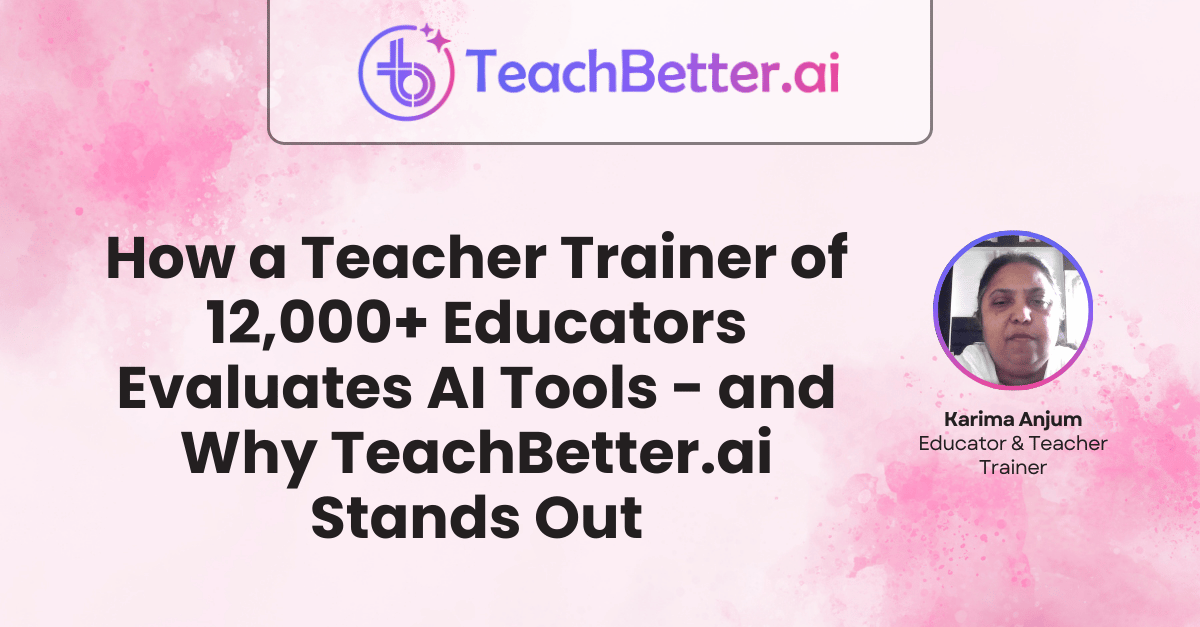
To explore this, we look at the perspective of someone deeply embedded in teacher training and educational transformation—Karima Anjum, a teacher developer associated with the Royal Society of Chemistry and a freelance educator who has trained over 12,000 teachers across different institutions and learning environments.
Her role goes beyond instruction. She actively evaluates emerging tools, integrates them into training programs, and helps educators adopt technologies that genuinely improve teaching outcomes. This means her recommendations are not based on features or marketing claims—but on hands-on validation across diverse classroom scenarios. When someone with this level of experience identifies a platform as a standout, it reflects more than preference—it reflects practical effectiveness at scale.
The Core Challenge: Why Most AI Tools Fail Teachers
Despite the rapid adoption of AI in education, most tools fail at the point where it matters most—classroom usability and pedagogical relevance. Teachers today operate in highly dynamic environments where they must balance curriculum requirements, student diversity, time constraints, and administrative responsibilities. In such a context, AI tools are expected to simplify work—not add another layer of complexity.
However, most existing tools fall short because they do not align with how teaching actually works. Teachers consistently face three major challenges:
- Time constraints: Creating high-quality, customized lesson plans for every class or student group is time-intensive and often not scalable.
- Diverse classrooms: A single classroom includes students with different learning speeds, styles, and levels of understanding, making uniform teaching ineffective.
- Generic AI outputs: Most AI tools produce broad, non-contextual responses that are not aligned with specific curricula, classroom needs, or learning objectives.
This is not just a technology gap—it is a design gap. Traditional teaching methods already struggle with engagement and real-world application, often resulting in superficial understanding rather than deep conceptual learning . Unfortunately, many AI tools replicate the same limitations at scale by generating content that is:
- Generic and one-dimensional
- Detached from real classroom context
- Not immediately usable without heavy modification
As a result, instead of saving time, these tools often require additional effort to refine and adapt outputs. What teachers truly need is not generic AI—but education-first AI, designed specifically to address the complexities of teaching, learning diversity, and curriculum alignment.
Inside the Evaluation: A Real Classroom Comparison of AI Tools
To move beyond assumptions and identify what actually works, Karima conducted a structured evaluation during one of her teacher training workshops in Bangalore. Rather than simply demonstrating tools, she created a hands-on comparison environment where teachers could actively test and evaluate different AI platforms in real teaching scenarios.
Participants were introduced to a range of widely used AI tools, including:
- Magic School
- Claude
- Khan Academy
- ChatGPT
Instead of focusing on features or interfaces, the evaluation centered on practical application. Teachers were asked to:
- Generate lesson plans
- Create activities and assessments
- Adapt content for different learning levels
- Evaluate usability and output quality
To further enhance objectivity, a structured comparative analysis was conducted using ChatGPT itself—asking it to evaluate and rank these tools based on criteria relevant to educators. This approach ensured that the evaluation was not influenced by bias or perception, but grounded in real usage, peer feedback, and structured analysis.
The Results: Why TeachBetter.ai Came Out on Top
The outcome of this evaluation was both clear and consistent across participants. TeachBetter.ai emerged as the most effective tool for teachers.
This was not because it generated more content or had more features—but because it delivered high-quality, structured, and classroom-ready outputs that required minimal refinement. Two key differentiators stood out immediately:
1. Differentiation Built Into the System
One of the most challenging aspects of teaching is addressing varied learning needs within the same classroom. Most AI tools provide a single version of content, leaving teachers to manually adapt it for different student levels.
TeachBetter.ai fundamentally changes this by embedding differentiation directly into its system. Teachers were able to:
- Create tiered activities for different learning levels
- Generate multi-level lesson plans within seconds
- Design content tailored to diverse learning abilities
This capability transforms lesson planning from a one-size-fits-all approach into a flexible, inclusive teaching model—something that is critical in modern classrooms but rarely supported effectively by generic AI tools.
2. Alignment with Educational Frameworks (NEP & Curriculum)
Another major gap in most AI tools is their lack of alignment with specific educational frameworks, particularly in regional contexts like India. TeachBetter.ai stood out by demonstrating:
- Strong alignment with NEP (National Education Policy) principles
- Outputs structured according to curriculum standards
- Context-aware content that reflects real classroom expectations
This ensures that teachers are not just generating content—but generating content that is:
- Relevant
- Structured
- Immediately usable in their teaching environment
Instead of spending time adapting outputs, teachers can directly integrate them into their lesson flow.
"TeachBetter.ai is an all-in-one game-changer for educators. Its standout feature is the ability to create personalized, differentiated lesson plans tailored to specific student learning styles. I even ran a comparison using ChatGPT, which highlighted TeachBetter AI's superiority in NEP alignment and differentiation over other popular tools. I strongly recommend it to all teachers."

Karima Anjum
Educator & Teacher Trainer
What Actually Matters: The 3 Capabilities Every AI Tool for Teachers Must Have
This evaluation led to a powerful insight: The value of an AI tool in education is not defined by how much it can generate—but by how effectively it solves real teaching challenges.
Three critical capabilities emerged as essential for any AI tool designed for educators:
1. Personalization at Scale
Teaching is inherently personalized, yet traditional systems and tools often fail to support this at scale. TeachBetter.ai enables personalization by allowing teachers to:
- Generate lesson plans based on different learning styles
- Adapt content for individual student needs
- Create customized teaching strategies without additional effort
This is particularly important as personalized learning continues to emerge as one of the most impactful applications of AI in education, helping students learn at their own pace while improving overall outcomes.
2. Built-in Differentiation (Not Manual Workarounds)
In most AI tools, differentiation requires manual adjustments—teachers need to rewrite, reframe, or regenerate outputs multiple times. TeachBetter.ai eliminates this friction by offering native differentiation capabilities, including:
- Tiered instruction models
- Multi-level activity generation
- Adaptive content outputs
This allows teachers to move from a uniform teaching approach to a dynamic, inclusive model, where every student is supported effectively.
3. Zero Prompt Dependency (Ease of Use)
One of the biggest barriers to AI adoption among teachers is complexity. Most tools assume that users can:
- Write detailed prompts
- Experiment with inputs
- Iterate multiple times to get the desired output
In reality, teachers need speed and simplicity. TeachBetter.ai addresses this by providing:
- Pre-built, structured input fields
- Guided workflows aligned with teaching needs
- Ready-to-use outputs that require minimal editing
This significantly reduces the learning curve and ensures that AI becomes a practical everyday tool, rather than an experimental technology.
From Features to Impact: How Teachers Actually Use TeachBetter.ai
What truly defines the value of any educational technology is not the number of features it offers, but the real impact it creates inside classrooms. TeachBetter.ai stands out precisely because it bridges the gap between capability and usability—transforming AI from a theoretical tool into a practical teaching assistant.
In real classroom environments, teachers are not experimenting with TeachBetter.ai—they are integrating it into their daily workflows. The platform becomes part of how they plan, teach, and assess, rather than an additional tool they need to learn or manage.
Teachers are actively using TeachBetter.ai to:
- Create structured, curriculum-aligned lesson plans in minutes, significantly reducing planning time that would otherwise take hours
- Design engaging learning experiences using real-life examples, activities, and discussions, making concepts more relatable and easier to understand
- Generate differentiated activities and classroom interactions that increase student participation and cater to varied learning levels
- Develop assessments and worksheets aligned with learning objectives, ensuring consistency between teaching and evaluation
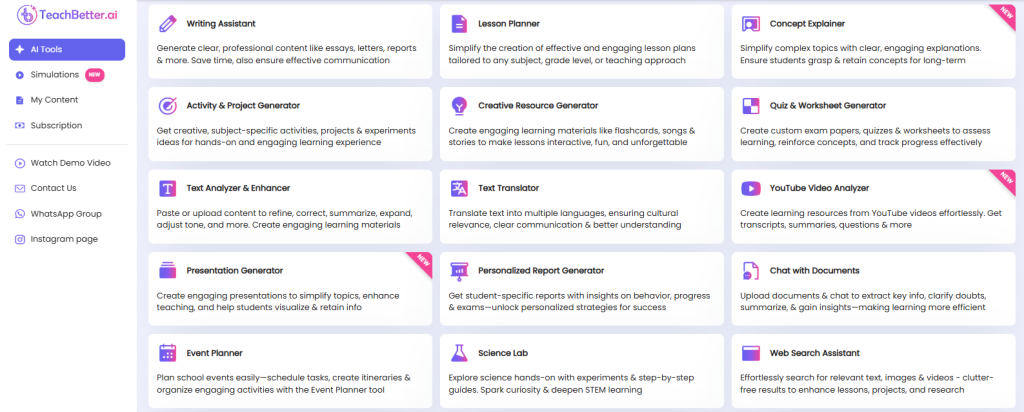
Beyond efficiency, the real transformation lies in the quality of teaching outcomes. Instead of relying on static content or textbook-driven instruction, teachers are able to create dynamic, interactive, and personalized learning environments.
This directly supports a larger shift in education—from rote memorization to concept-driven, application-based learning, where students not only understand what they learn but also how to apply it in real-world contexts.
The Bigger Shift: From AI Experimentation to Real Adoption
The education ecosystem is currently undergoing a significant transition—from curiosity about AI to active, large-scale adoption. While the initial phase of AI in education was driven by experimentation, the focus has now shifted toward practical implementation and measurable impact. Educators are no longer asking “What can AI do?”—they are asking “What can AI do for me in my classroom today?”
Recent insights highlight the scale of this shift:
- 87% of educators believe AI will play a defining role in the future of education
- Teachers currently spend nearly 40% of their time on administrative and repetitive tasks
- AI-powered tools have the potential to significantly reduce this burden while improving teaching effectiveness
However, widespread adoption is not driven by innovation alone—it depends on one critical factor: Practical usability
Teachers are not looking for:
- More tools to explore
- More features to understand
- More complexity to manage
Instead, they are looking for solutions that seamlessly integrate into their workflow and deliver immediate value. Specifically, tools that:
- Save time without compromising quality
- Improve teaching effectiveness and student engagement
- Work reliably in real classroom environments
This is where TeachBetter.ai establishes a clear advantage. By focusing on usability, structure, and education-specific design, it moves beyond being just another AI platform and becomes a solution built around the real needs of educators.
Expert Verdict: Why TeachBetter.ai Is Recommended
Based on extensive hands-on usage and feedback from teachers across training sessions, Karima’s recommendation of TeachBetter.ai is grounded in practical experience rather than theoretical evaluation. Her endorsement is built on three core strengths that consistently emerged during real-world usage:
1. All-in-One Platform
TeachBetter.ai consolidates multiple teaching needs into a single, unified platform. Instead of switching between different tools for lesson planning, activity creation, assessments, and resource generation, teachers can manage everything within one ecosystem.
This not only improves efficiency but also ensures consistency in content quality and structure, making it easier for teachers to plan and execute lessons seamlessly.
2. Deep Customization and Differentiation
One of the most defining strengths of TeachBetter.ai is its ability to support true classroom diversity. Rather than offering generic outputs, the platform enables teachers to:
- Adapt lessons for different learning levels
- Create tiered instructional strategies
- Personalize content based on student needs
This level of built-in differentiation ensures that teaching is not just efficient—but also inclusive and effective for every learner in the classroom.
3. Accessibility and Affordability
While many advanced AI tools remain complex or cost-prohibitive, TeachBetter.ai is designed to be both accessible and practical for everyday educators.
Its intuitive interface, guided workflows, and structured outputs reduce the barrier to entry, allowing teachers—regardless of technical expertise—to start using AI effectively from day one.
At the same time, its affordability ensures that high-quality AI-powered teaching is not limited to a select group, but available to a broader community of educators.
Final Takeaway: What This Means for the Future of Teaching
This interaction highlights a critical shift in how AI is being adopted in education. The future of teaching will not be shaped by the most advanced or complex AI systems—but by those that are intuitive, practical, and deeply aligned with classroom needs.
TeachBetter.ai succeeds because it is built on a simple yet powerful principle: AI should not replace teachers—it should empower them.
By focusing on real-world impact, the platform enables educators to:
- Reduce time spent on repetitive and administrative tasks
- Deliver personalized and differentiated learning experiences
- Simplify complex teaching workflows
- Create more engaging and interactive classrooms
In doing so, TeachBetter.ai is not just functioning as a tool—it is evolving into an essential teaching companion, supporting educators in delivering better outcomes with greater efficiency. As AI adoption continues to grow, the platforms that will lead are those that combine:
- Ease of use
- Pedagogical alignment
- Real classroom impact
TeachBetter.ai already embodies these qualities—and is actively setting a new benchmark for what AI in education should look like.

Vipin Kumar, Co-Founder, TeachBetter.ai
Vipin Kumar is building TeachBetter.ai to create intuitive AI tools that simplify teaching and enhance learning outcomes. With prior experience at global technology companies, he brings a deep understanding of scalable systems, user needs, and practical digital solutions. His mission is to make AI adoption in education easy, affordable, and truly impactful for teachers everywhere. He is committed to creating AI solutions that save time, boost creativity, and empower educators to focus on what matters most—teaching.
Read other articles authored by Vipin Kumar here.