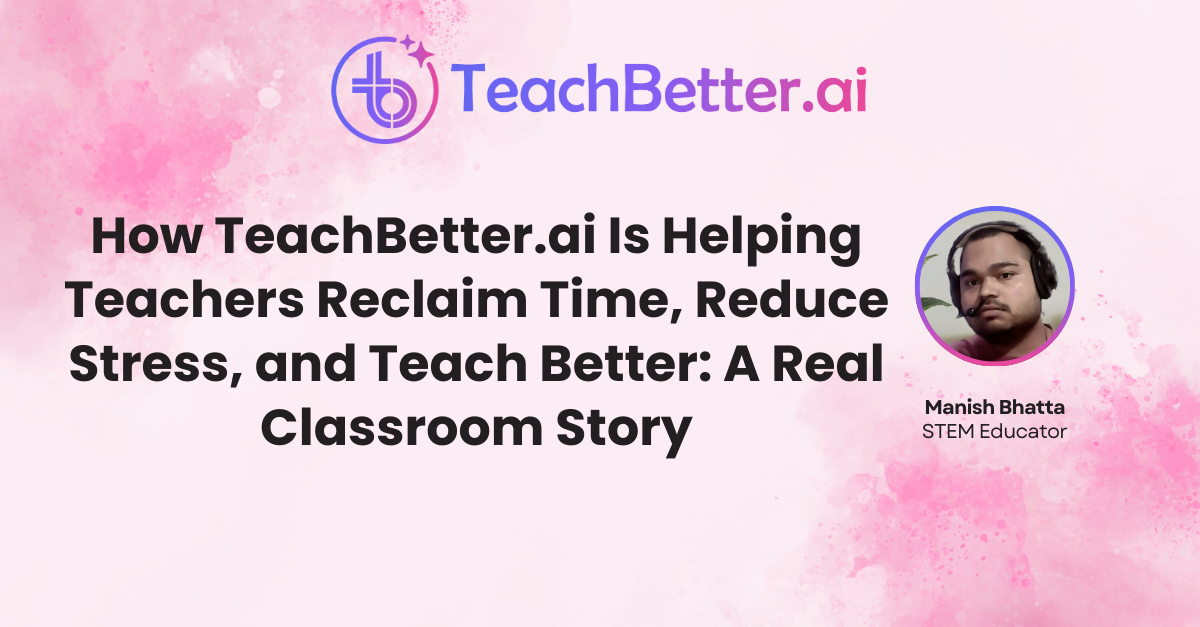
How TeachBetter.ai Is Helping Teachers Reclaim Time, Reduce Stress, and Teach Better: A Real Classroom Story
Vipin Kumar
|
 14 January, 2026
Teaching has always been a demanding profession, and many educators today are searching for the best AI platform for teachers to reclaim time, reduce stress, and teach more effectively. However, in today’s education landscape, the role of a teacher has expanded far beyond explaining concepts in the classroom. Teachers are now planners, evaluators, content creators, mentors, and communicators—often all at once.
While expectations from teachers continue to grow, the time available to meet those expectations does not. As a result, many educators find themselves spending more hours on administrative and repetitive tasks than on actual teaching. This imbalance affects not only teacher well-being but also student outcomes.
This blog shares a real user story from a STEM educator who uses TeachBetter.ai as part of his daily teaching workflow. His experience offers a clear picture of how AI, when designed specifically for education, can reduce workload, improve teaching quality, and support students more effectively.
The Modern Teacher’s Challenge: When Administration Overtakes Education
Most teachers choose this profession because they want to teach, guide, and inspire students. They enter classrooms with a passion for explaining concepts, sparking curiosity, and helping learners grow with confidence. However, the reality of modern education often looks very different from this ideal.
Today, a significant portion of a teacher’s working hours is spent outside the classroom, handling administrative and preparatory tasks that are essential but time-consuming. These include creating question papers and worksheets for multiple classes, designing assessments for students with different learning levels, preparing presentations and visual aids, reviewing student work and generating detailed feedback, and communicating academic progress and concerns to parents.
Each of these tasks plays an important role in the learning process. However, when done manually, they demand a large investment of time and mental energy. Over days and weeks, this repetitive workload begins to overshadow the core responsibility of teaching.
As a result, teachers often find themselves rushing through lessons, postponing personalized feedback, or working late hours just to keep up. This imbalance reduces opportunities for meaningful student interaction, deeper explanations, and one-on-one support—elements that are critical for effective learning.
Read more: Integrating AI Tools into Lesson Planning: A Step-by-Step Guide for Modern Educators
Meet the Educator: A STEM Teacher Balancing Teaching and Operations
Manish Bhatta is a teacher and tutor with more than five years of experience in STEM education. Based in Odisha, he runs his own personal coaching institute, where he works closely with students across different grades, subjects, and learning abilities.
In his role, Manish is not just a teacher. He is also the planner, evaluator, content creator, and primary point of contact for parents. Every lesson plan, assessment, worksheet, and progress update is his responsibility. This hands-on involvement allows him to understand each student’s needs deeply, but it also places a heavy operational burden on his daily schedule.
As the sole educator and administrator of his institute, Manish manages lesson planning, assessment creation, personalized academic support, and regular communication with parents. On top of this, he ensures that content remains aligned with curriculum requirements and student learning levels.
Over time, he noticed a clear pattern. Administrative work was slowly taking over his day. Tasks such as creating multiple question papers for different students, customizing assessments, and preparing teaching materials were consuming several hours every week. While these tasks were necessary, they significantly reduced the time he could dedicate to deeper concept explanation, student mentorship, and targeted intervention for struggling learners.
Read More: Beyond ChatGPT: Why Educators Need Purpose-Built AI like TeachBetter.ai
Searching for a Smarter Way to Teach
Recognizing that his growing workload was unsustainable, Manish began actively looking for ways to streamline his daily teaching tasks. Importantly, his goal was not to replace teaching with technology. Instead, he wanted support—something that could assist him with repetitive and time-consuming work while allowing him to remain fully involved in the learning process.
He started searching online for automation tools that could help with core teaching needs such as question paper generation, assessment creation, and presentation building. His focus was practical. He needed a solution that was easy to use, quick to implement, and relevant to real classroom scenarios.
Manish was not looking for a generic AI chatbot or a complex technical system. He wanted a tool that understood education, curriculum structure, and classroom realities. A tool that could save time without compromising academic quality.
This search eventually led him to TeachBetter.ai.
First Impressions: Why TeachBetter.ai Felt Different
From the very beginning, TeachBetter.ai stood out because it was clearly built for educators. Unlike generic AI tools that require detailed prompts and technical adjustments, the platform understood classroom contexts, grade levels, and curriculum needs intuitively.
Manish did not need to spend time learning prompt engineering or figuring out how to “talk” to the AI. Instead, the platform guided him naturally through its tools, allowing him to generate usable outputs with minimal input. This meant he could focus on teaching decisions rather than technical experimentation.
Another key difference was relevance. The outputs generated by TeachBetter.ai felt aligned with real teaching requirements rather than generic content. This built trust quickly and encouraged regular use.
This ease of use played a critical role in adoption. For teachers, simplicity is not a luxury—it is a necessity. A tool that saves time but requires significant learning effort defeats its own purpose. TeachBetter.ai avoided this pitfall by prioritizing usability and educator-first design. This is where an AI platform for teachers makes a meaningful difference by removing technical friction.
A Teacher’s Voice: Real Testimonial From Daily Classroom Use
The true value of any education platform lies not in its features, but in how it performs in real classrooms with real students. After using TeachBetter.ai regularly as part of his teaching workflow, Manish shared his experience:
“TeachBetter.ai has been a game-changer for me as a STEM educator. It’s an incredible automation tool that handles the administrative workload of assessments and creating personalized question papers, freeing up my time to focus on individual student needs. The platform’s targeted feedback and its ability to involve parents are invaluable, truly helping students perform much better in their learning journey.”

Manish Bhatta,
STEM Educator
This testimonial captures the essence of TeachBetter.ai’s impact. The platform does not remove the teacher from the process or reduce their role. Instead, it removes friction from the work that slows teachers down.
How TeachBetter.ai Supports Everyday Teaching Tasks
As an AI platform for teachers, TeachBetter.ai is designed to integrate directly into daily classroom workflows. One of the most valuable aspects of TeachBetter.ai is how seamlessly it integrates into daily teaching routines. Manish uses several features regularly, each addressing a specific challenge he previously faced.
Curriculum-aligned content categorization allows teachers to structure content by grade level and curriculum. For Manish, this is especially important because he teaches students aligned with Indian education boards such as CBSE and ICSE. This ensures that generated content remains relevant, structured, and academically appropriate.
Question paper and assessment generation significantly reduces preparation time. Instead of drafting assessments manually, Manish can generate well-structured papers quickly with minimal input. The system understands the teaching context and produces outputs that are easy to refine, saving hours every week.
Ad-free image generation simplifies lesson preparation further. Visual content plays an important role in STEM education, yet searching for suitable images online is time-consuming and distracting. TeachBetter.ai generates relevant visuals directly within the platform, keeping preparation fast and focused.
YouTube video summarization helps extract key insights from long educational videos. Rather than watching entire videos, Manish can quickly review summaries and use the information to strengthen his lessons.
Read More: From Lesson Plans to Assessments: Why Teachers Choose TeachBetter.ai to Simplify Teaching
Reducing Cognitive Load Without Reducing Teaching Quality
One of the most meaningful outcomes Manish experienced after adopting TeachBetter.ai was a noticeable reduction in cognitive load. For teachers, cognitive load is not just about time spent. It is about mental exhaustion caused by constant task-switching between planning, evaluating, documenting, and teaching.
Before using the platform, Manish often had to juggle multiple responsibilities in parallel. Over time, this reduced focus and made it harder to give each task the attention it deserved. Using an AI platform for teachers helps educators reduce mental fatigue without compromising teaching quality.
By automating repetitive tasks, TeachBetter.ai removed much of this mental burden. Manish could redirect his energy toward explaining complex STEM concepts clearly, identifying individual learning gaps, providing targeted feedback, and supporting struggling students more effectively.
This shift improved not only productivity but also teaching quality. With fewer distractions and less fatigue, Manish could teach with greater clarity, confidence, and consistency.
Supporting Personalized Learning at Scale
Personalized attention improves learning outcomes, but delivering it consistently is challenging. TeachBetter.ai helps bridge this gap by automating routine academic tasks and enabling targeted feedback.
For Manish, this meant adapting assessments and learning materials without increasing workload. Students received guidance that felt specific to their needs, even when the teacher was not physically present. Over time, students became more engaged and independent. Personalized learning shifted from an ideal to a practical, scalable reality.

Enabling Meaningful Parent Involvement
Parent involvement plays a crucial role in a student’s academic success. When parents understand how their child is progressing and where support is needed, learning outcomes improve significantly. However, maintaining clear and regular communication with parents often adds to a teacher’s workload.
TeachBetter.ai simplifies this process by helping teachers generate structured insights and feedback that can be easily shared with parents. Instead of spending extra hours drafting explanations or progress updates, teachers can rely on AI-assisted summaries that are clear, concise, and actionable.
Manish uses the platform to explain student performance and guide parents on how they can support learning at home. This includes clarifying strengths, highlighting improvement areas, and suggesting focused practice rather than vague advice.
This structured communication builds trust. Parents feel more informed and involved, while teachers avoid repetitive explanations. The result is a collaborative learning environment where teachers, students, and parents work toward the same goals.
Read More: Why Teachers Love TeachBetter.ai: The Best AI Platform to Simplify and Empower Teaching
Designed for Teachers, Not Technologists
One of the most important reasons TeachBetter.ai works effectively is its educator-first design. The platform does not assume that teachers are technologists or AI experts. Instead, it prioritizes simplicity, clarity, and usability.
Teachers do not need to learn technical concepts, write complex prompts, or configure advanced settings. Features such as simple Google login and intuitive workflows make onboarding quick and stress-free for both teachers and students.
Every tool is designed to feel familiar and purposeful. Teachers can focus on educational outcomes rather than navigating technology. This design philosophy ensures that AI supports teaching instead of becoming another responsibility to manage. For Manish, this ease of use made the platform a natural part of his daily routine rather than an additional system to learn and maintain.
What This Means for Other Teachers
Manish’s experience is not unique. It reflects the everyday reality faced by thousands of teachers across schools, coaching institutes, and home-tutoring setups. Educators today are expected to deliver high-quality learning outcomes while managing an ever-growing list of responsibilities. Lesson planning, assessment design, grading, documentation, and parent communication often compete for the same limited time and energy.
The key takeaway from Manish’s journey is simple but powerful. Teachers do not need more tools. They do not need complex systems or generic AI platforms that add another layer of learning and management. What teachers truly need are the right tools—tools that understand how education works, respect the teacher’s professional judgment, and solve real classroom problems without disruption.
TeachBetter.ai demonstrates how AI can be used thoughtfully in education. Instead of overwhelming teachers with features, the platform works quietly in the background. It takes care of repetitive, time-consuming tasks such as content generation, assessment creation, and structured feedback. This allows teachers to stay in control of the learning process while gaining back valuable time.
Read More: 10 Reasons Why Teachers Love TeachBetter.ai: The Educators’ Voice
Final Thoughts: Teaching Better With the Right AI Support
AI in education delivers real value only when it is built with teachers at the center of every decision. TeachBetter.ai does not attempt to replace educators or force a one-size-fits-all teaching model. Instead, it acknowledges a fundamental truth: teaching is a human-driven profession, and technology should exist to support—not disrupt—that human connection.
By reducing administrative workload, simplifying repetitive tasks, and enabling smarter workflows, TeachBetter.ai empowers teachers to teach more effectively without working longer hours. The time saved is reinvested into better explanations, stronger student relationships, and deeper learning experiences. For educators seeking an effective AI platform for teachers, TeachBetter.ai offers a proven, classroom-tested solution.
For educators who want to reclaim their time, reduce daily stress, and deliver more meaningful education, TeachBetter.ai offers a practical and proven solution. It is grounded in real classroom needs, shaped by teacher feedback, and validated through real teaching experiences like Manish’s.

Vipin Kumar, Co-Founder, TeachBetter.ai
Vipin Kumar is building TeachBetter.ai to create intuitive AI tools that simplify teaching and enhance learning outcomes. With prior experience at global technology companies, he brings a deep understanding of scalable systems, user needs, and practical digital solutions. His mission is to make AI adoption in education easy, affordable, and truly impactful for teachers everywhere. He is committed to creating AI solutions that save time, boost creativity, and empower educators to focus on what matters most—teaching.
Read other articles authored by Vipin Kumar here.