TeachBetter.ai vs ChatGPT: Which AI Platform Is Truly Built for Teachers?
Binit Agarwalla
|
 1 March, 2026
Introduction: The AI Shift in Education Is Already Here
Artificial Intelligence is no longer an experimental add-on in education. It is quickly becoming a structural part of modern classrooms worldwide. Teachers are using these tools to draft lesson plans, create assessments, simplify complex topics, generate differentiated materials, and prepare student feedback. Schools are also exploring AI to reduce administrative workload, improve efficiency, and support more personalized learning experiences. This growing shift makes the comparison of TeachBetter.ai vs ChatGPT more relevant than ever for modern educators.
As adoption grows, an important question emerges: Is every AI tool equally suited for education? Many educators begin with ChatGPT because it is powerful, flexible, and widely known. However, once AI moves from experimentation to daily classroom integration, teachers often encounter friction. That friction is rarely about intelligence — it is about structure, workflow alignment, and educational context.
This is where TeachBetter.ai becomes relevant. Rather than functioning as a general chatbot, it is built specifically for educators, schools, parents, and students. In this article, we compare TeachBetter.ai vs ChatGPT not only in features, but in workflow design, educational alignment, and long-term classroom impact.
The Foundational Difference: General Intelligence vs Educational Architecture
At first glance, both platforms appear similar. They use advanced language models capable of generating explanations, lesson ideas, structured content, and written material. Both can respond intelligently and assist with content creation. However, the real difference lies in how each system is designed.
ChatGPT is a conversational AI that generates outputs based entirely on user prompts. Its intelligence is broad and adaptable, but it is context-neutral. It does not automatically account for curriculum standards, grade-level pedagogy, assessment structures, or institutional requirements. Everything depends on how clearly the teacher defines the instruction.
TeachBetter.ai is built around educational architecture. It integrates GPT-based intelligence into structured tools, guided inputs, role-based access, and workflow-driven systems designed for K–12 environments. Instead of requiring teachers to engineer detailed prompts, the platform embeds instructional logic directly into its interface.
With ChatGPT, teachers structure the interaction. With TeachBetter.ai, the platform structures the workflow.
Curriculum Alignment: From Prompt Crafting to Pedagogical Structure
Curriculum alignment is non-negotiable in schools. Whether educators follow CBSE, ICSE, IB, IGCSE, or state board standards, lesson plans must align with defined objectives and measurable learning outcomes. This is where the difference between general AI and education-focused AI becomes clear.
When using ChatGPT for lesson planning, teachers must manually specify multiple instructional parameters, including:
- Grade level
- Subject and topic
- Learning objectives
- Bloom’s taxonomy level
- Assessment strategy
- Teaching framework (such as the 5E model)
- Real-world examples
Even with carefully written prompts, outputs often require additional formatting and restructuring to meet classroom standards. While ChatGPT can generate strong content, it does not automatically organize it according to institutional requirements unless explicitly instructed.
TeachBetter.ai, by contrast, embeds curriculum-aware generation directly into its Lesson Planner. Teachers select grade, subject, topic, and goals within a guided interface, and the system produces structured lesson plans with clearly defined objectives, engagement activities, explanations, and evaluation components.
This approach reduces preparation time and cognitive load. Teachers are no longer required to engineer complex prompts. Instead, they work within workflows designed specifically for classroom realities — transforming AI from a drafting assistant into a structured instructional tool. This is one of the clearest differences when evaluating TeachBetter.ai vs ChatGPT for structured lesson planning.
Administrative Burden: Assistance Is Not the Same as Automation
Educators spend a significant portion of their time on administrative tasks — including grading, report writing, documentation, formatting materials, and parent communication. While AI can help, the way it helps matters.
ChatGPT can assist with individual tasks. Teachers can paste student responses for feedback, request report comments, or draft emails quickly. However, these actions remain manual and disconnected. Each task requires separate prompting, editing, and organization.
TeachBetter.ai moves beyond assistance by introducing AI Agents designed to automate bulk workflows. These agents function as structured process systems rather than simple response generators. When comparing TeachBetter.ai vs ChatGPT in terms of administrative efficiency, the distinction becomes even more visible.
This is not just conversational support — it is operational automation. In classrooms with large sections and multiple batches, the time savings become substantial. What once required hours of manual review can now be processed efficiently within a scalable workflow.
The Evolution from Tool to Platform
It is important to distinguish between a powerful tool and an integrated platform. ChatGPT is a strong AI tool that excels in versatility, creativity, and general writing support. However, it operates through a single conversational interface built around prompt-and-response interactions.
TeachBetter.ai functions as a structured platform ecosystem designed specifically for education. It includes over 20 dedicated AI tools tailored to classroom needs, such as:
- Lesson Planner
- Concept Explainer
- Quiz & Worksheet Generator
- Presentation Generator
- Personalized Report Generator
- Doubt Solver
- Science Lab
- Event Planner
- Chat with Documents
- Web Search Assistance
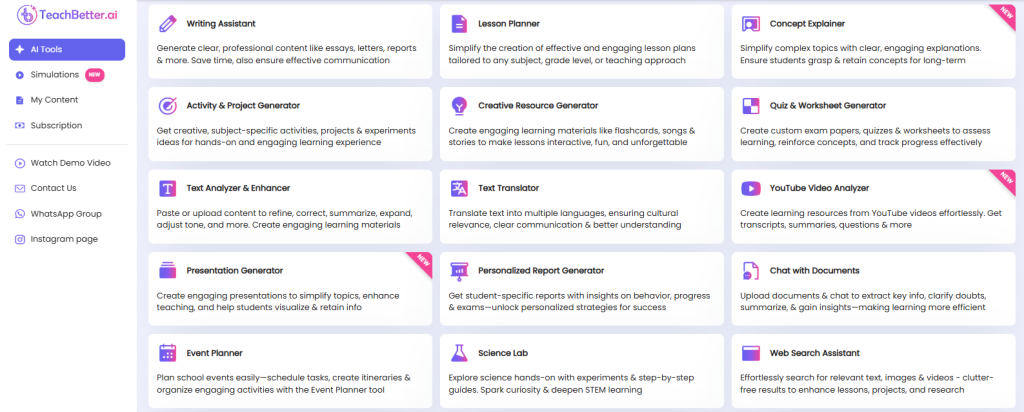
Each tool is built with predefined inputs, formatted outputs, export options, and content history tracking. Teachers can download materials as PDFs or Word files, export to Google Docs or Slides, and maintain an organized archive within the platform.
"I will always recommend TeachBetter.ai to all my co-teachers who are acquainted with me to take the advantage of this platform so that it will be helpful for their students also."

Suman Sinharoy
Science & Maths Teacher 30+ Years of Experience
ChatGPT stores outputs within chat threads, requiring manual organization and formatting. While this flexibility works well for open-ended tasks, it introduces friction in structured classroom workflows. In contrast, purpose-built tools standardize output quality and reduce repetitive formatting effort.
TeachBetter.ai vs ChatGPT: Detailed Feature Comparison
| Feature Area | TeachBetter.ai | ChatGPT |
| Core Design Purpose | Built specifically for schools, teachers, parents, and students with structured academic workflows. | Designed as a general-purpose conversational AI for broad use cases across industries. |
| Lesson Planning | Guided lesson planner with structured inputs for grade, objectives, activities, and evaluation. | Requires manual prompt writing; structure depends entirely on user instructions. |
| Curriculum Alignment | Embedded academic alignment within tools to match classroom standards. | Must be manually specified in prompts; no built-in curriculum logic. |
| Quiz & Worksheet Creation | Dedicated generator with formatted outputs ready for classroom use. | Can generate questions, but formatting and organization require manual effort. |
| Administrative Efficiency | Built to reduce workload through automation and structured tool systems. | Assists per task, but does not automate multi-step institutional workflows. |
| Role-Based Access | Separate access for teachers, school admins, and parents with centralized control. | Individual accounts only; no institutional access control layer. |
| School Governance & Licensing | Centralized dashboard for license management and usage monitoring. | No built-in school-level licensing or governance system. |
| Student Safety & Control | Controlled academic environment with guided learning tools. | Open-ended conversational system without school-specific guardrails. |
| Workflow Structure | Tool-based ecosystem with predefined input-output formats. | Single chat interface; structure must be manually managed. |
| Export & Documentation | Built-in export to PDF, Word, and presentation formats. | Requires copy-paste and manual formatting for external use. |
| Best Use Case | Structured classroom integration and institutional AI adoption. | Creative drafting, brainstorming, and open-ended exploration. |
The comparison highlights a fundamental distinction. ChatGPT delivers conversational intelligence that adapts to user prompts, making it ideal for brainstorming and flexible writing tasks. TeachBetter.ai, on the other hand, embeds AI within structured academic workflows, making it better suited for lesson planning, grading, governance, and school-level implementation. For schools making a strategic decision between TeachBetter.ai vs ChatGPT, the operational differences outlined above are critical.
Role-Based Access and School Governance
Schools operate within governance frameworks that demand accountability and structured implementation. AI adoption cannot be left to informal individual use; it must align with institutional policies, subscription control, and academic oversight.
TeachBetter.ai is built with this institutional structure in mind. It provides role-based access control for teachers, parents, and administrators, allowing schools to manage licenses, assign access, and monitor usage centrally. This transforms AI adoption into a coordinated initiative rather than isolated experimentation.
The platform also supports subscription management, license allocation, and usage history, ensuring transparency and alignment with institutional goals. Administrators gain visibility and control without relying on external systems.
ChatGPT, by comparison, functions primarily at the individual account level. There is no centralized administrative dashboard, licensing framework, or built-in governance system for school-wide deployment. For institutions integrating AI long term, structured governance is not optional — it is essential.
Safety, Control, and Student-Focused AI
Student safety is one of the most important considerations in AI adoption within schools. Educators and parents want innovation, but not at the cost of distraction, misinformation, or unstructured content exposure. As AI becomes part of everyday learning, safety and focus become as critical as capability.
TeachBetter.ai provides a controlled environment built specifically for academic use. Students access concept explainers, doubt-solving tools, and structured workflows within a platform aligned to classroom expectations. The experience is guided and curriculum-focused rather than open-ended.
Parents and administrators also gain visibility into usage, reinforcing transparency and trust. ChatGPT, while powerful, is inherently open-ended and not designed with embedded school-level guardrails. For institutions prioritizing focus and safety, this difference is significant.
Beyond Content Generation: Interactive & Engagement-Driven Learning
While many AI tools focus primarily on generating text, modern classrooms demand far more than written outputs. Today’s educators need tools that enhance engagement, improve visualization, and support interactive learning experiences. This is where TeachBetter.ai moves beyond traditional AI assistance and delivers classroom-ready functionality that transforms static content into dynamic instruction.
Live Quiz & Poll Generator: The Live Quiz & Poll Generator enables teachers and parents to create, validate, and deliver real-time assessments across subjects, grades, and curricula. Educators can generate high-quality multiple-choice questions, review and refine them before publishing, and instantly create a shareable online link for students without requiring login access. Responses are auto-evaluated with real-time scoring and performance insights, making formative assessments faster, more interactive, and easier to implement in both live and asynchronous settings. Rather than simply generating questions, the tool supports the full cycle of creation, delivery, and evaluation within a structured system.
Concept Mastery Coach: The Concept Mastery Coach introduces a gamified and mastery-driven approach to reinforcement. Instead of offering isolated question generation, it provides five AI-generated questions aligned with Bloom’s Taxonomy levels, along with detailed explanations for each answer. Students receive real-time feedback, opportunities to retry, and visible progress tracking as they strengthen their understanding. As learners successfully master concepts, they earn digital badges that reinforce achievement and motivation. This shifts AI from being an answer provider to becoming a structured reinforcement mechanism that deepens long-term retention.
"With 32 years of teaching experience, I can confidently say that TeachBetter.ai is a true game-changer. I’ve been using it for lesson plans, quizzes, worksheets, and even for adding related pictures to my lessons — all in one place. Unlike other platforms, I don’t have to waste time searching across ChatGPT, Google, or multiple tools."

Meenakshi Soni
Teacher, 32 years of experience
SJ Public School, Jaipur
Presentation Generator: The Presentation Generator further enhances classroom efficiency by allowing teachers to quickly create structured PowerPoint presentations, slideshows, and summaries that simplify complex topics. Instead of manually designing slides from scratch, educators can generate complete presentations with logical flow, clear slide segmentation, and topic breakdowns in minutes. The tool supports various presentation styles, including informational, persuasive, and storytelling formats, and can convert existing text-based content into ready-to-use slides. It also suggests related images and videos that teachers can manually integrate, ensuring lessons are visually engaging and easier for students to grasp and retain.
Interactive Simulations: TeachBetter.ai offers 118 interactive simulations that support experiential learning. These simulations allow students to visualize abstract concepts, experiment virtually, and interact with subject matter in a dynamic environment. Rather than relying solely on textual explanations, learners can explore cause-and-effect relationships and strengthen conceptual clarity through guided interaction. This expands AI usage from content generation into immersive educational engagement.
The Psychological Shift for Teachers
Beyond features, the difference between ChatGPT and TeachBetter.ai also affects teacher psychology. Both generate content quickly, but the user experience is different.
When using ChatGPT, teachers often need to:
- Refine prompts repeatedly
- Manually adjust formatting
- Reorganize content into approved templates
- Edit outputs to match curriculum standards
Although this saves time compared to starting from scratch, it keeps teachers in a micro-management role. TeachBetter.ai shifts teachers toward strategic oversight. Instead of crafting complex prompts, they configure structured inputs. Instead of rewriting extensively, they review and refine system-generated outputs. This reduces fatigue and builds confidence, supporting more sustainable long-term adoption.
Scaling AI Adoption Across Schools
There is a major difference between individual experimentation and institutional integration. A teacher using AI independently is one scenario; a school implementing AI across grades and departments is another.
TeachBetter.ai is structured to support scaling across subjects and operational functions. Schools can begin with lesson planning tools and gradually expand into grading automation and communication workflows.
Key advantages for scaling include:
- Centralized license management
- Role-based access
- Consistent output formatting
- Standardized tools across departments
- Administrative oversight and analytics
ChatGPT remains powerful at the individual level but lacks a built-in scaling framework. Institutional expansion requires external coordination and policy systems. Structured scalability ensures AI adoption grows strategically rather than inconsistently. This is where the long-term comparison of TeachBetter.ai vs ChatGPT becomes especially important for institutions.
The Long-Term Vision: AI as an Educational Infrastructure Layer
TeachBetter.ai is positioned not just as a collection of tools, but as an educational infrastructure layer for schools. Its vision is to simplify teaching and amplify learning through structured, safe, and curriculum-aligned AI systems that integrate into everyday academic operations.
The platform roadmap includes advanced AI Agents designed to automate workflows such as grading, feedback generation, and communication processes. This signals a move beyond basic content generation toward operational transformation within institutions.
As AI becomes more embedded in education, platforms designed for structured integration will play a central role in shaping how schools adopt and scale these technologies.
Final Verdict: TeachBetter.ai vs ChatGPT
If you are exploring AI casually or seeking a flexible conversational assistant, ChatGPT remains powerful and versatile. It excels in creativity, rapid drafting, and open-ended exploration.
However, if you are integrating AI into structured lesson planning, assessment, reporting, communication, and governance, TeachBetter.ai offers stronger alignment with classroom workflows. It shifts AI from being a content generator to becoming a workflow-driven system embedded in educational processes.
ChatGPT delivers intelligence. TeachBetter.ai delivers applied intelligence within educational structure.
The difference becomes clear not in a single session, but through consistent classroom use.
Conclusion: The Future Belongs to Structured AI in Education
AI is not replacing teachers — it is reshaping how they use their time and expertise. The educators who benefit most are those who adopt AI strategically rather than casually.
Purpose-built platforms reduce friction. Automation lowers burnout. Structured systems create consistency.
As AI adoption grows across schools, the distinction between general AI tools and education-focused platforms will matter more. Ultimately, the comparison between TeachBetter.ai and ChatGPT is not about which system is smarter. It is about which system is built for the classroom.

Binit Agarwalla, Founder, TeachBetter.ai
With over 15 years of seasoned expertise, Binit is a results-driven marketing leader specializing in B2B SaaS and B2C growth strategy - now channeling that experience into transforming education through TeachBetter.ai, an all-in-one AI platform built exclusively for teachers, students, and schools.
As the Founder of TeachBetter.ai, his mission is to simplify teaching and amplify learning by empowering educators with AI-driven tools that save time, enhance creativity, and make classrooms more engaging. TeachBetter.ai's vision is to make AI adoption in education simple, accessible, and affordable - helping every teacher leverage the power of AI without complexity or high cost.
Read other articles authored by Binit Agarwalla here.