Mind Maps for Teaching and Revision: How TeachBetter.ai Helps Students See the Complete Picture
Binit Agarwalla
|
 18 November, 2026
Mind Maps for Teaching and Revision are an effective way to simplify complex topics, organize information, and help students remember important concepts. With TeachBetter.ai, teachers can use mind maps to make learning more visual, engaging, and easier to understand across different subjects.
This is common because classroom content is usually presented in sequence. A textbook introduces one idea after another. A teacher explains a concept, demonstrates an example and then moves to the next part. A worksheet divides the topic into separate questions. This sequence is necessary, but it can leave students with individual pieces of knowledge rather than a connected understanding of the complete topic.
Mind maps address this gap by making the structure of knowledge visible. They place the main topic at the centre and organise related concepts around it through branches, diagrams, keywords, examples and visual relationships. Students can see the big picture while still examining the details within it.
With Mind Map Studio on TeachBetter.ai, teachers can access a ready-to-use collection of rich educational mind maps across K–12 subjects and topics. They can search for a topic, select a suitable mind map, personalise it with their school logo, school name and class details, and then download or share it with students.
The result is not simply a colourful summary. A well-designed mind map can become a teaching framework, a discussion prompt, a revision guide and a way for students to understand how ideas connect.
Visual explanations. Interactive learning. Extraordinary possibilities.
Why students need to see the structure of a topic
Learning is not only about collecting facts. Students also need to organise those facts into meaningful patterns.
Consider a chapter on electricity. Students may learn the definitions of current, potential difference and resistance. They may memorise Ohm’s law, draw series and parallel circuits, study the heating effect of current and calculate electrical power. Benefits of Mind Maps for Teaching and Revision. However, if these ideas remain separated in their minds, they may struggle to decide which principle applies when solving a new problem.
The same challenge appears in other subjects. In Mathematics, students may learn equivalent fractions and number lines without understanding that both represent the same underlying quantity. In Geography, they may study maps, directions, latitude, longitude and time zones as separate concepts instead of parts of a system for locating places. In Biology, nutrition, respiration, transport and excretion may be remembered as separate processes rather than connected requirements for maintaining life.
A mind map makes these relationships easier to examine. It gives the chapter a visible architecture: the central topic, its major components and the connections between them.
The Institute for Human and Machine Cognition describes concept maps as graphical tools for organising and representing knowledge. Although mind maps often use a more flexible radial structure, they serve a related purpose by helping learners see how concepts belong together. IHMC’s explanation of concept maps
What is an educational mind map?
An educational mind map is a visual representation organised around a central subject, chapter or concept. Its branches divide the topic into meaningful areas and connect each area with supporting information.
Depending on the subject and grade, a mind map may contain definitions, formulas, diagrams, classifications, stages, examples, comparisons, applications or common misconceptions. A primary-school map may rely more heavily on illustrations and familiar situations. A senior-secondary map may include equations, conditions, graphs and formal terminology.
A strong educational mind map should help students answer three questions:
- What is the topic mainly about?
- What are its most important components?
- How do those components relate to one another?
This distinguishes an educational mind map from a decorative poster. The visual organisation must support the meaning of the content.
The role of mind maps in teaching
Mind maps can play several roles depending on the lesson objective. They may be used before a chapter to provide orientation, during teaching to connect new ideas, after instruction to consolidate understanding, or during revision to support recall and self-assessment.
Providing an overview before detailed teaching
At the beginning of a chapter, students do not yet need every detail. They need a sense of direction.
A mind map can introduce the central question and major branches of the topic. This gives students a framework into which they can place new knowledge as the lessons progress. When the teacher later introduces a formula, process or example, students can see where it belongs within the larger topic.
This can be particularly valuable for long chapters. Instead of experiencing each lesson as a separate block, students recognise that every lesson contributes to a shared conceptual structure.
Connecting ideas during explanation
Teachers can return to the mind map throughout the chapter. After teaching a branch in detail, they can show how it connects with the centre and with other branches.
For example, while teaching electricity, a teacher might connect resistance to Ohm’s law, wire dimensions, circuit arrangements and heating effects. In Geography, longitude can be connected with Earth’s rotation and differences in local time.
The map provides a common visual reference for these explanations.
Consolidating the chapter after teaching
At the end of a topic, the complete map can bring the lessons together. Students can revisit the chapter as a connected whole rather than as a sequence of completed pages.
Teachers can use this stage to ask relationship-based questions. Instead of asking only for a definition, they might ask students to explain why two branches connect, how one process influences another or where a particular example belongs.
These questions reveal whether students understand the structure behind the content.
Supporting purposeful revision
Mind maps can make revision more organised, but students should use them actively.
A student can cover one branch and attempt to recreate it from memory. Another can convert each heading into a question. Pairs of students can explain different branches to each other. Students can also annotate the map with examples, misconceptions or areas requiring more practice.
The Education Endowment Foundation recommends explicitly teaching and modelling the strategies students use to plan, monitor and evaluate their learning. Mind maps can contribute to this process when teachers demonstrate how to use them for retrieval, explanation and self-review. EEF guidance on metacognition and self-regulated learning
The role of mind maps for teachers
For teachers, a mind map can function as both a preparation resource and a classroom tool.
During preparation, it can help identify the chapter’s main areas and the relationships that should be made explicit. It may reveal where students are likely to confuse two ideas or where a visual comparison would strengthen the explanation.
In the classroom, the teacher can use the map to maintain continuity across lessons. A branch taught on Monday can be reconnected with another branch later in the week. Students are repeatedly reminded that the lessons belong to one topic.
Mind maps can also support differentiation. A teacher might use the central topic and major branches with students who need a simpler overview, while inviting others to add conditions, examples or exceptions. The same visual can therefore support different levels of engagement without changing the core topic.
Most importantly, a mind map gives teachers an alternative to explaining a complex chapter only through paragraphs and blackboard notes. It provides a visual route through the content while leaving room for discussion, demonstration and practice.
The role of mind maps for students
For students, the primary value of a mind map is orientation. It shows what has been learned, what remains to be studied and where each idea belongs.
This can be useful when a chapter feels overwhelming. A student may not remember every detail immediately, but the branches provide retrieval cues. The heading “parallel connections,” for example, may prompt recall of voltage, branch currents, equivalent resistance and the independent operation of appliances.
Mind maps can also support students in explaining rather than merely recognising information. A student who can follow the branches and explain their relationships is demonstrating a deeper form of understanding than one who can only identify familiar words.
During independent study, the map can become a planning tool. Students can mark confident areas, identify weak branches and decide where further reading or practice is required.
The role of mind maps in a school’s teaching-resource strategy
Mind maps can become more valuable when schools use them as part of a consistent visual-resource approach.
Subject departments can identify important or difficult chapters and select appropriate maps for teaching and revision. Teachers working with the same grade can use a shared resource while adapting the explanation and activities to their classes. Schools can also include personalised mind maps in revision packs, learning portals or parent-supported study material.
Because TeachBetter.ai allows the addition of a school logo, school name and class details, the resources can carry a consistent institutional identity. This is helpful when several teachers are preparing materials for the same examination, grade or academic programme.
The aim is not to standardise every classroom explanation. It is to give teachers access to a shared, high-quality visual foundation that they can use with professional judgement.
What makes a mind map useful for classroom learning?
A visually attractive resource is not automatically educationally effective. Its structure and content must serve a clear learning purpose.
A clear central idea: Students should be able to identify the topic immediately. A strong centre gives the rest of the visual an anchor.
Meaningful branches: The main branches should reflect genuine divisions within the subject. They might represent stages of a process, categories, principles, causes, effects or related subtopics.
Visible relationships: Colours, lines, diagrams and spatial placement should help students understand how ideas are grouped. These devices should clarify the content rather than distract from it.
Subject-appropriate representations: Different topics require different visual forms. Fractions benefit from shaded models and number lines. Electricity requires circuit diagrams and formulas. Geography benefits from maps, globes and coordinate systems. Physics may require vectors, graphs and free-body diagrams.
Age-appropriate depth: The amount and form of information should reflect the learner’s level. Younger students may need large illustrations, simple statements and familiar situations. Older students may need precise definitions, mathematical notation, conditions and conceptual distinctions.
A balance between overview and detail: A map that contains too little information may add limited value. One that includes every line of the chapter may become difficult to process. A useful resource highlights the essential structure while preserving enough substance to support meaningful explanation and revision.
CAST’s Universal Design for Learning guidance recommends using multiple forms of representation and highlighting patterns, critical features, big ideas and relationships. Educational mind maps can support this principle when combined with teaching, reading, practice and feedback. CAST UDL Guidelines on representation
Mind Map Studio on TeachBetter.ai
Creating a high-quality mind map from the beginning can require substantial preparation. The teacher must identify the important concepts, organise them into a hierarchy, check the subject content, select examples, create diagrams and make the layout readable.
Mind Map Studio gives teachers access to a ready-to-use collection in which much of this work has already been completed.
Teachers can search for a relevant topic, review matching resources and select one appropriate for their class. They can then personalise it with their school identity and class details before downloading or sharing it.
This shifts the teacher’s effort from designing every visual element to choosing how the resource will support the lesson. The teacher can concentrate on the questions, explanations, examples and activities that turn the mind map into a learning experience.
Eight examples from the TeachBetter.ai Mind Map collection
The following examples show the breadth of the collection and the different roles mind maps can play. They are intentionally concise so that the article demonstrates variety without becoming a catalogue.
1. Going to the Mela: connecting learning with everyday experience
Class 3 EVS
The Going to the Mela mind map connects planning, travel, safety, navigation, local culture, community helpers, accessibility and cleanliness around a familiar public event. Rather than presenting these as unrelated ideas, the map shows how they form one complete experience.
A teacher could use it before the chapter to invite predictions or after teaching to help students retell what a responsible visit involves. Mind maps for teaching mathematics, the branches also provide opportunities for conversations about landmarks, public services, inclusive facilities and personal responsibility.
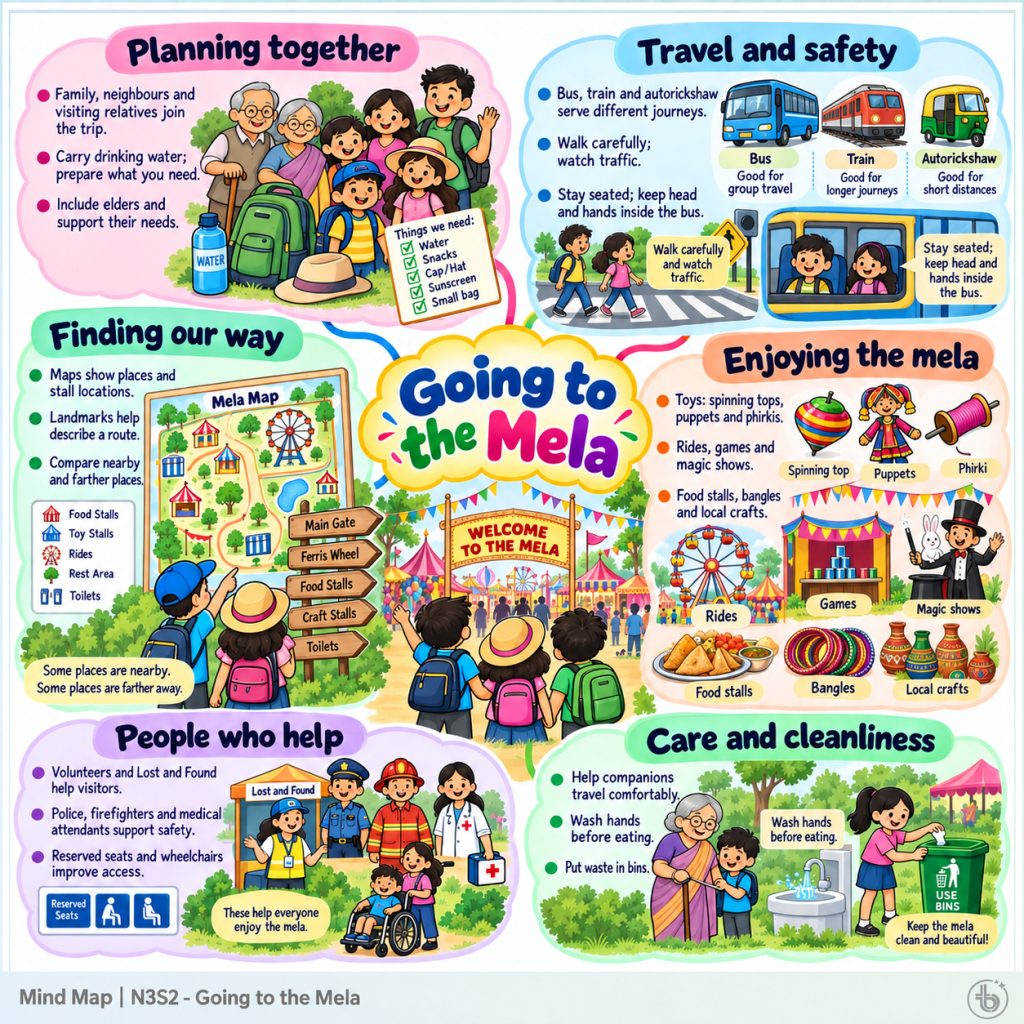
A Class 3 EVS mind map connecting planning, travel, safety, navigation and community responsibility through a visit to a mela.
Link: https://myspace.teachbetter.ai/view/resource/3622e387-62e0-4fe9-9571-269b066c14d7
2. Fractions: joining visual models and mathematical reasoning
Class 5 Mathematics
The Fractions mind map connects equal parts, equivalent fractions, comparison, benchmarks, improper fractions and number lines. Mind maps for teaching mathematics. Its shaded models and number-line examples help students see fractions as quantities rather than only as written numerator–denominator pairs.
Teachers can use the map to address misconceptions, compare different representations or structure chapter revision. Students might add examples to each branch or explain why one-third and two-sixths represent the same quantity.
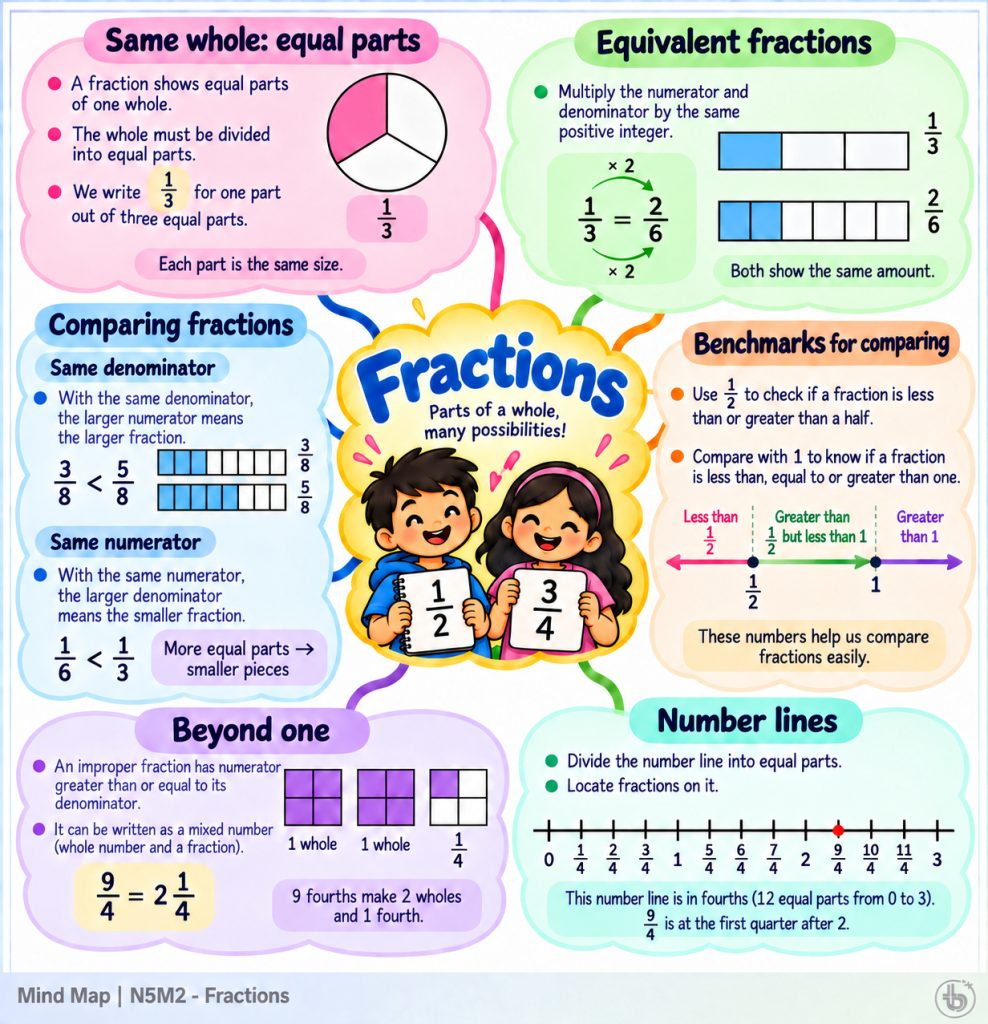
A Class 5 Mathematics mind map connecting equal parts, equivalence, comparison, benchmarks and number-line representation.
Link: https://myspace.teachbetter.ai/view/resource/5da80adb-3a15-4c80-bee5-6b16ffc72185
3. Locating Places on the Earth: connecting position, coordinates and time
Class 6 Social Science
The Locating Places on the Earth mind map brings maps, directions, globes, latitude, longitude, local time and the International Date Line into one visual system.
It helps students understand that these are not separate Geography topics. They are connected ways of representing and describing position on Earth. A teacher could move from local map-reading skills to global coordinates and then show how longitude relates to differences in time.
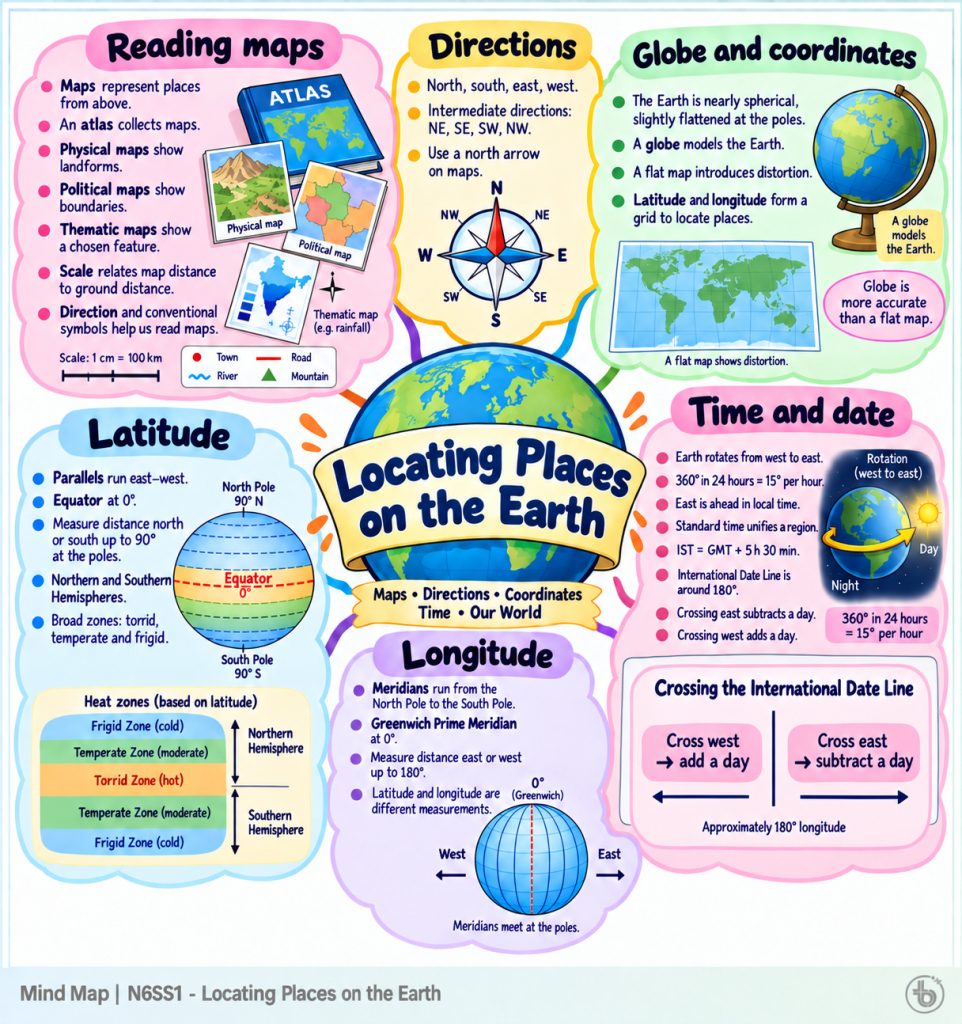
A Class 6 Social Science mind map joining map reading, directions, coordinates, latitude, longitude and time.
Link: https://myspace.teachbetter.ai/view/resource/dd1d7bf3-8392-44f6-9508-a6f9ffa7e2d6
4. The AI Project Lifecycle: showing that AI begins with a real problem
Class 8 Artificial Intelligence
The AI Project Lifecycle mind map organises an AI project into a responsible sequence: defining a useful problem, identifying stakeholders, collecting relevant data, preparing the data, training a model, evaluating it on separate examples and improving it through feedback.
A school-canteen food-waste example makes the process concrete. The map also introduces important ideas such as permission, anonymity, biased data, separate testing and human review. Teachers can use it to show that an AI project is not simply about training a model; it begins with a genuine need and continues through evaluation and responsible improvement.
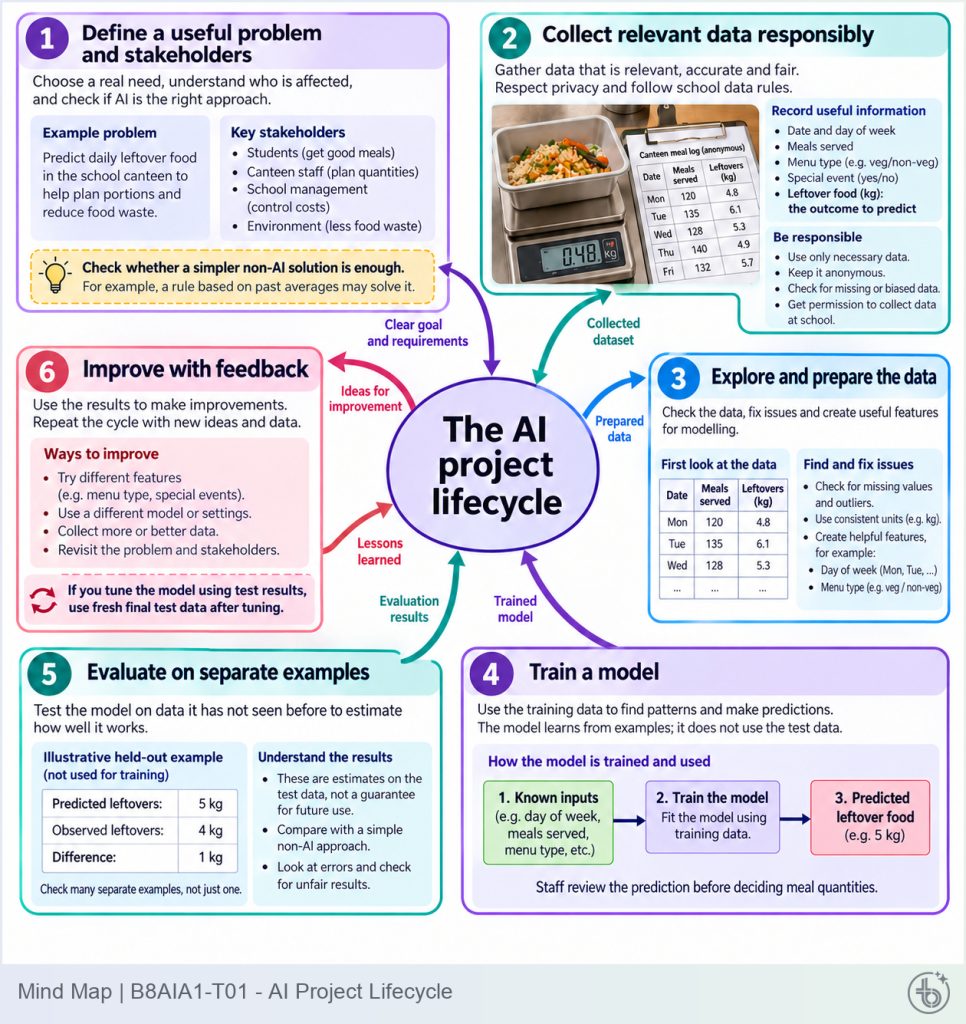
A Class 8 Artificial Intelligence mind map explaining responsible problem definition, data preparation, model training, evaluation and improvement.
Link: https://myspace.teachbetter.ai/view/resource/2dda259a-aa64-405d-8c64-2933034a9b26
5. Life Processes: bringing biological systems together
Class 10 Science
The Life Processes mind map connects nutrition, cellular respiration, human digestion, breathing, circulation, transport in plants and waste removal.
These processes are often taught in separate sections, but the map returns them to the central question of how organisms maintain life. Students can compare plants and humans, connect gas exchange with circulation, or examine how nutrition, respiration, transport and excretion depend on one another.
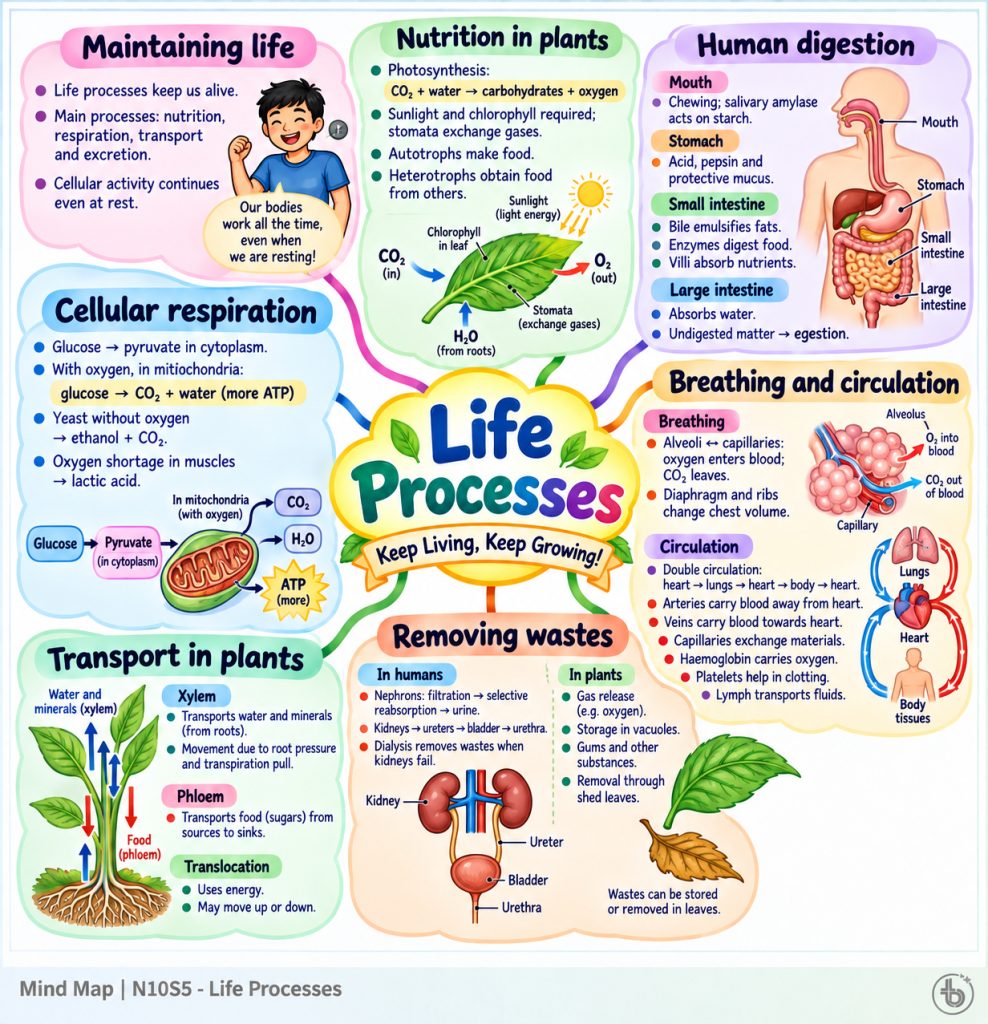
A Class 10 Science mind map connecting nutrition, respiration, transport, circulation, digestion and excretion.
Link: https://myspace.teachbetter.ai/view/resource/41f3c39c-5f95-4ab2-a929-7ddda8d094af
6. Electricity: organising formulas, circuits and applications
Class 10 Science
The Electricity mind map connects current, potential difference, Ohm’s law, resistance, series and parallel circuits, heating effects, power and electrical energy.
Circuit diagrams appear beside formulas and conceptual explanations, helping students connect symbolic relationships with physical arrangements. A teacher could use the map before problem-solving to help students identify which branch and principle apply to the question.
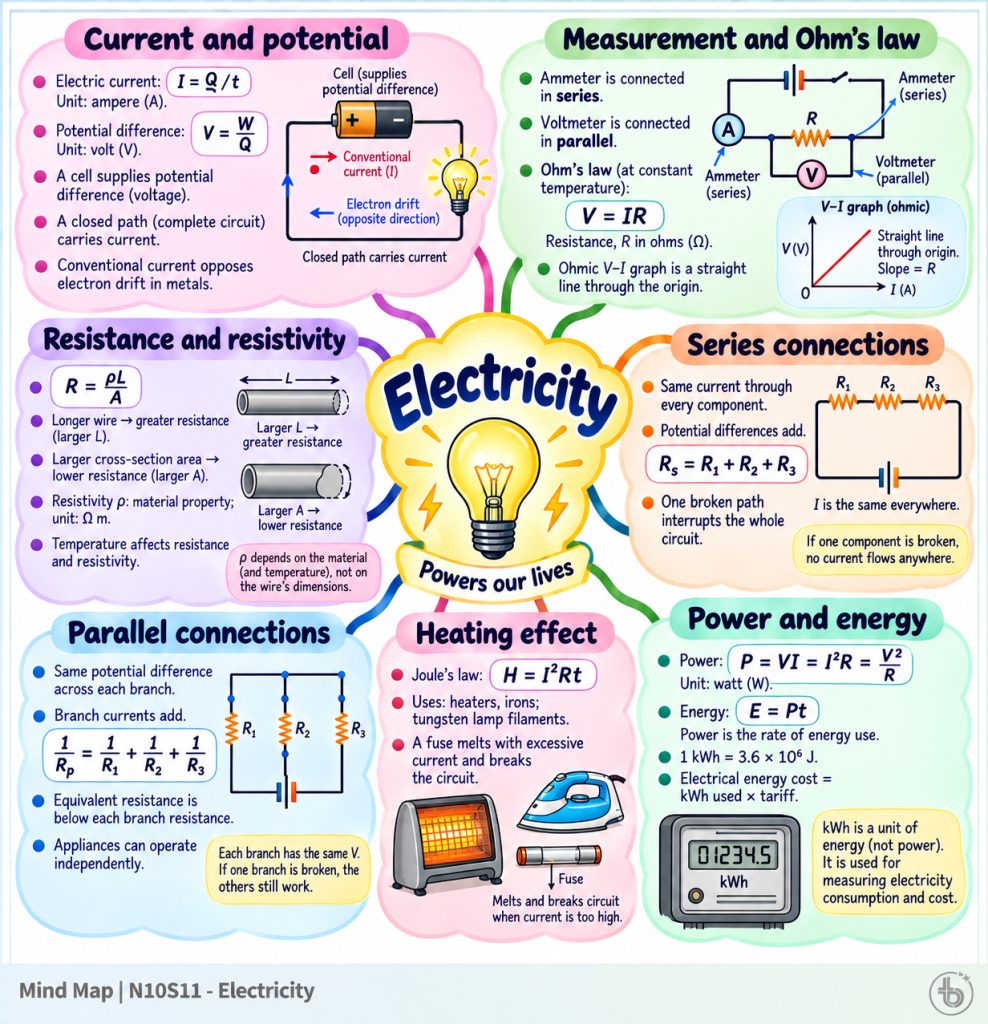
A Class 10 Science mind map connecting electrical quantities, circuits, resistance, heating, power and energy.
Link: https://myspace.teachbetter.ai/view/resource/7df8a9e2-74e4-427c-a998-e14a18dc1163
7. Sets: connecting operations with Venn reasoning
Class 11 Mathematics
The Sets—Operations and Venn Reasoning mind map connects union, intersection, difference, complement, De Morgan’s laws and the algebra of sets.
Its Venn diagrams make symbolic operations visible, while worked examples show how the same relationships appear in set notation. The map is particularly helpful for distinguishing operations that students may confuse, such as (A-B) and (B-A), or the complement of a union and the union of complements.
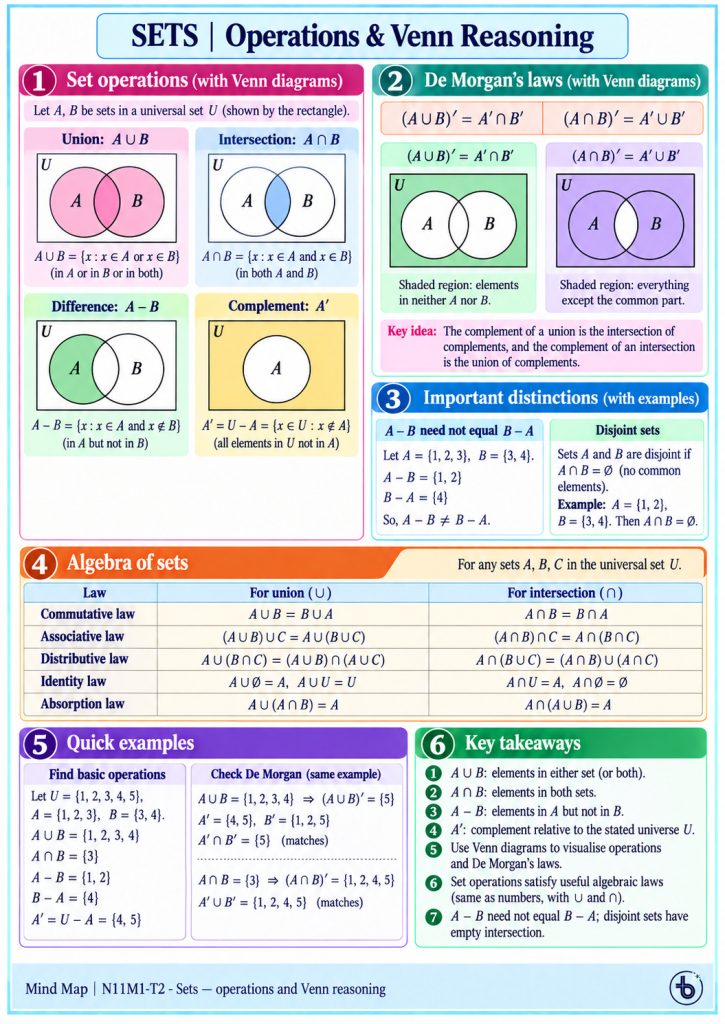
A Class 11 Mathematics mind map combining set operations, Venn diagrams, De Morgan’s laws and algebraic properties.
Link: https://myspace.teachbetter.ai/view/resource/de938595-417e-4205-9699-faf8cd750131
8. Newton’s Laws and Momentum: structuring advanced Physics reasoning
Class 11 Physics
The Newton’s Laws and Momentum mind map connects inertia, force, momentum, action and reaction, impulse, conservation of momentum, free-body diagrams and equilibrium.
It gives important distinctions a visible place. Action and reaction forces act on different objects, zero net force can mean constant velocity, and only a net external force changes the total momentum of a system. Teachers can use the map to classify problems before students select an equation or draw a free-body diagram.
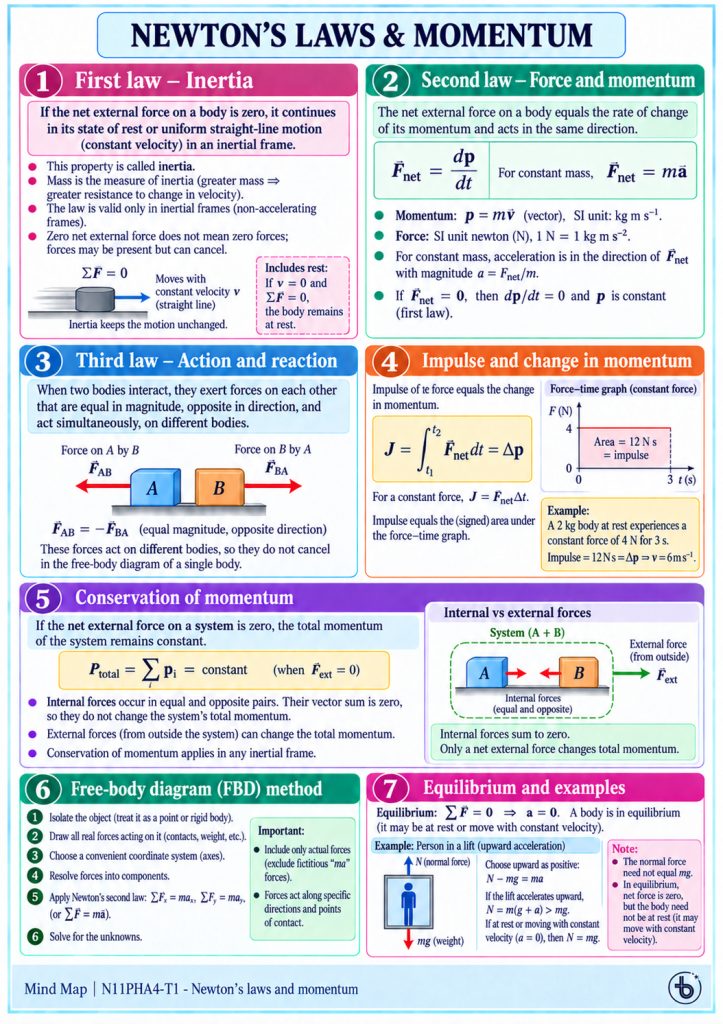
A Class 11 Physics mind map connecting Newton’s laws, momentum, impulse, conservation, free-body diagrams and equilibrium.
Link: https://myspace.teachbetter.ai/view/resource/fd05ff60-3005-48be-94e2-1035c4c94d40
How to choose the right mind map for a lesson
The most detailed map is not automatically the best map for every purpose.
A teacher introducing a new chapter may prefer a broad overview with clearly visible branches. A revision lesson may require a more comprehensive map containing formulas, conditions and comparisons. A younger class may benefit from a resource built around familiar illustrations, while an examination class may need greater conceptual density.
Before selecting a mind map, teachers should consider the learning objective, the students’ prior knowledge, the planned teaching activity and the amount of information students can reasonably process at that stage.
The map should also match the depth of the lesson. If only one part of the chapter is being taught, the teacher can focus on that branch rather than expecting students to process the entire visual.
How to use a mind map across the teaching cycle
Before the lesson: create orientation
Display the central topic and major branches before detailed instruction. Ask students what they recognise, what appears unfamiliar and how the branches might relate.
The purpose is not to teach the whole chapter immediately. It is to give students a map of the territory they are about to explore.
During the lesson: build understanding branch by branch
Focus on the branch relevant to the day’s lesson. Explain its details and then reconnect it with the central topic.
Teachers can annotate the visual, add classroom examples or ask students to predict what another branch might contain. This keeps the map active while preventing information overload.
After the lesson: consolidate relationships
Return to the complete map once the main content has been taught. Ask students to explain connections between branches and identify where examples, formulas or processes belong.
This shifts the discussion from recalling isolated facts to describing the organisation of the topic.
During revision: use the map for retrieval
Students can cover a branch, reconstruct it from memory, turn headings into questions or explain the map to a partner.
They can also mark branches according to confidence. This helps them make a more focused revision plan instead of repeatedly reading the entire chapter.
Before assessment: connect structure with practice
A mind map can identify the knowledge that needs to be reviewed, but students must still practise applying it.
After reviewing the map, they should attempt questions, diagrams, calculations, explanations or comparisons linked with its branches. The map organises revision; practice checks whether the knowledge can be used.
Practical classroom strategies
Teachers can vary how students interact with the same mind map.
A useful starting routine is orient, connect, elaborate, retrieve and apply. Students first identify the central topic and branches. They then explain a relationship, add an example, recall part of the map without looking and apply the relevant branch to a question or situation.
Other practical activities include:
- Removing one branch and asking students to reconstruct it
- Asking groups to explain different branches
- Turning branch headings into revision questions
- Adding misconceptions beside relevant concepts
- Comparing the mind map with textbook headings
- Creating a simplified student version
- Using the map to plan a short oral presentation
- Asking students to place new examples in the correct branch
The activity should match the lesson objective. Students should always know whether they are using the map to understand, compare, recall, explain or apply.
How to access and personalise Mind Map Studio
Mind Map Studio is designed to make visual-resource use straightforward.
- Sign in to TeachBetter.ai and open Mind Map Studio.
- Search for the required subject, chapter, topic or concept.
- Review the available matching mind maps and select the most appropriate resource.
- Personalise it with the school logo, school name and class details.
- Download the finished resource or share it digitally with students.
This process allows teachers to prepare a classroom-ready visual without designing the complete mind map themselves.
How TeachBetter.ai strengthens the use of mind maps
Mind maps are not a new teaching strategy. TeachBetter.ai’s contribution is to make rich, subject-specific educational maps easier to discover, personalise and connect with a wider teaching workflow.
Ready-to-use educational content
A generic mind-map tool usually gives the teacher a blank canvas. The teacher still needs to decide what to include, organise the content and create every branch.
Mind Map Studio provides completed educational resources with subject-specific concepts, diagrams, formulas, vocabulary and examples. Teachers can begin with an existing high-quality map and focus on how to use it.
Search instead of starting from zero
Teachers can search for a topic and explore matching resources. This makes mind maps more practical for everyday teaching, where preparation time is limited and resources must be relevant to the immediate lesson.
Personalisation for schools and classes
Adding the school logo, school name and class details turns the visual into a recognisable classroom resource.
This is useful for individual teachers and for schools creating shared revision materials across departments and grades.
Connection with the complete teaching journey
Mind Map Studio sits within a wider TeachBetter.ai teaching environment.
For a topic such as electricity, a teacher could use the mind map to organise the chapter, a Visual Concept Explainer to clarify a difficult relationship, Concepts in Real Life to show practical applications, an Interactive Simulation to let students explore variables and PaperQR to check understanding without requiring student devices.
TeachBetter.ai’s 20-plus AI tools can support the surrounding lesson plan, activities, questions, worksheets and presentations.
The mind map therefore becomes one part of a connected journey from explanation to exploration, application and assessment.
Mind maps and the wider visual-learning strategy
Mind Map Studio serves a specific purpose within TeachBetter.ai’s visual and interactive capabilities.
A mind map shows the structure of a topic and the relationships between ideas. A Visual Concept Explainer focuses closely on making a particular concept clear. Concepts in Real Life connects learning with everyday situations and practical applications. Interactive Simulations allow students to change variables, test predictions and observe outcomes.
These resources are complementary. A teacher does not need to use every format in every lesson. The choice depends on whether students need an overview, a focused explanation, real-world relevance or an opportunity to explore interactively.
Responsible and effective use
A mind map should support teacher explanation, not replace teacher judgement.
Teachers should check that the resource matches the grade, topic and intended depth. Dense maps should be introduced gradually. Unfamiliar vocabulary and symbols should be explained. Students should receive a task or question so they engage with the map actively.
When sharing digitally, teachers should use readable versions and include descriptive alt text where possible. Printed resources should be large enough for formulas, labels and diagrams to remain clear.
Most importantly, students should continue to encounter detailed explanations, examples, activities, practice and feedback. A mind map organises learning; it does not replace the complete learning process.
Frequently asked questions
What is Mind Map Studio on TeachBetter.ai?
Mind Map Studio is a TeachBetter.ai capability that gives educators access to a ready-to-use collection of educational mind maps across K–12 subjects and topics. Teachers can search for a resource, personalise it and download or share it.
How are educational mind maps different from ordinary notes?
Notes normally present information in a sequence. Mind maps organise information spatially around a central topic, making the main branches and relationships visible. The two formats work well together.
Can mind maps be used before teaching a topic?
Yes. A teacher can use the central topic and major branches to provide an overview, activate prior knowledge and introduce the questions that the chapter will answer.
Can students use mind maps for revision?
Yes. Students can use them to identify the chapter structure, generate questions, explain relationships, retrieve covered information and locate areas requiring more practice.
Are mind maps useful for secondary and senior-secondary students?
Yes. More advanced maps can include equations, graphs, diagrams, conditions, misconceptions and formal relationships. The Electricity, Sets and Newton’s Laws examples demonstrate this level of use.
Can TeachBetter.ai mind maps be personalised?
Teachers can personalise visual resources with their school logo, school name and class details before downloading or sharing them.
Which subjects are covered?
The collection spans areas including Mathematics, EVS, Science, Social Science, Physics, Chemistry, Biology, History, Geography, Economics, Political Science, Psychology, Sociology, Computing, Artificial Intelligence and Computational Thinking.
Do mind maps replace textbooks or teacher explanations?
No. Mind maps provide structure and overview. Textbooks, explanations, worked examples, activities, practice and feedback provide the required depth.
Bring the complete topic into view
Covering every page of a chapter does not automatically mean students understand how the ideas fit together.
They need opportunities to see the central concept, follow its branches, compare related ideas and connect details with the whole. Mind maps provide a visible structure for that work. Mind Maps for Teaching and Revision.
TeachBetter.ai’s Mind Map Studio makes this approach practical. Teachers can search a broad collection of well-designed educational mind maps, select a resource suited to the lesson, personalise it for their school and class, and use it throughout teaching and revision.
From a Class 3 visit to a mela to Class 11 set operations and momentum, the level of complexity changes. The underlying purpose remains consistent: help students see the big picture, understand the relationships and approach learning with greater structure.
Bring concepts to life. Empower teachers to explain. Inspire students to explore.
Explore Mind Map Studio on TeachBetter.ai and bring your next topic together in one powerful visual.

Binit Agarwalla, Founder, TeachBetter.ai
With over 15 years of seasoned expertise, Binit is a results-driven marketing leader specializing in B2B SaaS and B2C growth strategy - now channeling that experience into transforming education through TeachBetter.ai, an all-in-one AI platform built exclusively for teachers, students, and schools.
As the Founder of TeachBetter.ai, his mission is to simplify teaching and amplify learning by empowering educators with AI-driven tools that save time, enhance creativity, and make classrooms more engaging. TeachBetter.ai's vision is to make AI adoption in education simple, accessible, and affordable - helping every teacher leverage the power of AI without complexity or high cost.
Read other articles authored by Binit Agarwalla here.