CBSE AI & Computational Thinking Curriculum 2026–27: A Complete Guide for Schools, Teachers & the Future of Learning in India
Binit Agarwalla
|
 13 April, 2026
The CBSE AI Curriculum 2026 marks a major shift in how education is designed and delivered in India. With the introduction of Artificial Intelligence (AI) and Computational Thinking (CT) across Classes 3 to 8, CBSE is redefining how students learn, think, and apply knowledge in real-world contexts.
If you are trying to understand the CBSE AI curriculum 2026, its impact on schools, and how computational thinking will be implemented in classrooms, this guide provides a clear and structured explanation. It not only decodes the framework but also helps educators and school leaders understand how to adapt to this shift effectively.
For decades, classrooms have largely focused on structured syllabi, standardized teaching methods, and memory-based assessments. However, the demands of the modern world—driven by rapid technological advancement, automation, and complex problem-solving—require a fundamentally different approach to learning. The rise of AI in school education in India is accelerating this need, making it essential for students to develop analytical thinking, adaptability, and decision-making skills from an early stage.
CBSE’s new framework directly responds to this need by embedding these competencies into the foundation of school education. It shifts the focus from theoretical learning to application, reasoning, and real-world relevance—ensuring that students are better prepared for future academic and professional environments.
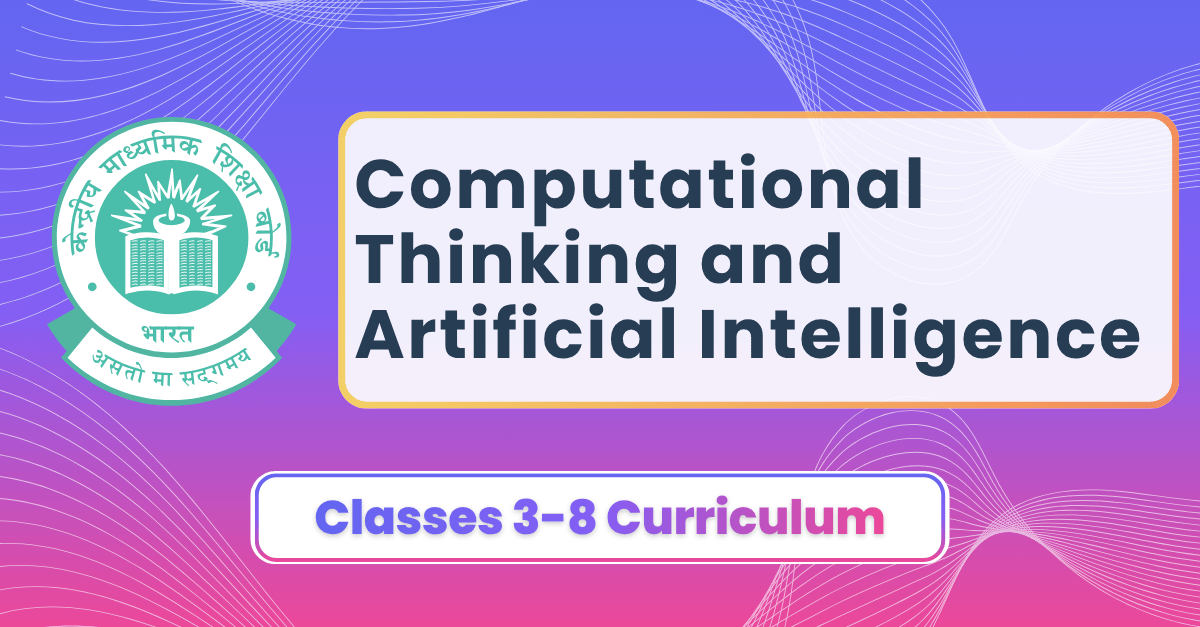
If you are searching for the official CBSE AI curriculum PDF (2026–27), you can access it here: Computational Thinking and Artificial Intelligence | Classes 3-8 Curriculum
This blog provides a comprehensive breakdown of the CBSE framework, decoding what it actually means for schools and teachers on the ground. More importantly, it connects these changes to real classroom execution and explains how platforms like TeachBetter.ai are emerging as critical enablers in translating this vision into practice.
What Is the CBSE AI & Computational Thinking Curriculum?
The CBSE AI curriculum 2026 introduces a structured approach to building thinking skills across subjects. Unlike traditional subjects that operate independently, this framework is designed to be deeply integrated across disciplines, making learning more interconnected, contextual, and relevant.
At its core, the curriculum focuses on enabling students to approach problems logically, identify patterns, and apply structured thinking to real-world scenarios. Instead of limiting learning to theoretical knowledge, it encourages active engagement, exploration, and practical application of concepts.
This approach reflects a broader shift in global education, where the emphasis is increasingly on critical thinking, computational reasoning, and applied learning, rather than rote memorization.
The framework emphasizes the following key competencies:
- Problem-solving and logical reasoning
- Pattern recognition and abstraction
- Real-world application of concepts
- Project-based and experiential learning
This marks a fundamental shift—from teaching students what to learn, to enabling them to think independently, solve problems effectively, and apply knowledge across real-life contexts.
Key Highlights from the CBSE AI Curriculum (Detailed Breakdown)
1. AI as a Foundational Skill, Not a Subject
One of the most important aspects of the CBSE AI curriculum is its positioning of AI and Computational Thinking as foundational cognitive skills rather than standalone subjects. This means AI is not treated as an additional topic but as an underlying layer that influences how all subjects are taught and understood.
In practice, this transforms the learning experience for students. Instead of passively receiving information, they are encouraged to question, analyze, and apply knowledge across contexts. Mathematics becomes a tool for structured reasoning, science becomes a platform for inquiry and experimentation, and language becomes a medium for expressing logical thought.
For schools, this requires a fundamental redesign of lesson delivery. Teaching must move beyond content coverage to creating learning experiences that emphasize thinking, connections, and application.
What this shift enables in classrooms:
- Early development of analytical and critical thinking skills
- Seamless integration of concepts across subjects
- Stronger focus on real-world relevance and problem-solving
This ensures that students are not only academically competent but also equipped with skills that extend beyond the classroom.
2. Structured Learning Progression: CT → AI → Application
The CBSE framework follows a carefully designed progression that aligns with how students develop cognitive abilities over time. In Classes 3–5, the emphasis is on building foundational Computational Thinking skills through puzzles, logic-based exercises, and structured activities. As students progress to Classes 6–8, they are gradually introduced to AI concepts, data handling, and project-based applications.
This staged approach ensures that students first learn how to think systematically before engaging with more advanced concepts. It avoids superficial exposure to AI and instead builds a strong conceptual foundation.
However, implementing this progression in classrooms requires thoughtful planning and consistency. Teachers must ensure that learning evolves logically across grades, concepts are introduced at the right level of complexity, and abstract ideas are translated into engaging classroom experiences.
What this progression requires from educators:
- Designing structured and continuous learning pathways
- Creating activities that progressively build logical reasoning
- Connecting foundational concepts to real-world applications
While the curriculum design is robust, its effectiveness depends heavily on how well it is executed in everyday teaching.
3. Pedagogical Shift: From Teaching to Experiential Learning
The CBSE AI curriculum promotes a clear shift from traditional teaching methods to experiential and activity-based learning. This is a significant transformation in how classrooms operate.
Instead of relying primarily on lectures and textbooks, teachers are now expected to create environments where students actively engage with concepts through activities, projects, and discussions. Learning becomes more interactive, collaborative, and application-driven.
This approach significantly improves student engagement and retention. When students learn through experience, they develop a deeper understanding and are better able to apply knowledge in new situations.
This shift is a core part of the CBSE AI curriculum 2026, which emphasizes experiential learning. Designing meaningful activities, sourcing relevant examples, and ensuring alignment with learning objectives requires additional effort and planning.
What experiential learning requires:
- Activity-driven lesson design
- Contextual and real-world examples
- Interactive, student-centered classroom environments
While the benefits are substantial, sustaining this approach consistently requires structured support and efficient tools.
4. Assessment Transformation: From Recall to Application
Assessment changes under the CBSE AI curriculum 2026 focus on application and understanding. CBSE’s transformation of assessment methods represents a major shift in how student learning is evaluated. The focus is moving away from memory-based exams toward assessment models that measure understanding, application, and critical thinking.
Students are now evaluated through projects, practical assignments, and reflective exercises that require them to apply their knowledge in meaningful ways. This creates a more accurate and holistic picture of their learning progress.
For teachers, however, this introduces additional challenges. Designing effective assessments, evaluating open-ended responses, and providing personalized feedback require significantly more time and effort compared to traditional testing methods.
Key changes in assessment approach include:
- Increased emphasis on application-based evaluation
- Continuous and formative assessment methods
- Greater focus on qualitative feedback and student development
This shift improves learning outcomes but also increases the need for efficient systems to manage the evaluation process.
5. Redefining the Role of Teachers
The CBSE AI curriculum 2026 significantly redefines the role of teachers in classrooms. The CBSE framework redefines teachers as facilitators, mentors, and designers of learning experiences. This marks a shift from content delivery to guided learning, where teachers support students in exploring, understanding, and applying concepts independently.
In this evolving role, teachers are expected to manage diverse learning needs, design engaging classroom experiences, and support individualized learning journeys. This requires not only subject expertise but also strong instructional design and classroom management skills.
However, this expanded role comes with increased expectations and workload. Without the right support systems, teachers may find it difficult to balance lesson planning, teaching, assessment, and administrative responsibilities effectively.
What teachers now need to succeed:
- Tools for efficient lesson and activity creation
- Structured support for curriculum planning
- Assistance in assessment design and evaluation
Empowering teachers with the right resources is essential for the successful implementation of the CBSE AI curriculum.
6. Open Ecosystem: No Platform Dependency
A key strength of the CBSE framework is its flexibility. Schools are not restricted to specific platforms or tools, allowing them to adopt solutions that best suit their teaching environment and operational needs.
This open ecosystem encourages innovation and ensures that adoption is driven by value rather than compliance. Schools can choose tools that genuinely improve teaching efficiency and learning outcomes.
For the broader education ecosystem, this creates a competitive environment where platforms must demonstrate real impact in classrooms.
What this open approach enables:
- Flexibility in selecting tools and solutions
- Encouragement of innovation in education technology
- Focus on practical implementation and measurable outcomes
This makes execution capability the defining factor in successfully adopting the CBSE AI curriculum.
Execution Challenges in CBSE AI Curriculum 2026 Implementation
While the CBSE AI curriculum 2026 is progressive and forward-looking, its real challenge lies not in design but in execution. Translating this vision into consistent classroom practice requires a significant shift in how teaching is planned, delivered, and evaluated. What appears structured and logical at a policy level often becomes complex and demanding when implemented in day-to-day school environments. Implementing the CBSE AI curriculum 2026 at scale requires structured tools and workflows.
The transition from traditional teaching methods to activity-based, interdisciplinary, and application-driven learning introduces a new layer of operational complexity. Teachers no longer just deliver content—they now design learning experiences, create real-world problem scenarios, assess open-ended responses, and ensure alignment with evolving curriculum objectives.
This is not merely a pedagogical shift; it is a systemic transformation that demands new workflows, tools, and support systems.
Key execution challenges schools are likely to face include:
- Increased teacher workload due to planning, content creation, and activity design
- Lack of structured tools for implementing computational thinking and AI concepts
- Difficulty in consistently creating high-quality activities and projects
- Time-intensive assessment, evaluation, and feedback processes
- Ongoing need for curriculum-aligned and context-relevant teaching resources
Without the right infrastructure, these challenges can quickly lead to teacher fatigue, inconsistent implementation across classrooms, and ultimately, reduced impact on student learning outcomes. This is where the gap between curriculum intent and classroom reality becomes most evident.
How TeachBetter.ai Aligns Perfectly with CBSE’s Vision
The CBSE framework clearly defines what needs to change in education, but it does not prescribe how to implement it effectively at scale. This is where TeachBetter.ai becomes highly relevant.
TeachBetter.ai is not a generic AI tool; it is a purpose-built platform for educators that helps them operationalize the CBSE AI and Computational Thinking curriculum in real classroom settings. It acts as a structured execution layer that simplifies planning, content creation, and assessment—making the transition practical and sustainable.
By aligning closely with classroom workflows, the platform enables teachers to generate, customize, and deploy curriculum-aligned resources efficiently. Every output—whether it is a lesson plan, activity, or assessment—is designed to be immediately usable, editable, and relevant to the teaching context.
More importantly, it addresses the core challenge schools face today: How to implement the CBSE AI curriculum without increasing teacher workload
1. Enabling Experiential & Activity-Based Learning
One of the central pillars of the CBSE framework is experiential learning. However, consistently designing meaningful activities and projects for every lesson can be time-consuming and difficult to sustain.
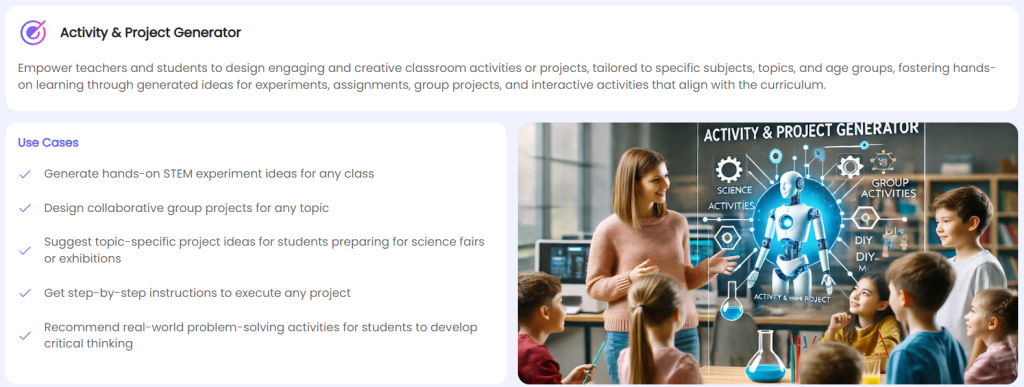
TeachBetter.ai simplifies this process by enabling teachers to generate structured, curriculum-aligned activities and project ideas instantly. This allows educators to focus on facilitating learning rather than spending hours preparing for it.
How TeachBetter.ai supports experiential learning:
- Instantly generates activity and project ideas aligned with topics and grade levels
- Provides real-world examples to make concepts more relatable
- Enables creation of engaging, application-based classroom experiences
This transforms experiential learning from a high-effort initiative into a scalable and repeatable teaching approach.
2. Simplifying Lesson Planning Aligned with CT & AI
The CBSE AI curriculum requires lesson plans to be more structured, interconnected, and outcome-driven. Teachers must ensure that each session contributes to developing computational thinking and prepares students for higher-level application.
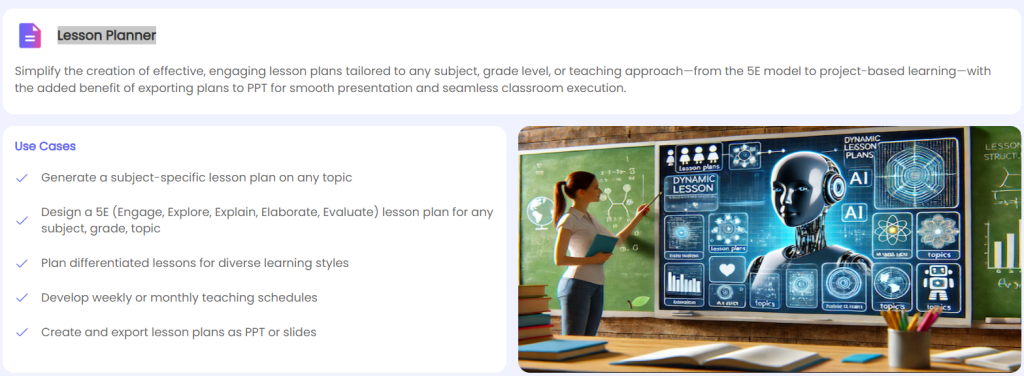
TeachBetter.ai’s AI-powered Lesson Planner addresses this complexity by generating comprehensive lesson structures based on curriculum inputs. It automatically aligns objectives, suggests activities, and ensures that lessons follow a logical progression.
Key capabilities that enhance lesson planning:
- Curriculum-aligned lesson plan generation
- Automatic mapping of learning objectives and outcomes
- Structured session flow with integrated activities and examples
This ensures not only efficiency but also consistency and quality across classrooms, regardless of teacher experience levels.
3. Supporting the Shift to Concept-Based Teaching
As the CBSE curriculum moves toward deeper conceptual understanding, teachers are required to explain topics in a way that is both simple and relatable. This can be particularly challenging when dealing with abstract or complex concepts.
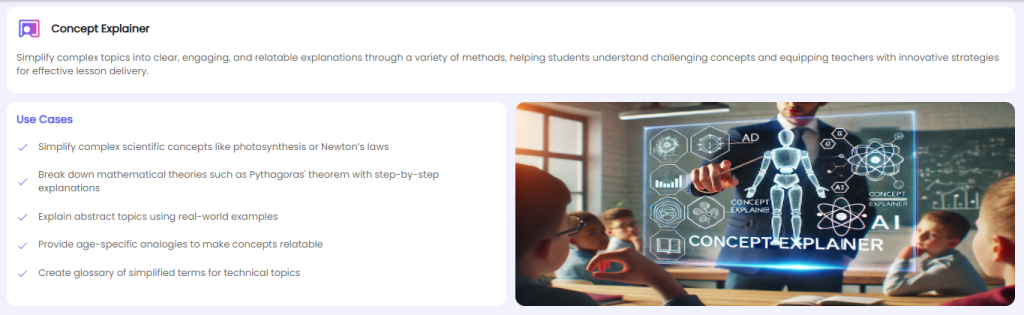
TeachBetter.ai supports this shift by generating explanations tailored to grade level and learning context. It incorporates real-life examples and simplified narratives, helping teachers make concepts easier to understand and more engaging for students.
How the platform strengthens concept-based teaching:
- Delivers age-appropriate explanations of complex topics
- Integrates real-world examples to improve clarity
- Adapts content to different learning levels within the classroom
This enables teachers to deliver high-quality conceptual learning without additional preparation effort, improving both comprehension and retention.
4. Transforming Assessment & Evaluation
The move toward application-based and continuous assessment significantly increases the complexity of evaluation for teachers. Designing meaningful questions, evaluating subjective answers, and providing personalized feedback can be extremely time-intensive.
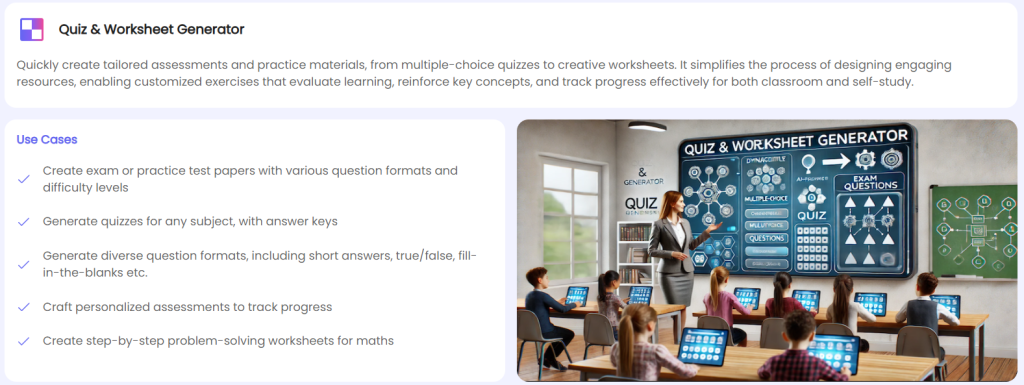
TeachBetter.ai streamlines this entire process by enabling teachers to create structured assessments aligned with learning objectives. It also supports feedback generation, making evaluation more efficient and scalable.
How TeachBetter.ai supports modern assessment:
- Generates application-based quizzes and worksheets
- Provides structured formats for evaluation
- Enables personalized feedback and reporting
This ensures that assessment remains effective, consistent, and manageable, even in larger classrooms. AI-driven assessment tools for teachers can significantly simplify evaluation and feedback processes.
5. Reducing Teacher Workload at Scale
One of the most critical challenges in implementing the CBSE AI curriculum is the increased workload on teachers. Planning lessons, creating resources, and managing assessments can quickly become overwhelming without the right tools.
TeachBetter.ai is built specifically to address this challenge. By automating repetitive tasks and enabling instant content generation, it significantly reduces the time required for preparation and evaluation.
Key ways the platform reduces workload:
- Automates lesson planning and teaching resource creation
- Provides ready-to-use, editable content
- Eliminates repetitive manual effort in content development
This allows teachers to focus on what truly matters—student engagement, mentoring, and improving learning outcomes.
6. Acting as the Operational Layer for AI in Education
While CBSE provides the vision for integrating AI into education, successful implementation requires a system that connects all aspects of teaching into a unified workflow.
TeachBetter.ai fulfills this role by acting as an operational layer for AI in school education. It integrates lesson planning, content creation, assessment design, and student support into a single ecosystem, eliminating fragmentation and inefficiencies.
What this integrated approach enables:
- Seamless workflow from lesson planning to evaluation
- Consistency in teaching practices across classrooms
- Scalable implementation across schools and institutions
This positions TeachBetter.ai not just as a tool, but as a core infrastructure layer for modern, AI-enabled education systems.
TeachBetter.ai Alignment with CBSE Curriculum Initiatives
| CBSE Initiative / Requirement | What It Means in Classrooms | How TeachBetter.ai Solves It |
|---|---|---|
| AI as a Foundational Skill | AI and computational thinking must be integrated across subjects, not taught in isolation | Enables cross-subject lesson planning with AI-generated content, examples, and activities aligned to different subjects |
| CT → AI → Application Progression | Structured learning journey from logic-building to real-world problem-solving | AI Lesson Planner creates progressive, level-based lesson flows aligned with grade and learning stage |
| Experiential & Activity-Based Learning | Teachers must design activities, projects, and real-world learning experiences regularly | Activity & Project Generator creates ready-to-use, curriculum-aligned activities instantly |
| Interdisciplinary Teaching | Subjects need to be connected through real-world scenarios and integrated learning | Generates contextual examples and content that link multiple subjects seamlessly |
| Concept-Based Learning | Focus shifts from memorization to deep understanding and application | Concept Explainer simplifies complex topics with real-life examples and multi-level explanations |
| Application-Based Assessment | Students evaluated through projects, reflection, and practical application | Quiz & Worksheet Generator creates application-focused questions aligned with learning objectives |
| Continuous & Personalized Evaluation | Teachers must provide ongoing feedback and track student progress | Personalized Report Generator supports structured feedback and evaluation at scale |
| Teacher as Facilitator & Mentor | Teachers guide learning rather than deliver content, increasing their workload | Automates planning and content creation, allowing teachers to focus on student engagement |
| Open Ecosystem (No Platform Lock-in) | Schools can choose tools that best support implementation | TeachBetter.ai integrates seamlessly into existing workflows without dependency or complexity |
| Scalable Implementation Across Classrooms | Schools need consistency in quality and delivery across teachers and grades | Provides standardized, editable, and reusable content for consistent teaching practices |
Why TeachBetter.ai Is the Ultimate Solution for CBSE’s AI Curriculum
In an open ecosystem where schools are free to choose their tools, the deciding factor is not availability—but effectiveness. TeachBetter.ai stands out because it is purpose-built for education and directly aligned with the needs of teachers implementing the CBSE AI curriculum.
Unlike generic AI platforms that require adaptation and technical expertise, TeachBetter.ai is designed specifically for classroom use. It understands the realities of teaching and delivers outputs that are practical, relevant, and immediately usable.
What differentiates TeachBetter.ai:
- Built specifically for educators and school environments
- Fully aligned with CBSE curriculum requirements
- Designed for ease of use without technical complexity
- Focused on reducing effort while improving outcomes
It effectively bridges the most critical gap in education today: The gap between curriculum design and classroom execution
Conclusion: The Future of Education Is Already Here
The CBSE AI and Computational Thinking curriculum marks a defining shift in Indian education—one that prioritizes thinking over memorization, application over theory, and engagement over passive learning.
However, the success of this transformation depends entirely on execution. Schools need the right systems, teachers need the right tools, and the ecosystem needs solutions that make this transition practical, scalable, and sustainable.
TeachBetter.ai is built precisely for this moment. It empowers educators to implement the CBSE AI curriculum with confidence, reduce operational complexity, and deliver meaningful learning experiences at scale.
Ready to Implement the CBSE AI Curriculum in Your School?
If your school is planning to adopt the CBSE AI curriculum, the next step is not just understanding the framework—but enabling your teachers to execute it effectively.
Explore TeachBetter.ai and discover how it can simplify lesson planning, streamline assessments, and transform classroom learning.

Binit Agarwalla, Founder, TeachBetter.ai
With over 15 years of seasoned expertise, Binit is a results-driven marketing leader specializing in B2B SaaS and B2C growth strategy - now channeling that experience into transforming education through TeachBetter.ai, an all-in-one AI platform built exclusively for teachers, students, and schools.
As the Founder of TeachBetter.ai, his mission is to simplify teaching and amplify learning by empowering educators with AI-driven tools that save time, enhance creativity, and make classrooms more engaging. TeachBetter.ai's vision is to make AI adoption in education simple, accessible, and affordable - helping every teacher leverage the power of AI without complexity or high cost.
Read other articles authored by Binit Agarwalla here.