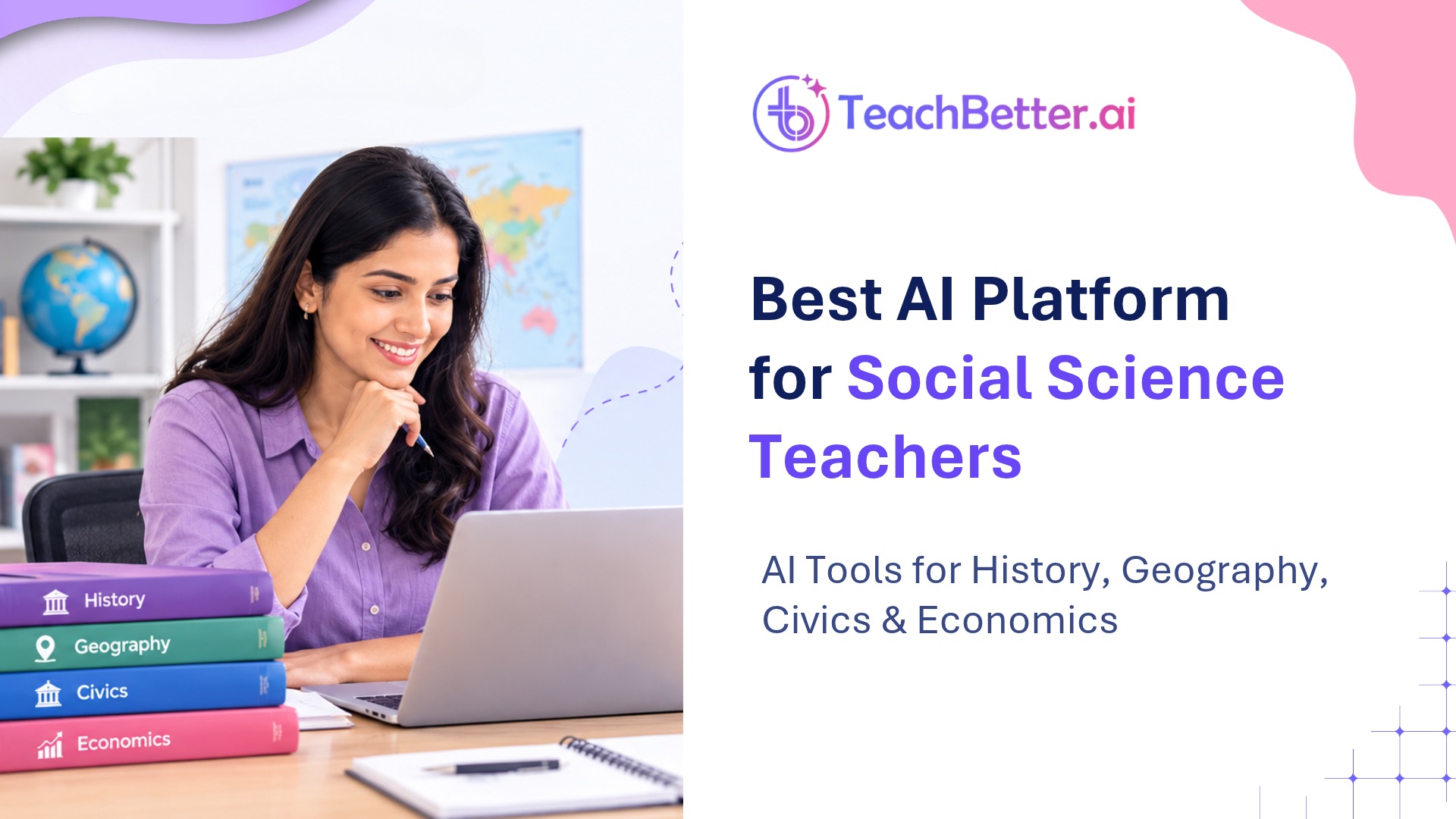
Best AI Platform for Social Science Teachers: AI Tools for History, Geography, Civics & Economics
Binit Agarwalla
|
 27 October, 2026
The Best AI Platform for Social Science Teachers
Teaching Social Science is about much more than helping students remember dates, definitions, places, laws, or economic terms. Instead, it encourages students to understand the world around them. For example, they can explore historical events, examine environmental challenges, understand civic responsibilities, and connect economic concepts to everyday life.
More importantly, the real challenge is helping students understand why events happened, how societies changed, how places influence people, how governments function, and how economic decisions affect everyday life. Therefore, effective Social Science teaching should encourage critical thinking, meaningful discussions, and real-world connections.
Yet Social Science classrooms can easily become textbook-driven. Teachers may have to spend significant time preparing lesson plans, creating worksheets, developing quizzes, designing activities, finding examples, preparing presentations and adapting resources for students with different learning needs.
This is where artificial intelligence can become a practical teaching assistant.
The best AI platform for Social Science teachers is not simply one that generates text. A useful education-focused AI platform should help teachers move smoothly from lesson planning to classroom delivery and assessment. Additionally, it should keep learning contextual, interactive, and appropriate for students. As a result,teachers can create more meaningful learning experiences while supporting students’ understanding and engagement.
TeachBetter.ai is designed around this approach. Its AI-powered teaching suite includes tools for lesson planning, concept explanation, activity and project creation, quizzes and worksheets, presentations, creative resources, document analysis and personalized learning support. Moreover, its comprehensive platform is designed to meet the diverse needs of educators, schools, parents, and students.
For a Social Science teacher, that can translate into a much more efficient workflow: plan the lesson, explain the concept, create learning activities, assess understanding and provide follow-up resources—all with AI assistance.
Why Social Science Teachers Can Benefit from AI
Social Science covers a remarkably broad range of concepts.
For instance, a History teacher may explain the causes of the French Revolution and explore its lasting consequences for society.To make the topic clearer, AI can help organize key events, simplify complex ideas, and create engaging classroom activities. A Geography teacher may need to make climate patterns easier to visualize. A Civics teacher may want students to understand the relationship between rights and responsibilities. An Economics teacher may need to connect inflation or supply and demand with situations students encounter in daily life.
These subjects also require different forms of learning.
Students may need to:
- Understand chronology and cause-and-effect relationships
- Interpret maps, graphs, charts and other visual information
- Compare historical events or political systems
- Analyse primary and secondary sources
- Discuss different perspectives
- Apply concepts to real-world situations
- Construct arguments using evidence
- Write structured answers
- Participate in projects and group activities
Preparing all of this manually can take considerable time.
AI can help teachers create the first version of these resources quickly. More importantly, an education-focused platform can help teachers adapt those resources to the grade level, topic, learning objective and classroom context.
TeachBetter.ai's platform documentation describes tools for lesson planning, concept explanation, activities, projects, quizzes, worksheets, creative resources, presentations and personalized reports, among other educational functions.
The teacher remains responsible for reviewing and refining the material, but AI can reduce the amount of repetitive preparation involved.
What Should You Look for in AI Tools for Social Science Teachers?
Not every AI tool is equally useful for classroom teaching.
A general-purpose chatbot may be able to answer questions or generate paragraphs, but Social Science teachers often need something more structured.
When evaluating AI tools for Social Science teachers, consider whether the platform can support the following:
1. Lesson planning: The platform should help turn a topic and learning objective into a structured lesson rather than simply producing a block of text.
2. Real-world connections: Social Science becomes more meaningful when students can connect classroom concepts to events, communities, institutions and everyday experiences.
3. Multiple learning formats: Teachers should be able to create explanations, activities, worksheets, quizzes, projects and presentations rather than relying on one output format.
4. Different levels of difficulty: A Grade 5 explanation of democracy should not look like a Grade 10 explanation. AI should help teachers adapt content to student age and learning level.
5. Assessment support: A useful platform should help teachers check whether students have understood a concept, not simply help them create teaching material.
6. Teacher control: AI-generated content should be something teachers can review, edit, refine and adapt before using it in class.
These capabilities are particularly valuable for Social Science because the subject often requires explanation, interpretation, discussion and application, rather than memorization alone.
How AI Can Transform Social Science Teaching
1. Simplifying Lesson Planning
Explain how AI helps teachers organize learning objectives, lesson content, and classroom activities.
Making Complex Concepts Easier to Understand: Describe how AI can simplify topics in History, Geography, Civics, and Economics using age-appropriate explanations.
Creating Engaging Classroom Activities: Discuss how teachers can develop discussions, projects, case studies, and real-world learning activities.
Improving Assessment and Practice: Explain how AI can generate worksheets, quizzes, and questions to assess student understanding.
Adapting Content to Different Learning Needs: Show how teachers can modify explanations and activities to suit different learning levels and abilities.
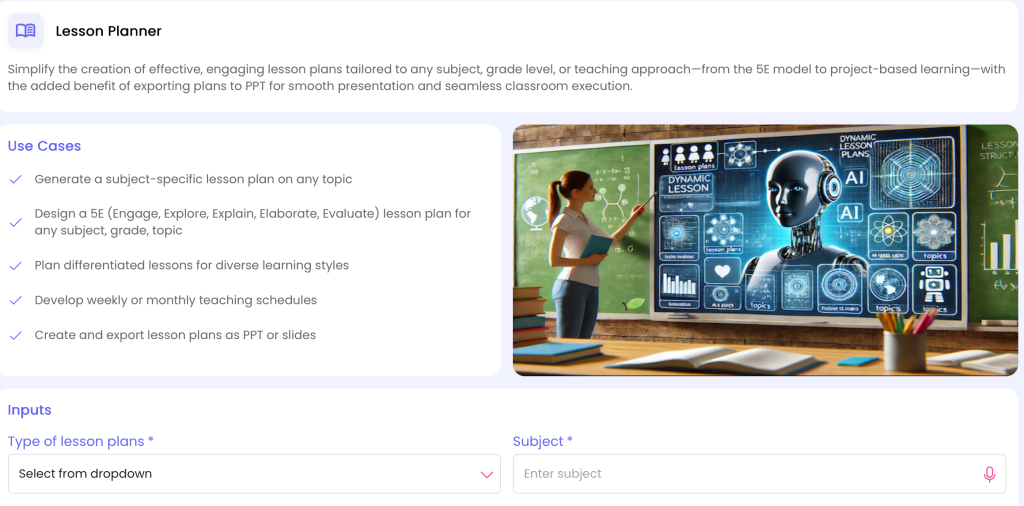
Lesson Plan: https://myspace.teachbetter.ai/view/resource/ec816c4b-be88-4b08-8c7a-be1891c52fec
2. Explain Difficult Social Science Concepts at the Right Level
Some Social Science concepts are difficult because they are abstract.
Terms such as federalism, separation of powers, opportunity cost, urbanization, colonialism, inflation or demographic transition can be difficult for students to understand through textbook definitions alone.
An AI concept explainer can help teachers create explanations appropriate to the age and background of their students.
For example, a Civics teacher introducing separation of powers could request:
- A simple explanation
- A classroom analogy
- A real-world example
- Three questions for discussion
- A short assessment
TeachBetter.ai's Concept Explainer is documented as generating explanations tailored to grade and age level, including real-life examples.
This approach can shift the classroom from:
Definition → Memorization
toward:
Concept → Example → Discussion → Application → Understanding
That distinction matters particularly in Social Science, where students need to understand relationships between ideas rather than simply recall terminology.
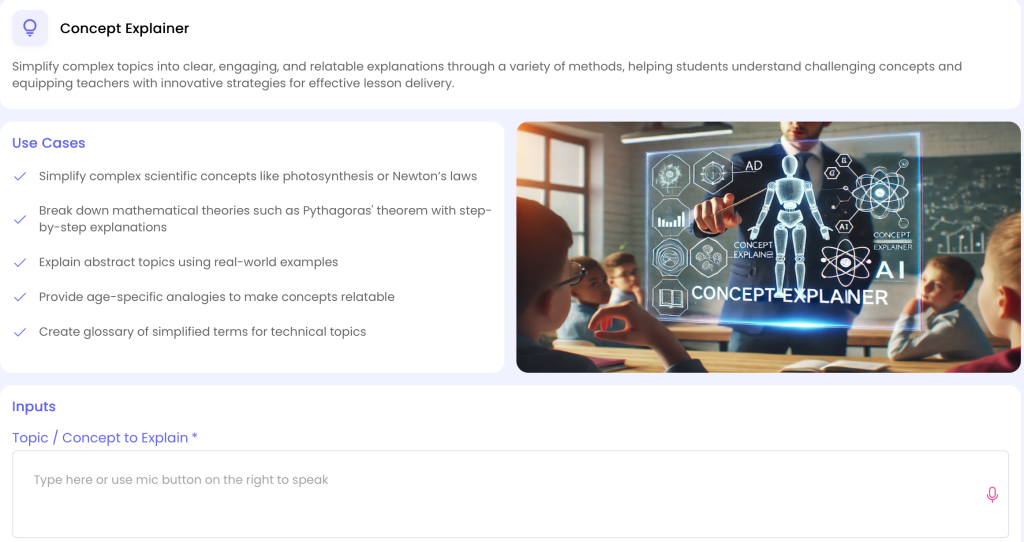
Concept Explain: https://myspace.teachbetter.ai/view/resource/24a47683-d6e3-4574-be0b-06cd125c9c17
AI for History Teachers
History teaching becomes stronger when students understand causes, consequences, chronology, perspectives and connections.
AI can support teachers across each of these areas.
Build Cause-and-Effect Activities
Consider a lesson on the French Revolution.
Rather than giving students a conventional worksheet containing factual questions, a teacher could create an activity asking students to classify different factors as:
- Economic
- Political
- Social
- Intellectual
Students could then discuss which factors contributed to the revolution and how the factors were interconnected.
An Activity & Project Generator can help teachers develop classroom activities around a topic, grade level and desired activity format. TeachBetter.ai's documented platform scope includes activity and project generation as a core teaching capability.
Create Historical Debates
AI can also help generate discussion prompts.
For example:
Topic: Indian Independence Movement
Students could be asked to examine different perspectives on:
- Methods of resistance
- Political negotiations
- Mass movements
- Economic effects of colonial rule
- The role of different leaders and groups
The teacher can then select and refine the prompts to suit the class.
The goal is not to let AI decide the historical interpretation. The goal is to give the teacher more material with which to facilitate evidence-based discussion.
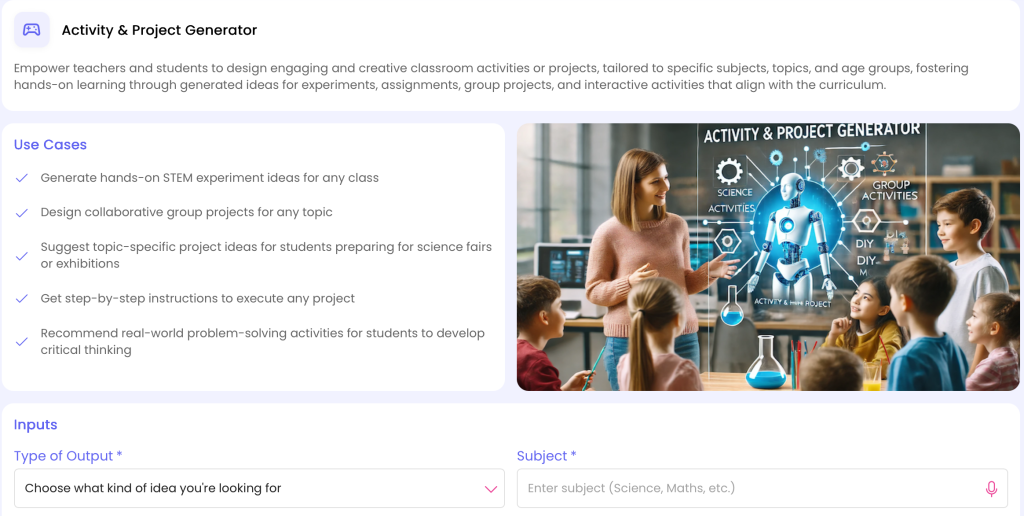
Activity and Project Generate: https://myspace.teachbetter.ai/view/resource/2d1c80ee-0437-4da9-83d4-d2dca580711c
AI for Geography Teachers
Geography often requires students to connect physical processes, human activity and spatial patterns.
AI can help teachers turn these relationships into classroom activities.
Imagine teaching urbanization.
Instead of limiting the lesson to a definition, a teacher could create a scenario:
A rapidly growing city is facing traffic congestion, housing shortages, pressure on water resources and increasing waste. What decisions should the city government make?
Students could then work in groups to identify:
- The causes of urban growth
- The problems created by rapid urbanization
- Possible solutions
- Trade-offs associated with each solution
This type of scenario helps students apply geographical concepts to a realistic situation.
AI can help teachers generate multiple versions of such activities for different grade levels and learning objectives.
Turn Geography Content Into Projects
Geography is particularly suitable for project-based learning.
Teachers can use AI to generate project frameworks around topics such as:
- Climate change
- Water conservation
- Population distribution
- Natural resources
- Agriculture
- Urban planning
- Migration
- Disaster management
A project could ask students to investigate a local environmental issue, gather information, analyse causes and propose solutions.
The teacher can use AI to prepare the project brief, research questions, assessment criteria and reflection questions while retaining control over what students ultimately investigate.
AI for Civics Teachers
Civics involves concepts that students often encounter in everyday life but may struggle to connect with formal definitions.
Consider fundamental rights.
Instead of simply asking students to memorize constitutional provisions, a teacher could present hypothetical situations and ask:
- Which right is involved?
- What conflict exists?
- What should happen?
- What evidence supports your answer?
AI can help generate multiple scenarios at different levels of difficulty.
Similarly, a lesson on democracy could include:
- A short introductory explanation
- A mock election activity
- Discussion questions
- A comparison exercise
- A reflection worksheet
- A short quiz
This gives teachers multiple ways to approach the same concept.
For Civics especially, AI-generated scenarios should be reviewed carefully by teachers to ensure that they are factually accurate, age-appropriate and consistent with the curriculum.
AI for Economics Teachers
Economics becomes much easier to understand when students can connect concepts to situations they already know.
Take inflation.
A teacher could explain the concept through a simple classroom scenario involving the changing price of everyday goods.
AI can help create:
- A concept explanation
- A real-world scenario
- Data interpretation questions
- A classroom discussion
- A worksheet
- A quiz
Similarly, a lesson on supply and demand could use a hypothetical market for school supplies, while a lesson on opportunity cost could use decisions involving students' time or household spending.
TeachBetter.ai's platform concept specifically emphasizes generating real-life scenarios and examples to help teachers connect concepts with practical understanding.
3. Create Social Science Worksheets in Minutes
Worksheets remain an important classroom resource, but creating a good worksheet takes more than writing questions.
A useful worksheet should have an appropriate difficulty level, clear instructions and a logical relationship with the lesson objective.
For example, a worksheet on World War II could include:
| Section | Example |
| Recall | Identify important events |
| Understanding | Explain why an event occurred |
| Application | Analyse a historical situation |
| Comparison | Compare two developments |
| Critical thinking | Support a conclusion with evidence |
An AI worksheet generator can help teachers produce the initial resource and then refine it before distributing it.
TeachBetter.ai's documented Worksheet Generator specification includes topic, grade level, subject and focus area as inputs and generates customized exercises and examples.
For Social Science teachers, this means one lesson can produce differentiated practice material without requiring the teacher to build every question from scratch.
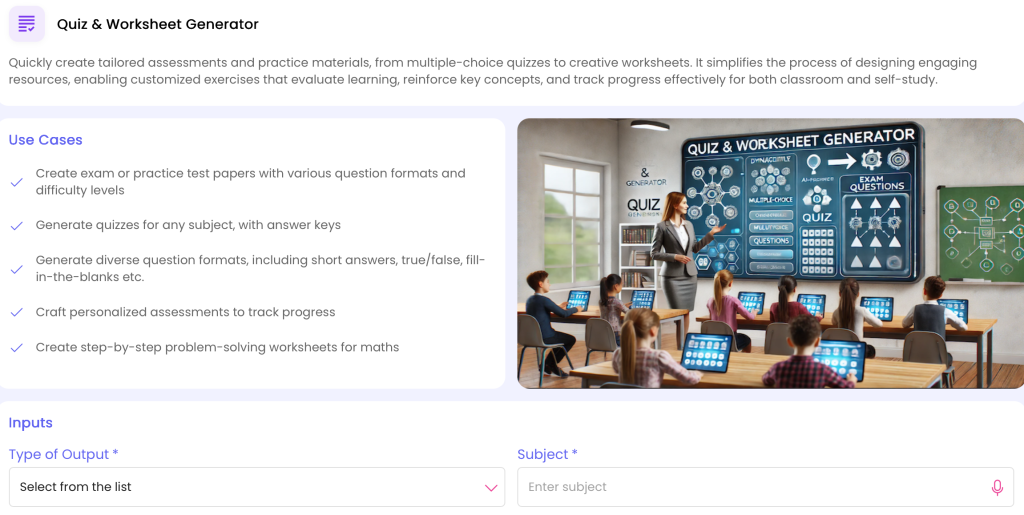
Quiz and Worksheet Generate: https://myspace.teachbetter.ai/view/resource/b0f4ce16-9597-4a8e-b330-c5f176f10f9c
Create Better Social Science Quizzes
Assessment should reveal what students understand—not simply whether they can remember facts.
AI can help teachers create quizzes with different question types and cognitive demands.
For example, after a lesson on the Indian Constitution, a quiz could contain:
- Multiple-choice questions
- Short-answer questions
- Scenario-based questions
- Conceptual questions
- Application questions
A teacher could also create different versions for revision, formative assessment or homework.
TeachBetter.ai's Quiz Generator specification describes inputs including topic, grade level, subject, number of questions and focus area, with outputs including multiple-choice and descriptive questions.
The teacher should still check questions and answers before classroom use, particularly for topics involving historical interpretation, current affairs or complex factual details.
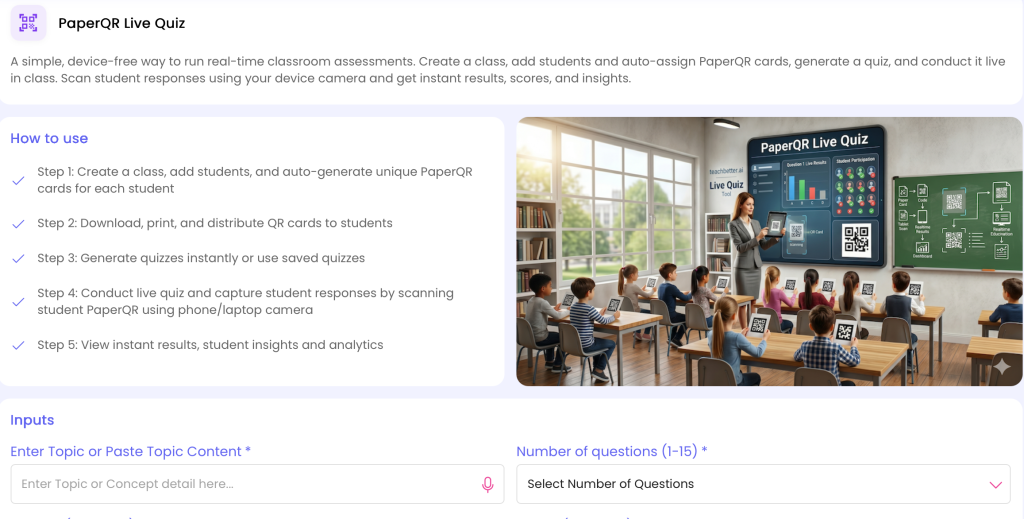
4. Turn Social Science Lessons Into Presentations
A well-designed presentation can help students visualize relationships between events, people, places and concepts.
A teacher preparing a presentation on the causes of World War I, for example, might organize it around:
- European alliances
- Militarization
- Imperial competition
- Nationalism
- The assassination at Sarajevo
- The escalation of conflict
AI can help create the initial presentation structure and supporting content, allowing the teacher to focus more attention on classroom explanation and discussion.
TeachBetter.ai includes a Presentation Generator among its documented teaching tools.
The most effective approach is not to create a presentation and use it unchanged. Teachers should refine the generated material, add curriculum-specific content and decide which visuals or questions are most useful for their students.
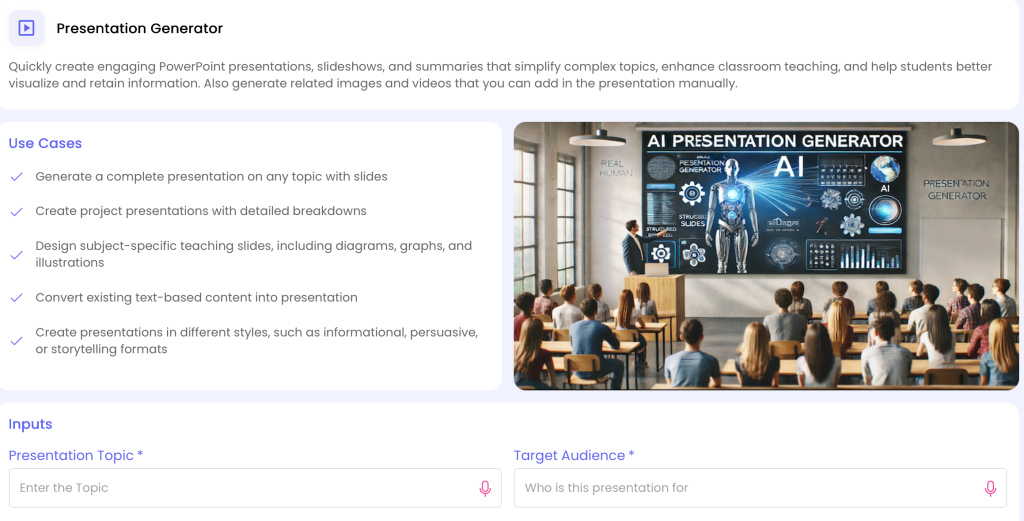
Presentation Generate: https://myspace.teachbetter.ai/view/resource/0301864b-79c6-45c4-9762-373d4e078e1f
5. Use Videos and Documents as Learning Resources
Social Science teachers already work with large amounts of text and multimedia.
These may include:
- Textbook chapters
- Historical documents
- Articles
- Reports
- Research material
- Educational videos
- School-created resources
AI can help teachers work with these resources more efficiently.
TeachBetter.ai includes Chat With Documents and YouTube Video Analyzer among its platform tools. The platform guide describes the tools as part of its broader AI teaching suite.
For example, after using an educational video about the French Revolution, a teacher could use AI assistance to develop comprehension questions, discussion prompts or revision material.
Similarly, a teacher working with a long document could use document-based AI assistance to extract relevant information and build classroom resources around it.
Teachers should always review AI-generated summaries and questions against the original source, especially when historical nuance or interpretation matters.
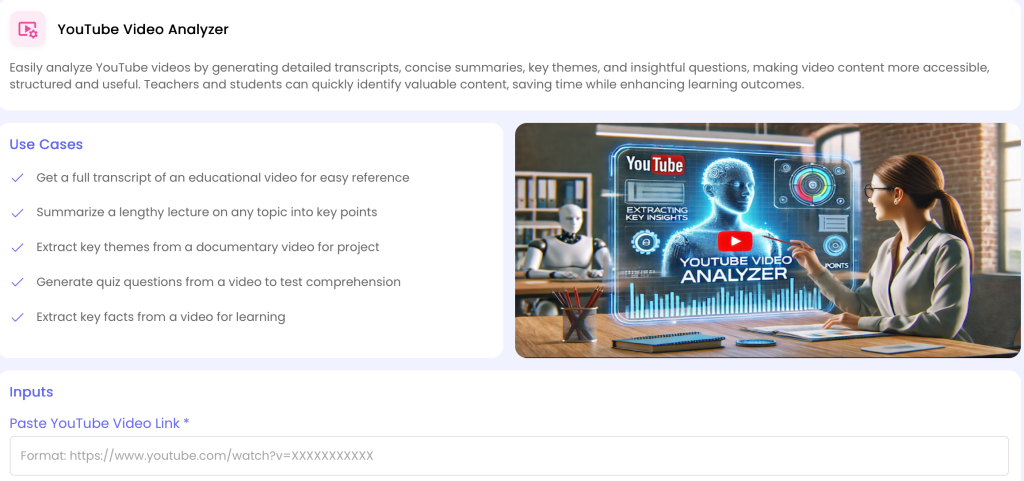
YouTube Video Analysis: https://myspace.teachbetter.ai/view/resource/2d1c80ee-0437-4da9-83d4-d2dca580711c
6. Make Social Science More Interactive With Projects and Activities
One of the biggest opportunities for AI for Social Science teaching is moving beyond the question-and-answer format.
AI can help teachers design:
Role-play activities
Students could simulate:
- A parliamentary debate
- A constitutional assembly
- A town planning meeting
- A historical negotiation
- An international summit
Group investigations
Students can work together to investigate:
- Migration
- Urbanization
- Environmental challenges
- Historical events
- Economic problems
Problem-solving activities
Students could receive a scenario and develop a solution based on evidence.
Project-based learning
Teachers can create multi-stage projects involving research, analysis, presentation and reflection.
TeachBetter.ai's broader educational approach emphasizes activities, group discussions, real-life examples and multi-step problem solving rather than relying entirely on textbook-based instruction.
That approach fits naturally with Social Science, where discussion and interpretation are central to learning.
Personalize Social Science Learning
A classroom rarely contains students who learn at exactly the same pace.
One student may understand a historical concept quickly but struggle with written responses. Another may know the facts but have difficulty connecting them into an argument.
AI can help teachers prepare different versions of learning material.
For example, the same Geography topic could be presented through:
Basic Understanding (Level 1): Introduce concepts through simple explanations and relatable, everyday examples to help students grasp the fundamentals.
Level 2 – Standard Learning: Explore textbook-style explanations, followed by relevant practice questions.
Level 3 – Advanced Thinking: Apply analytical reasoning to higher-order questions that require evidence and critical thinking.
This makes it easier to provide additional support without requiring the teacher to manually create three completely different resources.
TeachBetter.ai's platform objectives include personalized learning support, concept explainers, tailored assessments and learning resources designed around different student needs.
From Lesson Planning to Assessment: A Complete AI Workflow
The real value of an AI platform becomes clearer when individual tools are connected into a workflow.
Consider a teacher preparing a lesson on Climate and Human Activity.
Step 1: Plan the Lesson: Start by using an AI Lesson Planner to structure learning objectives, explanations, classroom activities, and assessments. This helps create a clear, organized lesson that supports effective teaching.
Step 2: Explain the Concepts: Use a Concept Explainer to develop age-appropriate explanations of topics such as greenhouse gases, climate patterns, and human impact. This helps students understand complex ideas more clearly.
Step 3: Engage Students: Design a classroom activity that encourages students to investigate how human activities affect the environment. This promotes critical thinking and connects classroom learning to real-world issues.
Step 4: Practise and Assess: Generate a worksheet featuring recall, interpretation, and application-based questions. This helps reinforce key concepts while assessing students’ understanding and ability to apply their learning.
Step 5: Assess Learning: Create a quiz to evaluate students’ understanding of key concepts. Include a mix of question types to reinforce learning and identify areas that may need further explanation.
Step 6: Extend: Create a project in which students investigate a local environmental issue and propose solutions.
Step 7: Review: Use assessment information and teacher observations to identify areas where students need additional support.
Instead of treating AI as a single question-answering tool, teachers can use it as a teaching workflow assistant.
What Makes TeachBetter.ai Relevant for Social Science Teachers?
The value of a platform should not be measured simply by how many AI tools it contains.
For Social Science teachers, relevance comes from how easily those tools support the actual teaching process.
TeachBetter.ai's documented platform includes a range of tools covering lesson planning, concept explanation, activities and projects, creative resources, quizzes and worksheets, presentations, personalized reports, document interaction, web search and video analysis.
The platform's stated objective is to help educators create and manage educational content such as lesson plans, quizzes, creative resources and assessments while supporting personalized learning.
For a Social Science teacher, this creates a practical connection between planning, teaching, practice and assessment.
The important point is that AI does not remove the teacher from the process.
The teacher decides:
- What students should learn
- Which sources should be trusted
- Which examples are appropriate
- What classroom discussion should focus on
- Whether generated content is accurate
- How student responses should be interpreted
- What happens next in the learning process
AI can handle more of the preparation work so that teachers can spend more time on the parts of teaching that require professional judgment.
How to Use AI Responsibly in Social Science Classrooms
AI-generated educational content should always be reviewed before it reaches students.
This is particularly important in Social Science because historical and social topics can involve:
- Complex causes
- Different interpretations
- Sensitive events
- Political and social issues
- Regional perspectives
- Changing factual information
Teachers should verify important facts, dates, statistics, quotations and interpretations.
AI should also be used as a starting point rather than an unquestioned authority.
A good workflow is:
Generate → Review → Correct → Adapt → Teach
This preserves teacher judgment while still gaining the efficiency benefits of AI.
TeachBetter.ai's stated objectives include responsible and ethical AI, with emphasis on inclusivity, accessibility and student safety.
How to Choose the Best AI Platform for Social Science Teachers
If you are comparing AI teaching tools for Social Science, look beyond marketing claims.
Ask practical questions:
Does it understand the teacher's workflow?
Yes. The right AI platform should support the entire teaching process, from lesson planning and interactive classroom activities to assessments and resource creation. Rather than simply generating text, it should help teachers develop structured lessons, engage students, evaluate learning, and prepare ready-to-use educational materials.
Can it adapt content?
AI can adapt learning content to suit students’ different learning levels and needs. For example, teachers can simplify complex concepts, provide additional practice, or introduce more challenging questions to support varied abilities and promote personalised learning.
Can teachers specify grade, topic, learning objective and difficulty?
Can it support different Social Science subjects?
A platform should be useful across History, Geography, Civics, Economics and broader Social Studies.
Can teachers edit the output?
AI-generated material should be treated as editable teaching content.
Does it support different resource types?
Look for lesson plans, worksheets, quizzes, activities, projects and presentations.
Can it work with teacher-provided material?
Document-based capabilities can be particularly useful when teachers need resources based on their own curriculum material.
Does it support personalization?
The ability to create age-appropriate or differentiated resources can make AI much more useful in real classrooms.
The best platform for a particular teacher will ultimately depend on curriculum, classroom requirements, preferred workflow and the level of AI assistance needed.
Frequently Asked Questions
What is the best AI platform for Social Science teachers?
The right platform depends on the teacher's requirements. A useful platform should support core Social Science workflows such as lesson planning, concept explanation, activities, worksheets, quizzes, projects and presentations. TeachBetter.ai brings these types of tools together in an education-focused platform designed for teachers and schools.
How can AI help History teachers?
AI can help History teachers create lesson plans, explanations, discussion questions, historical scenarios, worksheets, quizzes, projects and presentations. It can also help teachers adapt explanations to different grade levels.
Can AI help Geography teachers create activities?
Yes. Teachers can use AI to create scenario-based activities around topics such as climate, population, migration, urbanization, natural resources and environmental challenges. Teachers should review the generated content and ensure that data and examples are appropriate.
How can AI help Civics teachers?
AI can help generate explanations, classroom scenarios, discussion prompts, debates, worksheets and assessments around concepts such as democracy, rights, government, citizenship and constitutional principles.
Can AI create Social Science worksheets?
Yes. AI worksheet generators can create exercises based on a topic, grade level and learning objective. Therefore, teachers should carefully review all questions and answers before using them in the classroom.
Can AI generate Social Science quizzes?
Yes.Additionally, AI can generate a variety of questions, such as multiple-choice, short-answer, and descriptive questions, to support classroom assessment. Teachers can use these for formative assessment, revision or homework.
Can AI replace Social Science teachers?
Although AI can assist with lesson planning and resource creation, effective teaching still depends on professional judgment, classroom interaction, and an understanding of students’ needs. Therefore, teachers must make informed decisions that support meaningful learning.The teacher remains central to the learning process.
Teachers should use AI responsibly and verify educational content before classroom use. For further guidance, educators can explore UNESCO’s digital education initiatives to learn more about the role of technology in education.
Conclusion: Use AI to Teach Social Science With More Context and Less Preparation
The most valuable use of AI in Social Science education is not simply generating more content. Instead, it helps teachers create better learning experiences with less repetitive preparation.
For example, History teachers can spend less time preparing worksheets and more time discussing historical evidence. Geography teachers can turn textbook concepts into real-world problem-solving activities. Similarly, Civics teachers can create scenarios that explore rights, responsibilities and institutions, while Economics teachers can connect abstract concepts to everyday situations.
How AI Can Support Better Social Science Learning
The best AI platform for Social Science teachers should support the entire teaching process, from lesson planning and classroom activities to assessments and learning resources. Rather than focusing only on the number of AI features, teachers should consider how effectively a platform supports student understanding and engagement.
TeachBetter.ai brings together tools for lesson planning, concept explanation, activities, projects, quizzes, worksheets, presentations and other teaching workflows. As a result, teachers can move beyond rote learning and encourage deeper understanding, real-world application and more engaging classroom experiences.
Ultimately, AI can handle repetitive preparation tasks; however, human judgment, classroom experience and teacher expertise should remain at the heart of learning.
Whether you teach History, Geography, Civics, Economics or Social Studies, AI can help simplify everyday teaching tasks and make learning more engaging.
Explore TeachBetter.ai and start using AI for Social Science teaching.

Binit Agarwalla, Founder, TeachBetter.ai
With over 15 years of seasoned expertise, Binit is a results-driven marketing leader specializing in B2B SaaS and B2C growth strategy - now channeling that experience into transforming education through TeachBetter.ai, an all-in-one AI platform built exclusively for teachers, students, and schools.
As the Founder of TeachBetter.ai, his mission is to simplify teaching and amplify learning by empowering educators with AI-driven tools that save time, enhance creativity, and make classrooms more engaging. TeachBetter.ai's vision is to make AI adoption in education simple, accessible, and affordable - helping every teacher leverage the power of AI without complexity or high cost.
Read other articles authored by Binit Agarwalla here.