Best AI Platform for Maths Teachers: Transform Mathematics Teaching with TeachBetter.ai
Vipin Kumar
|
 5 October, 2026
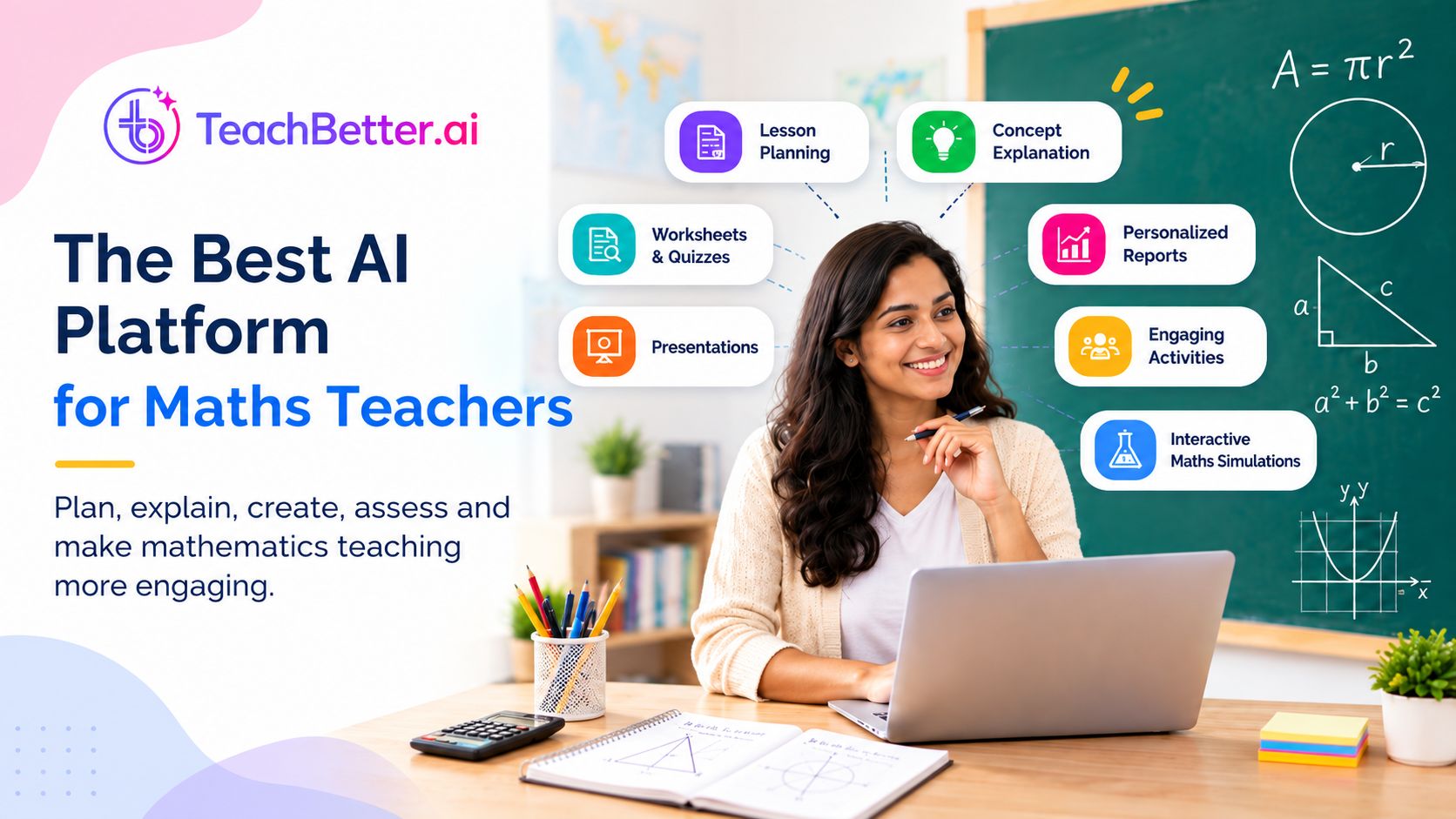
An AI platform for maths teachers can make mathematics teaching more engaging, efficient, and personalized. TeachBetter.ai provides practical AI tools that help maths teachers plan lessons, create worksheets and quizzes, explain difficult concepts, and develop interactive learning experiences for students.
A student may remember that the area of a circle is πr², but still be unable to explain what the formula represents. A student may successfully solve a linear equation by following a series of steps but struggle when the same concept appears in a word problem. Another student may know that the square root of 36 is 6 but may not immediately recognize how to use square roots to determine the side of a square when the area is given.
For Maths teachers, therefore, the challenge is much bigger than simply completing the syllabus or teaching students how to arrive at the correct answer. TeachBetter.ai supports the wider teaching process, helping teachers create engaging and meaningful learning experiences.
This is where Artificial Intelligence can become a practical teaching assistant.
TeachBetter.ai brings together AI-powered tools that can support Maths teachers across lesson planning, concept explanation, classroom activities, practice, visual learning, doubt solving and assessment. Instead of using AI simply as a question-answering chatbot, teachers can use TeachBetter.ai to support the wider teaching process, create engaging lessons, and deliver more meaningful learning experiences. As a Best AI Platform for Maths Teachers, TeachBetter.ai helps educators plan, explain, practise, and assess Mathematics more effectively.
The goal is not to replace the Maths teacher. The goal is to reduce repetitive preparation work so that teachers can spend more time doing what matters most: explaining concepts, interacting with students, identifying learning gaps, encouraging questions and developing mathematical thinking.
Why Maths Teachers Need More Than an AI Calculator
When people talk about AI and Mathematics, it is natural to think about calculations, equations and problem solving. AI can certainly perform these tasks, but these are only a small part of what a Maths teacher does.
A calculator can tell a student that √36 = 6. An AI system can also solve a complicated equation in seconds. But neither of those things automatically creates understanding.
From Calculations to Mathematical Understanding
A Maths teacher needs to ask much deeper questions:
- Why does this formula work?
- How did we arrive at this method?
- When should we use it?
- Can the same idea be represented differently?
- Where would a student encounter this concept outside the classroom?
- What does a student's mistake tell us about their understanding?
Consider the simple question: Find the square root of 36.
The expected answer is 6, and most students who have learned square roots will arrive at it quickly. But the teacher can turn the same mathematical idea into a much richer problem:
Turning Calculations into Real-World Learning
A square field has an area of 36 square metres. What is the length of each side? If the field needs to be fenced, how much fencing will be required?
Now students have to recognize that the square root of the area gives them the side length. Once they have found the side, they can use the concept of perimeter to determine the amount of fencing required. The mathematical journey becomes:
Square root → Side length → Perimeter → Real-world application
The calculation has not changed. What has changed is the context and depth of understanding.
This illustrates why Maths teachers need more than an AI calculator. They need tools that can help them design explanations, create meaningful examples, develop activities, generate practice material and check whether students are actually understanding what they are being taught.
TeachBetter.ai can support teachers across these stages, helping them move from simply asking students to solve Mathematics problems towards helping students think mathematically.
How TeachBetter.ai Helps Maths Teachers
A Mathematics lesson rarely begins and ends with a single explanation Before the class starts, the teacher has to decide what students should learn and how the concept will be introduced. During the lesson, the teacher needs examples, questions, activities and explanations that keep students involved. After teaching, students need opportunities to practise, and the teacher needs ways to determine whether the concept has actually been understood.
This creates a continuous teaching cycle:
Plan → Explain → Explore → Practise → Assess → Review → Improve
TeachBetter.ai can support different parts of this cycle through a collection of AI-powered teaching tools. For a Maths teacher, this means AI does not have to be something used occasionally when a difficult question appears. It can become part of everyday lesson preparation and classroom practice.
Here are some of the most useful TeachBetter.ai tools for Mathematics teachers.
1. Lesson Planner: Build Better Maths Lessons
A good Maths lesson starts long before the teacher enters the classroom.
The teacher needs to think about what students already know, what they need to learn next, how the new concept should be introduced, which examples will make the idea understandable, what students should practise and how understanding will be checked. When a teacher is preparing several lessons every day, creating this structure repeatedly can consume a considerable amount of time.
TeachBetter.ai's Lesson Planner can help teachers create a structured lesson around a particular subject, grade, topic and learning objective. It can provide a useful starting point that teachers can then refine according to their textbook, curriculum, classroom duration and students' existing level of understanding.
The real benefit is not simply producing a lesson plan faster. It is helping teachers think beyond the traditional sequence of definition → formula → exercise.
For example, consider a lesson on Percentage.
Instead of beginning the lesson by writing: 25% = 25/100
a teacher could introduce a situation students are familiar with:
A school has 800 students. Twenty-five percent of them participate in a sports event. How many students are participating?
Students now have a reason to understand what 25% represents.
The lesson can then move naturally from the real-world situation to the mathematical concept. The teacher can explain the relationship between percentages, fractions and decimals, work through examples with the class, introduce a practical activity and finish with a short assessment.
This makes the lesson more than a sequence of mathematical procedures. It gives students a reason to understand the concept.Best AI Platform for Maths Teachers
The teacher can then review the AI-generated plan, add their own examples and modify the sequence based on the students they know.
In this way, AI handles some of the initial preparation while the teacher remains responsible for the instructional design.
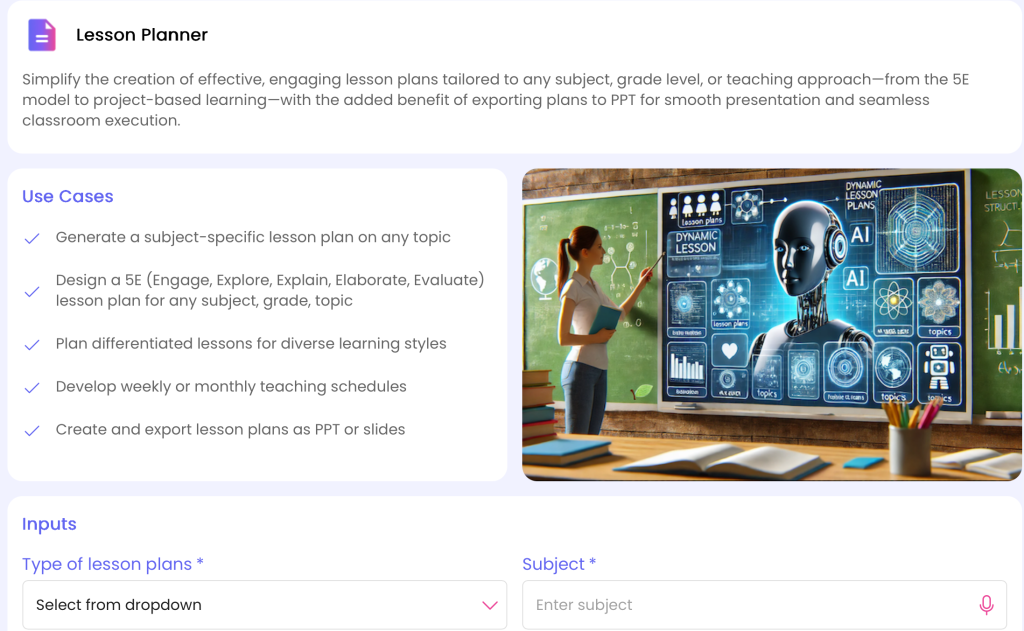
Sample Lesson Plan: https://myspace.teachbetter.ai/view/resource/66a64f7d-0bc4-4fab-b2ac-2fb5cdd11931
2. Concept Explainer: Make Difficult Maths Concepts Easier to Understand
One of the most important skills of a Maths teacher is the ability to explain the same idea in different ways. A concept that seems obvious to one student may be completely confusing to another. A textbook may provide one explanation, but the teacher may need to introduce an analogy, a visual example, a real-world situation or a simpler explanation before the student understands it.
This is particularly true for topics such as algebra, quadratic equations, trigonometry, coordinate geometry, probability, functions, mensuration and statistics.Best AI Platform for Maths Teachers
TeachBetter.ai's Concept Explainer can help teachers develop explanations and examples around difficult mathematical concepts. Instead of spending considerable time searching for another way to explain a topic, teachers can use AI to explore alternative explanations and then select and refine the one that is most appropriate for their classroom.
Consider Pythagoras' Theorem.
A traditional introduction might immediately present: a² + b² = c²
Students can memorize the equation, but memorization does not necessarily mean they understand what the relationship represents.
A teacher could instead begin with a practical situation involving a ladder leaning against a wall. The distance between the bottom of the ladder and the wall forms one side of a right-angled triangle. The height reached by the ladder forms another side, while the ladder itself represents the hypotenuse.
The mathematical formula now has a physical situation attached to it.
The teacher can then move from the real-world example to the geometric representation and finally to the equation.
This progression helps students understand that the formula is not an arbitrary rule. It describes a relationship between the sides of a right-angled triangle.
This is where an AI concept-explanation tool becomes valuable. It can help the teacher explore different ways of presenting an idea before deciding how to teach it.
The teacher remains the expert, but AI provides another layer of preparation support.
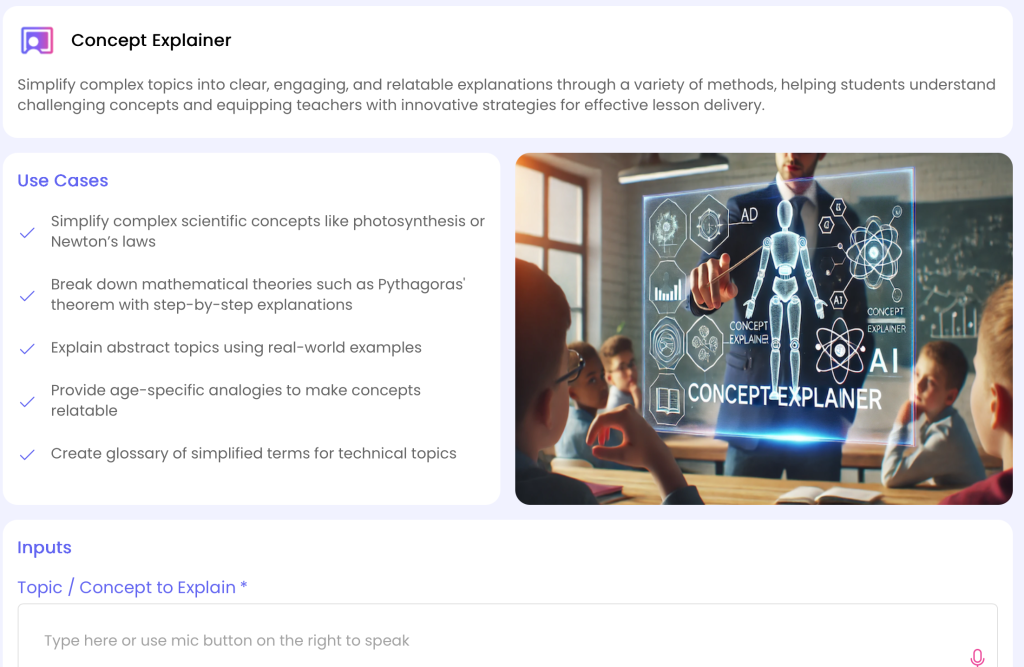
Concept Explain: https://myspace.teachbetter.ai/view/resource/445341de-2e8e-4868-a364-5657b6d8dbda
3. Activity & Project Generator: Turn Maths Into an Active Learning Experience
Mathematics is often taught through explanation followed by written practice. While this approach is important, students can develop a much deeper understanding when they also have opportunities to measure, investigate, collect data, experiment, compare results and solve practical problems.
TeachBetter.ai's Activity & Project Generator can help Maths teachers create activities and projects around particular concepts.
Consider a lesson on Geometry.
Instead of limiting the lesson to textbook diagrams, students could investigate the geometry of their own classroom. They could measure the length and width of tables, doors, windows or the classroom itself and use those measurements to calculate perimeter and area.Best AI Platform for Maths Teachers.
The teacher could then introduce questions such as:
If the classroom floor needs new tiles, how much floor area needs to be covered?
If a border is to be placed around the classroom, how much material will be required?
Students are now applying the same mathematical formulas to something they can see and measure.
Probability offers another strong opportunity for activity-based learning. Students can conduct repeated coin or dice experiments, record the outcomes and compare experimental probability with theoretical probability. The difference between expected and observed results can then become a natural starting point for classroom discussion.
These activities change the role of the student. Instead of simply receiving a mathematical rule from the teacher, students are given an opportunity to discover relationships and use Mathematics to investigate something.
For teachers, the Activity & Project Generator provides a way to create these experiences without having to design every activity from scratch.
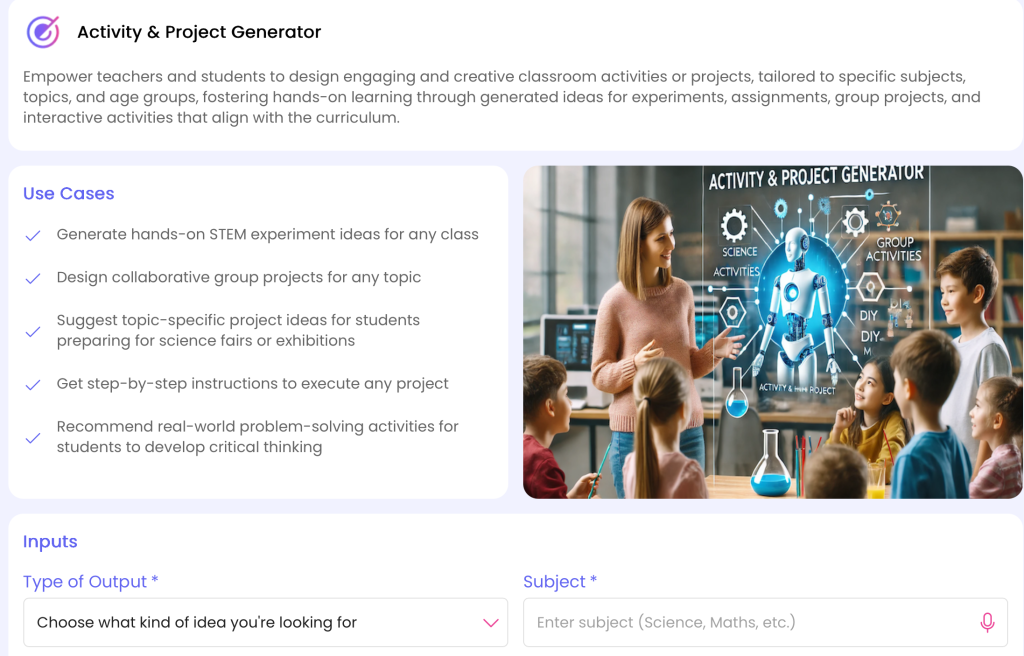
Activity and Project Generate: https://myspace.teachbetter.ai/view/resource/9baae643-b3c0-4da0-afce-6afb53476bf6
4. Creative Resource Generator: Create More Engaging Maths Learning Material
Not every Mathematics lesson needs to begin with a formula.
Sometimes the most effective way to introduce a concept is through a story, puzzle, challenge, analogy or real-world situation that makes students curious about the problem before they learn the formal mathematics behind it.
TeachBetter.ai's Creative Resource Generator can help teachers create additional learning resources around mathematical topics and introduce variety into their lessons.
Consider Fractions.
Rather than immediately presenting operations on fractions, the teacher could introduce a situation involving sharing a pizza among different numbers of people. Students can discuss what happens when the pizza is divided into equal parts and how the size of each part changes.Best AI Platform for Maths Teachers.
The teacher can then connect the discussion to fractions and eventually move towards operations.
For Ratio, a recipe can provide a simple and familiar context. If a recipe requires two cups of flour for every one cup of sugar, students can explore what happens when the quantity is doubled, tripled or reduced.
These resources can also be used as lesson starters.
Imagine beginning a class with:
A shop announces a 40% discount. Is the customer always saving 40% of what they would have spent?
Students immediately have something to think about.
The teacher can then use their responses to introduce the formal mathematics.
The purpose of creative resources is not to make Mathematics less rigorous or turn every lesson into entertainment. The purpose is to provide students with an accessible entry point into an abstract mathematical idea.
A strong Maths lesson can still be rigorous while being interesting, relatable and intellectually engaging.
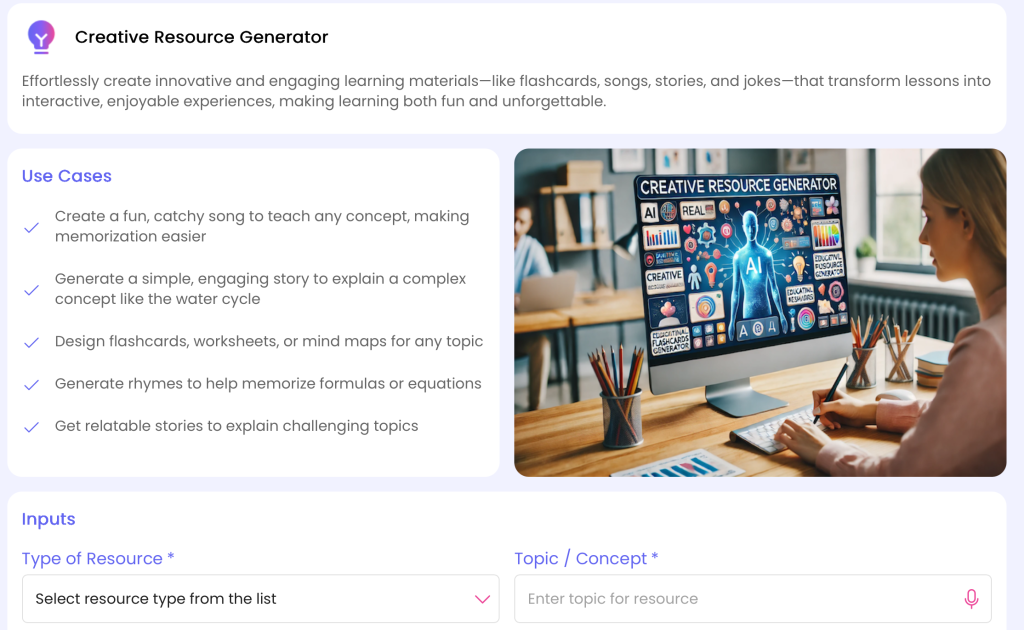
Creative Resource Generate: https://myspace.teachbetter.ai/view/resource/41b6e4a7-3693-440b-ab97-7102686c7f07
5. Quiz & Worksheet Generator: Create Maths Practice Material Faster
Practice is an essential part of learning Mathematics. Students need repeated opportunities to apply concepts, recognize patterns, make calculations, test strategies and solve unfamiliar problems.
The challenge for teachers is that creating good practice material takes time. A useful Mathematics worksheet should contain more than a collection of repetitive calculations. It should provide an appropriate mixture of direct questions, conceptual questions, application problems and situations that require students to think carefully about which mathematical method they should use.
TeachBetter.ai's Quiz & Worksheet Generator can help teachers create practice material around specific Mathematics topics. The platform's documented examples include areas such as sets, exponents, commission, bonus, profit and loss.
Consider a lesson on Linear Equations.
A teacher could begin with a straightforward question: Solve: x + 7 = 15.
The next question might test whether the student understands the situation rather than simply the procedure:
A number increased by 7 is 15. What is the number? Represent the situation using an equation.
The worksheet can then move into application:
A taxi charges a fixed starting amount plus a charge for every kilometre travelled. How could you represent the total fare using a linear equation?
All three questions relate to the same mathematical idea, but they require progressively different types of thinking.Best AI Platform for Maths Teachers.
This is particularly valuable when teachers need to create material repeatedly for several sections or classes. Rather than starting with a blank document every time, the teacher can use AI to generate an initial set of questions and then apply their professional judgement to select, modify and verify them.
The teacher remains in control of the final worksheet, while AI helps reduce the repetitive work involved in creating the first draft.
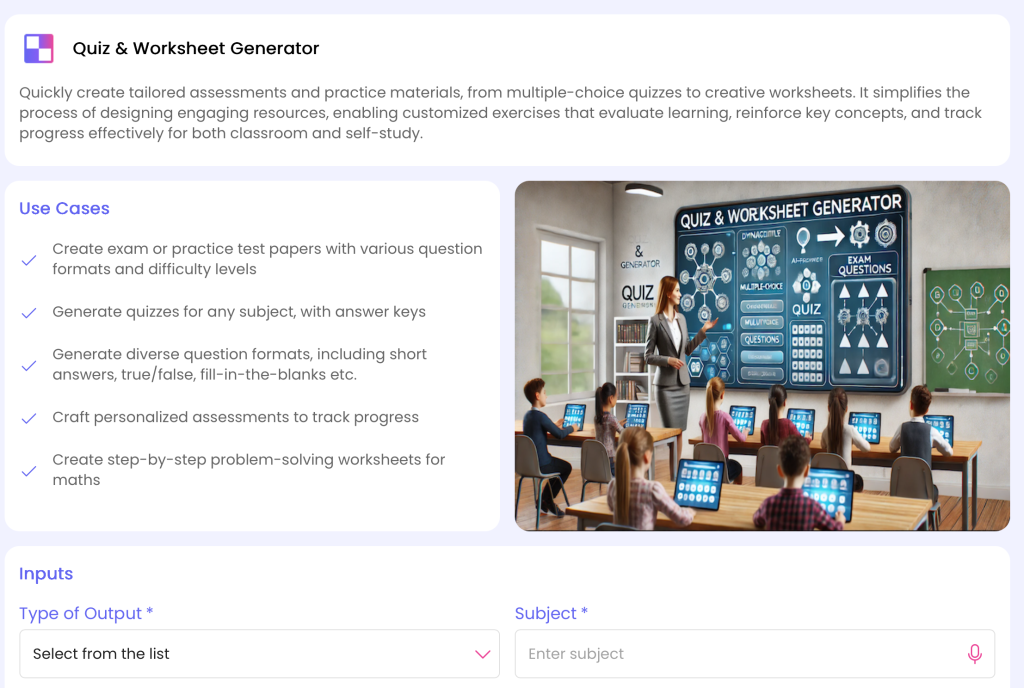
Quiz and Worksheet Generate: https://myspace.teachbetter.ai/view/resource/261ce527-108e-439f-91a7-486ea59a6185
6. Presentation Generator: Make Mathematical Ideas More Visual
Mathematics contains many relationships that students understand more easily when they can see how the ideas connect.
A presentation can help a teacher structure those relationships visually and guide students through a concept step by step.
TeachBetter.ai's Presentation Generator can help teachers create structured visual teaching material around a particular topic.
Consider Trigonometry.
Instead of introducing sine, cosine and tangent as three isolated formulas, a presentation can build the concept progressively. It can first establish what a right-angled triangle looks like, identify the hypotenuse and the other two sides, explain how the sides relate to an angle, and then introduce the three trigonometric ratios.
Once students understand the basic relationship, the teacher can move to worked examples and finally show how trigonometry is used in practical situations.
The same approach can make Statistics easier to understand.
Students can be shown how raw information becomes organized data:
Raw Data → Table → Graph → Statistical Measure → Interpretation
This sequence helps students understand that calculating a mean or median is only one part of statistical analysis.
Presentations can also be particularly useful for revision. The value of AI here is not simply that it can create slides faster. It can help teachers organize mathematical content into a logical teaching sequence, after which the teacher can add diagrams, examples and explanations that reflect the needs of their particular class.
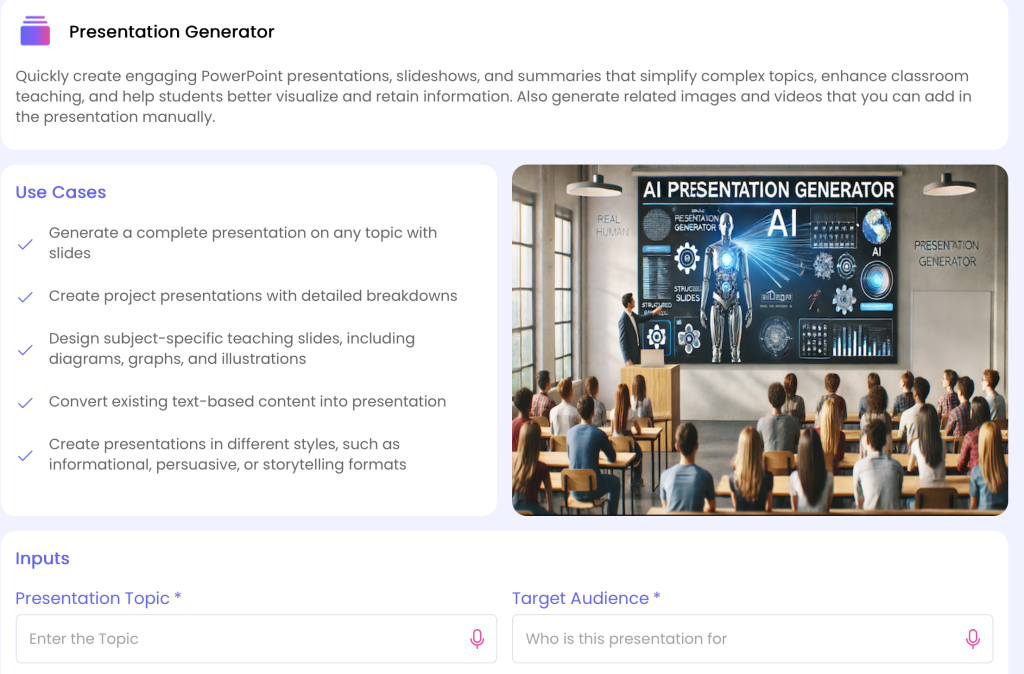
Presentation Generate: https://myspace.teachbetter.ai/view/resource/74fd0ad5-b374-480d-a063-b0c63a815ef8
7. Doubt Solver: Help Students Move Past Stuck Points
One of the biggest barriers to Mathematics learning is not necessarily that a student does not know anything. Often, the student understands most of the problem but becomes stuck at one particular step.
A student may understand the concept of an equation but become confused when rearranging it. Another may know the formula for area but be unsure which measurements from a word problem should be used. A student solving a geometry problem may understand the diagram but not recognize which theorem applies.
TeachBetter.ai's Doubt Solver can help provide explanations for difficult student questions and give learners another way to approach a concept. Consider a student asking:
Why does dividing both sides of an equation by the same number not change the solution?
Simply telling the student to "divide both sides" teaches the procedure. A better explanation focuses on the underlying principle of maintaining equality.
If: 2x = 10
and both sides are divided by 2, the equation becomes: x = 5
The important idea is that the same operation has been applied to both sides, so the equality is preserved. That reasoning is much more useful than simply memorizing a step. These are not merely questions about getting answers. They are questions about understanding mathematical relationships.
For teachers, such explanations can also be useful as preparation material. If several students are struggling with the same idea, the teacher can use an alternative explanation as the basis for a classroom discussion or a second explanation of the concept.Best AI Platform for Maths Teachers.
In this way, AI can help create additional explanations without taking the teacher out of the learning process.
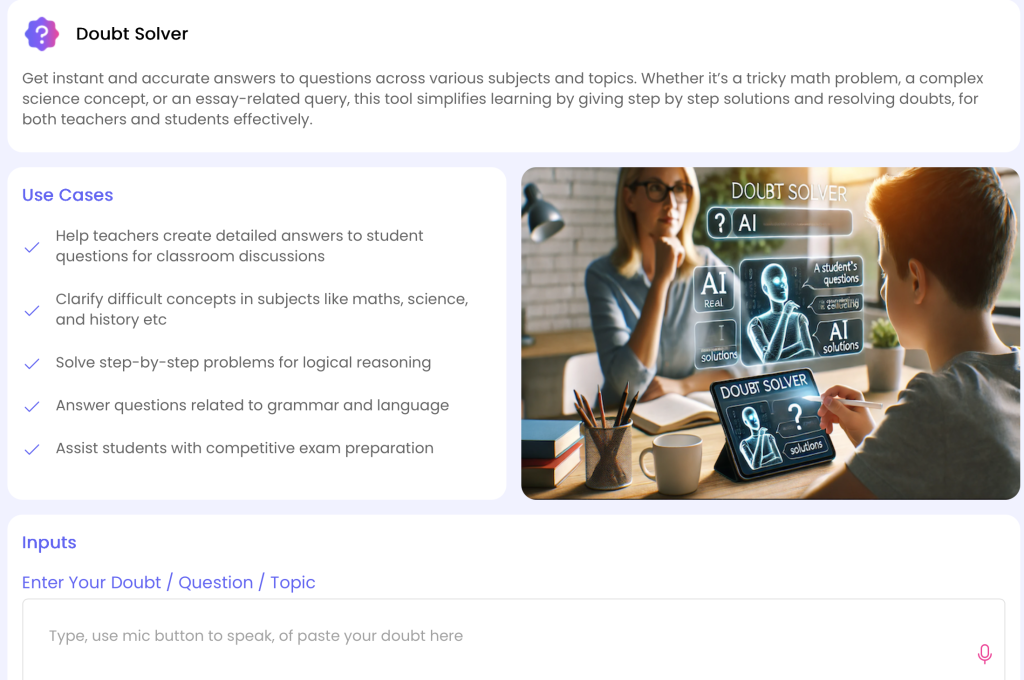
Doubt Solve: https://myspace.teachbetter.ai/view/resource/7a8c0c0e-aeb5-4237-a896-471195c8d2c8
8. Chat With Documents: Work With Existing Maths Resources
Maths teachers rarely work from a blank page.
They already have textbooks, school-created notes, worksheets, question papers, revision documents and other teaching resources. The challenge is often not a lack of content but the amount of time required to find, organize and transform existing content into something useful for students.
TeachBetter.ai's Chat With Documents can help teachers interact with their existing documents and use them as a foundation for further teaching resources.
For example, a teacher preparing a revision lesson may have a lengthy Mathematics chapter in PDF format. Instead of manually reading through the entire document again to identify key areas, the teacher can use the document as the basis for extracting important concepts, preparing revision questions or developing student-friendly explanations.
Suppose the chapter covers Quadratic Equations.
A teacher may want to identify the key concepts students need to revise, extract important formulas, prepare concept-based questions and develop a short revision activity.
The teacher can use the existing chapter as the starting point and then review the AI-generated material to ensure that it accurately reflects what was taught in class.Best AI Platform for Maths Teachers.
This can be particularly useful when preparing students for examinations.
The important role of the teacher remains unchanged. AI can help organize and transform the content, but the teacher should always review the output for mathematical accuracy, curriculum relevance and suitability for the students.
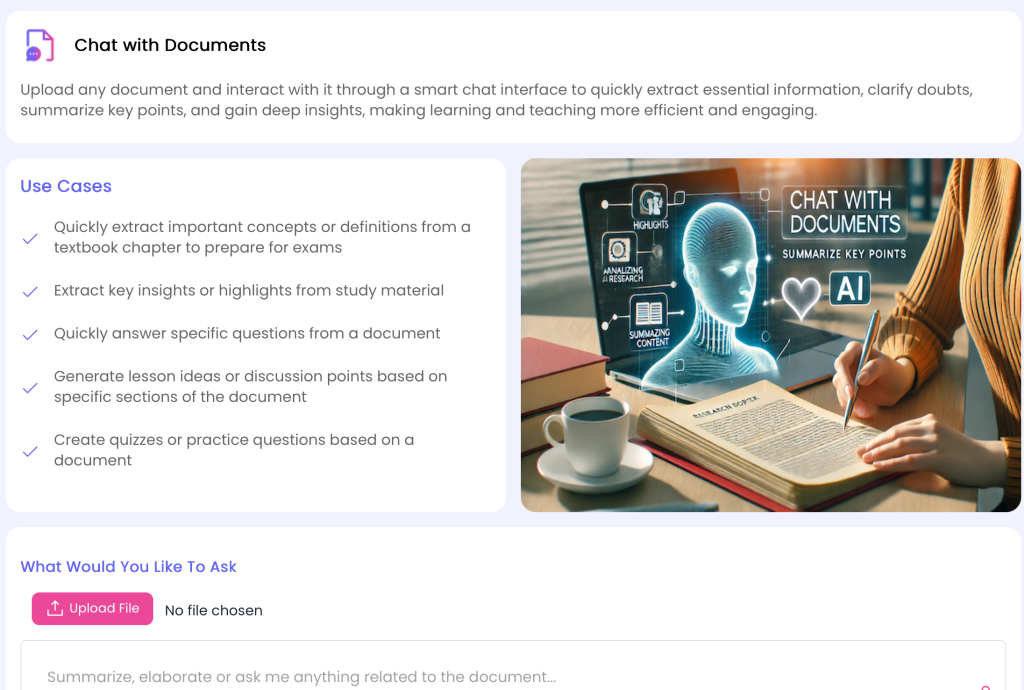
9. YouTube Video Analyzer: Turn Educational Videos Into Learning Resources
Educational videos can be valuable in Mathematics because some concepts benefit from visual demonstrations, animations, worked examples or explanations that students can watch at their own pace.
However, simply showing a video in class does not automatically create learning.
A video becomes much more useful when it is connected to a clear learning objective and followed by questions, discussion and practice.
TeachBetter.ai's YouTube Video Analyzer can help teachers work with educational videos and use their content as part of a broader teaching process. Video analysis is included among the platform's documented AI teaching capabilities.
Imagine a teacher wants to use a video explaining Pythagoras' Theorem.
Rather than simply asking students to watch it, the teacher can use the video as one stage in a larger lesson:
Watch → Understand → Discuss → Question → Practise → Apply
Before playing the video, the teacher might give students a question to think about:
Why can the length of a ladder be calculated if we know its distance from a wall and the height it reaches?
Students then watch the video with a specific purpose.
Afterwards, the teacher can move into discussion and ask students to identify the mathematical relationship they observed. The class can then solve a related problem and finally apply the theorem to a practical situation.Best AI Platform for Maths Teachers.
The same approach can be used for videos covering fractions, coordinate geometry, trigonometry, probability, statistics and algebra.
The key advantage is that the video does not remain an isolated piece of content. It becomes part of the teacher's instructional design.
Ultimately, the objective is not simply to show students more educational videos.
It is to make every resource—including video—a purposeful part of the learning journey.
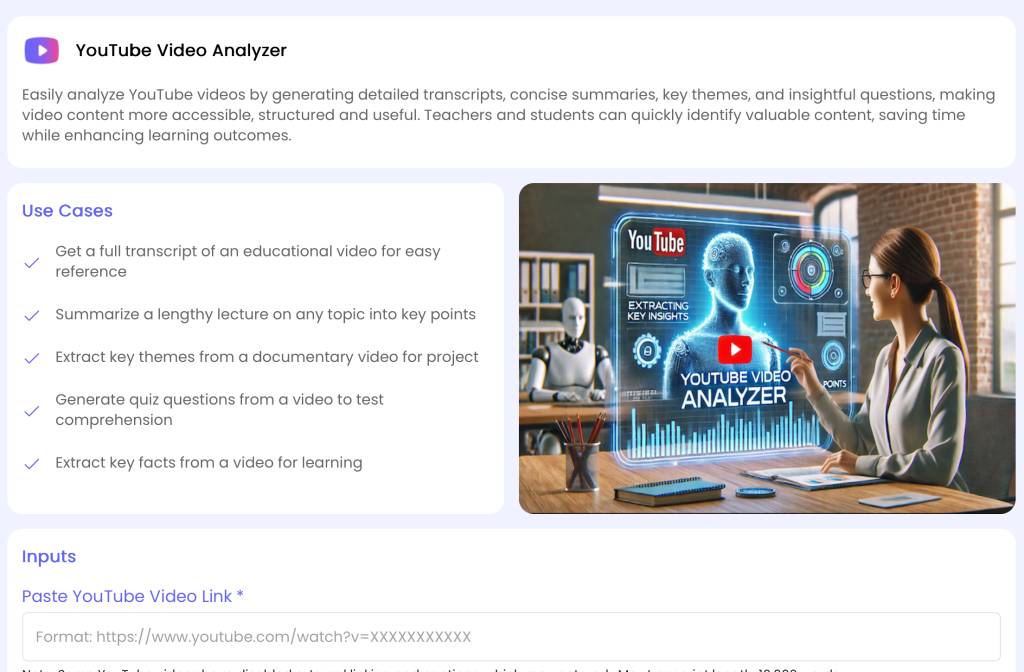
YouTube Video Analysis: https://myspace.teachbetter.ai/view/resource/72580ced-4ace-4755-b4d7-b1d19c311681
10. PaperQR Live Quiz: Check Understanding During the Maths Lesson
One of the biggest challenges in Mathematics teaching is knowing whether every student has understood a concept, not just the students who answer questions aloud. A teacher may explain a formula and ask, "Everyone understood?" but a classroom full of nodding heads does not always reveal who is still confused.
This is especially important in Mathematics because concepts build on one another. A gap in fractions can affect percentages and ratios, while weak foundations in algebra can make advanced equations much more difficult.
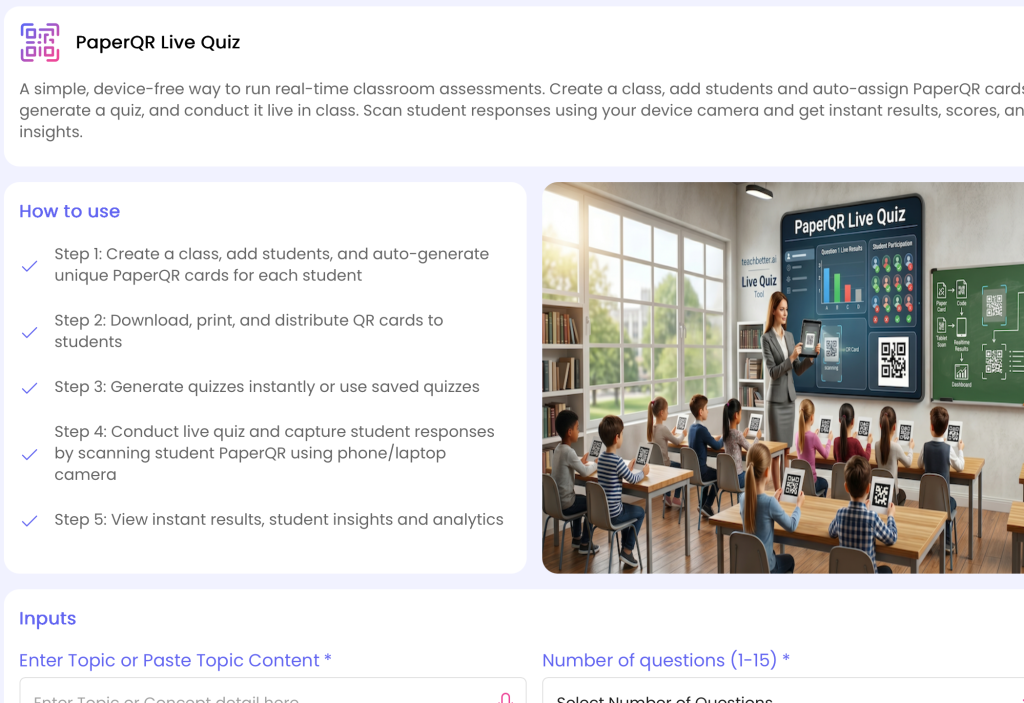
PaperQR Live Quiz helps Maths teachers bring quick, real-time formative assessment into the classroom. Students do not need individual smartphones or computers. Each student receives a unique printed PaperQR card, and the teacher captures their responses using a phone or laptop camera. Results and insights are generated instantly.
Example: Checking Understanding After Quadratic Equations
After teaching quadratic equations, a teacher could conduct a short five-question PaperQR quiz covering concepts such as identifying quadratic equations, understanding the discriminant and determining the nature of roots.
Instead of waiting for a worksheet or unit test, the teacher immediately sees how the class has responded. If most students answer correctly, the teacher can confidently move ahead. If many students select an incorrect answer, the teacher knows that the concept needs another explanation or example.
The process becomes:
Teach → Check → Identify Gaps → Explain → Practise → Move Forward
Simple, Device-Free Classroom Assessment
PaperQR Live Quiz is designed to make live assessment practical for everyday classroom use. Teachers can create a class, add students or upload them in bulk, and automatically assign unique PaperQR cards. The cards can then be downloaded, printed and distributed to students.Best AI Platform for Maths Teachers.
Teachers can create a new quiz based on a topic or use a previously saved quiz. During the lesson, students respond using their PaperQR cards, while the teacher scans the responses with a device camera.
The teacher can then view instant results, class performance and individual student performance, along with quiz insights and downloadable reports.
This makes PaperQR useful not only for tests, but also for quick checks at the beginning, middle or end of a Maths lesson.
For example, before teaching Trigonometry, a teacher can check whether students remember the properties of right-angled triangles. After explaining a new concept, a quick quiz can test understanding. At the end of the lesson, another short quiz can show whether students are ready to move forward.
PaperQR Live Quiz therefore turns assessment from something that happens after teaching into something that happens as part of teaching.
The question is no longer simply:
"Did I teach the topic?"
It becomes:
"Do my students understand the topic?"
11. Personalized Report Generator: Turn Assessment Into Action
Marks are useful, but marks alone do not always tell a Maths teacher what a student needs next.
Suppose two students both score 70% in a Mathematics test. At first glance, their performance appears identical. But when the teacher looks more closely, the underlying picture may be very different.
Student A may have performed strongly in Algebra and Statistics but struggled with Geometry.
Student B may have done well in Geometry but made repeated errors in Algebra.
Both students received the same overall score, but their learning needs are clearly different. This is where assessment becomes more valuable when it is connected to analysis and intervention.
TeachBetter.ai's Personalized Report Generator can help teachers organize student performance information into structured reports that provide a clearer view of performance and areas for improvement. For a Maths teacher, the value of such reporting is not simply producing another document. It is helping turn assessment results into information that can support the next teaching decision.
For example, instead of telling a student: "You scored 62%."
the teacher can have a more meaningful conversation:
"You are performing well in Algebra and Statistics, but your Geometry questions show that you need more practice with properties of triangles and angle relationships."
That is a much more actionable form of feedback.
A Complete Maths Teaching Workflow With TeachBetter.ai
The real value of TeachBetter.ai does not come from using one AI tool in isolation. It comes from the possibility of connecting different tools to support the complete Mathematics teaching and learning cycle.
Consider a teacher preparing a lesson on Percentage.
The process can begin with the Lesson Planner, where the teacher develops the overall structure of the lesson and identifies opportunities to connect percentage with everyday situations such as discounts, examination scores, taxes or changes in prices.Best AI Platform for Maths Teachers.
The teacher can then use the Concept Explainer to explore a clear way of introducing the relationship between percentages, fractions and decimals. Rather than relying solely on a formal definition, the teacher can prepare examples that gradually move students from familiar situations to mathematical notation.
Next, the Activity & Project Generator can be used to design a practical classroom activity. Students might receive a fictional shopping catalogue and calculate discounts, final prices and percentage savings.
The teacher can use the Creative Resource Generator to create an additional challenge or problem scenario that encourages students to think beyond straightforward calculations.
For visual instruction, the Presentation Generator can help organize the mathematical concepts, worked examples and applications into a structured presentation.
Once the concept has been taught, the Quiz & Worksheet Generator can provide practice material. The teacher can combine direct calculations with application-based questions and word problems.
During the lesson, students may encounter questions that require a different explanation. The Doubt Solver can support explanations around difficult concepts and help the teacher approach the question from another perspective.
The teacher can then use PaperQR Live Quiz to conduct a quick formative assessment and determine whether the class is ready to move forward.
After assessment, the Personalized Report Generator can help organize student performance information so that the teacher can identify areas requiring additional attention.
Finally, students can use the Concept Mastery Coach to continue practising and checking their understanding.
The complete process becomes:
Plan → Explain → Explore → Practise → Assess → Analyse → Master
This is a much broader role for AI than simply generating a worksheet.
AI becomes part of the teacher's workflow while the teacher remains at the centre of the learning process.
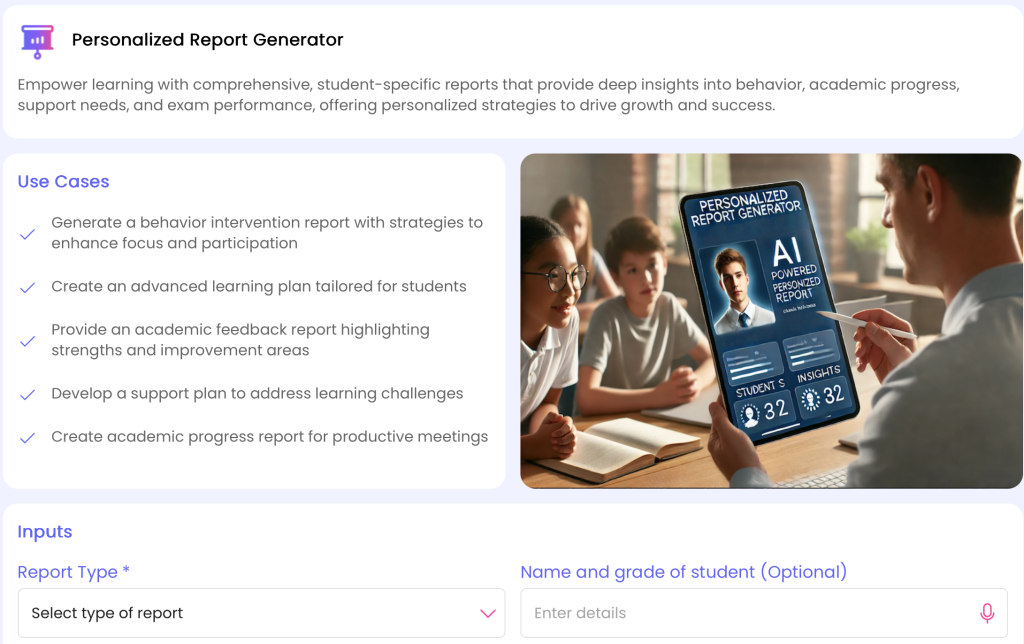
Personalised Report Generate: https://myspace.teachbetter.ai/view/resource/71289f97-3208-450c-b82f-405db2a42888
Real-World Mathematics: Moving Beyond Rote Learning
One of the strongest opportunities for AI in Mathematics education is helping teachers bridge the gap between abstract mathematical concepts and the real world.
Students frequently ask a simple question:
"Where will I ever use this?"
Sometimes the difficulty is not the Mathematics itself. Students simply cannot see why the concept matters.
A real-world context can change that.
- Percentage in Everyday Life
Percentage is everywhere.Students encounter percentages when they see discounts in shops, calculate examination marks, read financial information, compare prices or look at statistics.A teacher teaching percentage could ask:
A product originally costs ₹2,000 and is offered at a 20% discount. What is the discount amount? What is the final price?
The student is still performing a percentage calculation, but the question now represents a familiar situation. The teacher can take it further by asking what happens when there are two successive discounts, or whether a 20% increase followed by a 20% decrease brings the price back to its original value.
The mathematics becomes a tool for reasoning about everyday decisions.
- Geometry in the Physical World
Geometry is not confined to diagrams in a textbook.
Buildings, rooms, roads, gardens, packaging and furniture all involve geometric relationships. A teacher could ask students to estimate the area of their classroom, calculate how much flooring would be required, determine the amount of paint needed for a wall or calculate the fencing required around a school garden.
Students can see that perimeter and area are not simply formulas to remember. They solve practical measurement problems.
- Ratio and Proportion
Ratio becomes easier to appreciate when students encounter situations involving quantities.
A recipe, for example, may require two cups of flour for every one cup of sugar. What happens if the recipe needs to be prepared for twice as many people? Students can explore the relationship between quantities and understand proportional reasoning through something familiar.
The same mathematical thinking applies to maps, scale drawings, mixtures, construction and many other contexts.
- Statistics and Data
Students live in a world filled with data.Sports statistics, examination results, social surveys, attendance records and population information can all be used as Mathematics learning material.
Instead of giving students an artificial list of numbers, a teacher could ask them to collect data from their own class and analyse it.They can calculate the mean, median and mode and then discuss what the results actually tell them.
This introduces an important mathematical skill: interpreting results rather than simply calculating them.
- Speed, Distance and Time
Speed, distance and time can be connected naturally with travel.
Students can calculate how long a journey will take at different speeds, compare two travel routes or determine the average speed of a vehicle. The teacher can then introduce more complex questions involving changes in speed, stops during a journey or different stages of travel.
Once again, the mathematical calculation becomes part of a meaningful situation.
Why TeachBetter.ai Can Be a Powerful AI Platform for Maths Teachers
The rapid growth of generative AI has given teachers access to an enormous number of tools. However, having access to AI is not the same as having an effective AI teaching workflow.Best AI Platform for Maths Teachers.
A Maths teacher does not necessarily need another generic chatbot that can answer a question. The teacher needs practical support for the things they actually do every week:
Planning lessons. Explaining difficult concepts. Creating activities. Preparing worksheets. Developing visual material. Answering student questions. Assessing understanding. Reviewing performance. Supporting revision.
TeachBetter.ai brings these capabilities together in a teacher-focused environment.
- Faster Preparation Without Losing Teacher Control
One of the most immediate benefits of AI is reducing the amount of time teachers spend starting from a blank page.
A teacher can use AI to generate a first version of a lesson plan, worksheet, activity or presentation and then apply professional judgement to refine it. This is important because the objective is not to automate the teacher's thinking.
It is to remove some of the repetitive work that surrounds it.
- Stronger Focus on Conceptual Understanding
Mathematics education becomes more effective when students understand the ideas behind the procedures.
TeachBetter.ai can help teachers explore alternative explanations, practical examples, activities and supporting resources that make abstract concepts easier to approach. This gives teachers more options when the first explanation does not work for a particular group of students.
- Bringing Mathematics Into the Real World
AI can make it easier to create contextual examples around familiar situations.
A percentage problem can become a shopping scenario. A geometry lesson can become a classroom measurement exercise. Statistics can be based on real class data. These connections help students see Mathematics as something they can use rather than simply something they have to memorize.
- More Engaging Classroom Experiences
Students learn Mathematics through practice, but practice does not have to mean doing the same type of question repeatedly.
Activities, projects, creative resources, presentations and live quizzes can introduce different ways for students to interact with mathematical concepts. This gives teachers more opportunities to make students think, discuss, investigate and apply.
- Assessment That Supports Teaching
Assessment becomes more valuable when teachers can act on the results.
Quick formative assessments can reveal whether a concept has been understood. Performance reports can help identify areas requiring additional attention. Practice and mastery activities can provide students with further opportunities to improve.
The result is a continuous cycle rather than an isolated examination:
Teach → Assess → Understand → Intervene → Practise → Improve
- More Time for Students
Ultimately, the value of AI should not be measured only by how much content it can generate.
The more important question is:
What does the teacher gain from the time saved?
If AI reduces repetitive preparation, that time can be redirected towards individual student support, classroom interaction, explanation, mentoring and problem-solving discussions. That is where the human value of the teacher remains irreplaceable.
AI Should Assist the Maths Teacher—Not Replace the Teacher
Artificial Intelligence can make Mathematics teaching faster and more flexible, but it does not replace the expertise of a good Maths teacher.
Mathematics requires precision. An AI-generated explanation may be useful, but it should still be reviewed. A generated worksheet may contain excellent questions, but the teacher needs to check whether the questions are appropriate for the class. A solution may look convincing while containing an error that needs to be identified before it reaches students.
Teachers should therefore review AI-generated material for mathematical accuracy, appropriate terminology, clarity, difficulty level, curriculum relevance and examination requirements. More importantly, teachers understand things that an AI system cannot fully understand from a prompt.
Through regular classroom interaction, teachers can identify know which students are struggling.
Understanding each learner's progress helps teachers assess can also recognize know which concepts need another explanation.
Most importantly, their experience allows them to distinguish know when a class is ready to move ahead.
They understand the confidence level of individual students.
They know when a student has made a careless calculation error and when that error reflects a deeper misunderstanding.
This is why the most effective approach is not:
AI instead of teacher.
It is:
AI + teacher.
AI can help generate ideas, organize information and accelerate preparation. The teacher provides judgement, context, experience, empathy and instructional decision-making. A useful way to think about the relationship is:
AI generates. Teacher reviews. Teacher adapts. Students learn.
That is the model in which AI becomes a genuine teaching assistant rather than a replacement for the educator.
Frequently Asked Questions
- What is the best AI platform for Maths teachers?
There is no single AI platform that will be the best choice for every teacher. The right platform depends on the teacher's requirements, curriculum and classroom context.Best AI Platform for Maths Teachers.
TeachBetter.ai is designed specifically as an AI-powered teaching platform that brings together capabilities for lesson planning, concept explanation, activities, worksheets, presentations, doubt solving, document-based learning, classroom assessment, student reporting and concept mastery.
For Maths teachers, its value lies in supporting multiple stages of teaching rather than focusing only on solving mathematical problems.
- Can TeachBetter.ai create Maths lesson plans?
Yes. The Lesson Planner can help teachers structure lessons around a specific topic, grade and learning objective. Teachers can use the generated plan as a starting point and then adapt it according to their curriculum, classroom duration and students' existing knowledge.
The tool can also help teachers think about practical examples and real-world applications that can make a Mathematics lesson more meaningful.
- Can AI create Maths worksheets?
Yes. The Quiz & Worksheet Generator can help teachers create practice material around specific Mathematics topics.
Teachers can use generated material for classroom practice, homework, revision, topic-based exercises and assessment preparation. As with any AI-generated content, teachers should review the questions and solutions before distributing them to students.
- Can TeachBetter.ai help explain difficult Maths concepts?
Yes. The Concept Explainer can help teachers develop explanations and examples for difficult mathematical concepts.
This can be especially useful when students are struggling with abstract topics such as algebra, geometry, trigonometry, probability or statistics and the teacher wants to approach the concept from another angle.
- Can Maths teachers use AI for classroom activities?
Yes. The Activity & Project Generator can help teachers design activities and projects around mathematical concepts.
These can be connected to measurement, data collection, probability experiments, financial Mathematics and other practical situations.
- Can AI help Maths teachers create real-world examples?
Yes. TeachBetter.ai can support teachers in incorporating real-world contexts into lesson planning and creative resource development.
For example, percentage can be connected with discounts, geometry with classroom measurements, ratio with recipes and statistics with classroom or sports data.
- Can TeachBetter.ai help Maths teachers assess students during class?
Yes. PaperQR Live Quiz can be used for quick classroom MCQ assessments, helping teachers obtain immediate feedback about student understanding.
This can allow teachers to identify concepts that may need additional explanation before progressing to the next part of the lesson.
- Can TeachBetter.ai work with existing Maths PDFs and notes?
Yes. Chat With Documents can help teachers interact with existing documents and use them as a basis for creating summaries, questions, revision resources and other teaching material.
This can be useful for teachers who already have substantial school-created resources and want to make them more useful without recreating everything from scratch.
- Can teachers use educational videos as part of Maths lessons?
Yes. The YouTube Video Analyzer can help teachers work with educational videos and turn their content into a more structured part of the learning experience.
Instead of simply showing a video, teachers can connect it with questions, discussion, practice and follow-up activities.
- Can students use TeachBetter.ai for Maths practice?
Yes. The Concept Mastery Coach provides an interactive quiz-based experience that can help students practise and test their understanding of concepts.
This can support revision and independent practice beyond the classroom.
Conclusion: Make Maths Easier to Teach and More Meaningful to Learn
The future of Mathematics education is not about removing formulas, textbooks, written practice or examinations. Students will always need to learn mathematical concepts, understand formulas and practise solving problems.Best AI Platform for Maths Teachers.
The opportunity is to make that learning more meaningful. A student should not only know that the area of a circle is πr².Students should have opportunities to understand what that formula represents and where it can be used.
Rather than simply should not simply memorize how to calculate percentages. They should recognize percentages when they encounter discounts, marks, financial information and real-world data.They should not only learn how to solve equations. They should develop the confidence to use equations to represent and solve unfamiliar problems.
And teachers should not have to spend hours repeatedly creating every lesson plan, worksheet, activity and supporting resource from scratch. This is where AI can make a meaningful difference.
TeachBetter.ai brings together tools such as Lesson Planner, Concept Explainer, Activity & Project Generator, Creative Resource Generator, Quiz & Worksheet Generator, Presentation Generator, Doubt Solver, Chat With Documents, YouTube Video Analyzer, PaperQR Live Quiz, Personalized Report Generator and Concept Mastery Coach to support different stages of Mathematics teaching and learning.
The opportunity is not simply to generate more educational content. It is to help teachers create better learning experiences. For Maths teachers, AI should not replace the teacher standing at the board. It should give that teacher more time, more ideas, more flexibility and more ways to support students. Because ultimately, the goal of Mathematics education is not simply to help students solve more questions.
It is to help them understand Mathematics, think mathematically, solve problems confidently and recognize the role Mathematics plays in the world around them.

Vipin Kumar, Co-Founder, TeachBetter.ai
Vipin Kumar is building TeachBetter.ai to create intuitive AI tools that simplify teaching and enhance learning outcomes. With prior experience at global technology companies, he brings a deep understanding of scalable systems, user needs, and practical digital solutions. His mission is to make AI adoption in education easy, affordable, and truly impactful for teachers everywhere. He is committed to creating AI solutions that save time, boost creativity, and empower educators to focus on what matters most—teaching.
Read other articles authored by Vipin Kumar here.