Best Ways to Engage Students in Class and Keep Them Attentive: A NEP 2020 Guide for Modern Teachers
Vipin Kumar
|
 3 June, 2026
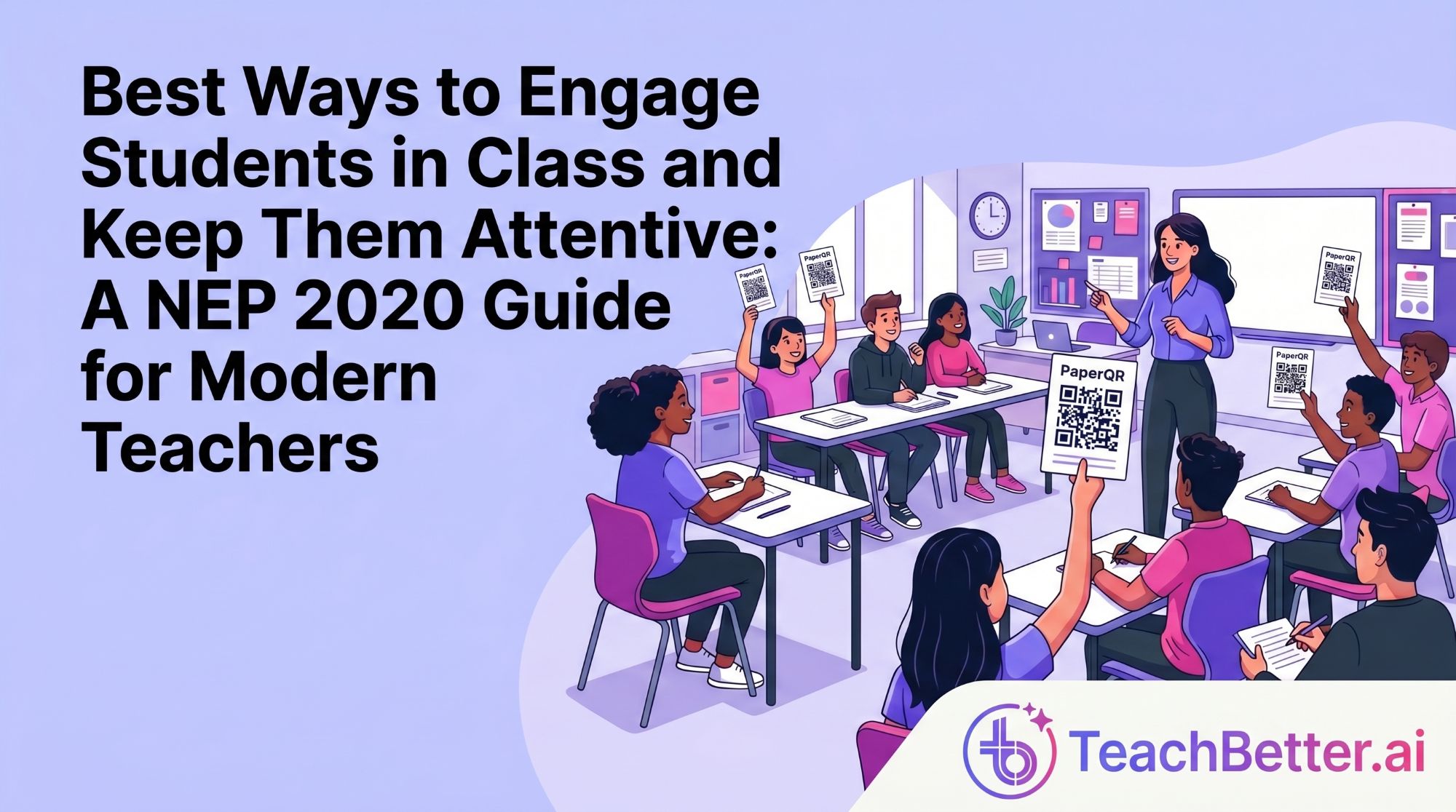
Student engagement in classroom settings has become one of the biggest challenges facing teachers today. You may have planned an excellent lesson, prepared relevant examples, and defined clear learning objectives, yet within a few minutes some students become distracted while only a handful participate actively.
Keeping students attentive and engaged throughout a lesson requires more than effective teaching. It requires creating learning experiences that encourage participation, collaboration, curiosity, and continuous feedback.
However, student engagement is about much more than simply paying attention. An engaged student is emotionally invested, intellectually curious, and actively involved in the learning process. They ask questions, participate in discussions, collaborate with peers, solve problems, and apply concepts to real-world situations. Such students are more likely to retain information, perform better academically, and develop essential skills that prepare them for future success.
Recognizing this need, the National Education Policy (NEP) 2020 advocates a shift away from rote memorization and toward experiential learning, competency-based education, critical thinking, and continuous assessment. The policy emphasizes creating learner-centric classrooms where students actively participate rather than passively receive information.
In this blog, we will explore practical strategies to keep students attentive and engaged in class, understand how these approaches align with NEP 2020, and discover how TeachBetter.ai's PaperQR Live Quiz can help educators transform classroom engagement and assessment into a more interactive, effective, and meaningful experience.
Why Student Engagement in Classroom Matters More Than Ever
Student engagement is the foundation of meaningful learning. No matter how carefully planned a lesson may be, learning outcomes suffer when students are not actively involved. Engagement influences how students process information, retain concepts, and apply knowledge in different situations. In simple terms, students learn more effectively when they actively participate in learning rather than simply listening.
Research consistently shows that engaged students perform better academically, attend classes more regularly, and demonstrate higher levels of motivation. They are more likely to ask questions, contribute to discussions, seek clarification when confused, and persist through challenging concepts. These behaviors not only improve academic achievement but also help students become more confident and independent learners.
Engagement is equally important for developing twenty-first-century skills. Modern education is no longer focused solely on remembering facts. Students must learn to think critically, collaborate with others, communicate effectively, and solve complex problems. Active participation naturally helps develop these competencies while making learning more enjoyable and relevant.
Perhaps most importantly, engaged students develop a stronger connection with learning itself. Instead of viewing education as a series of assignments and examinations, they begin to see learning as a process of exploration, discovery, and growth. This mindset encourages lifelong learning and curiosity—qualities that are increasingly valuable in a rapidly changing world.
This aligns closely with the vision of NEP 2020, which seeks to create holistic learners who can think independently, innovate, and adapt to changing environments. In today's educational landscape, student engagement is not an optional enhancement—it is a necessity for effective teaching and meaningful learning.
Why Students Lose Attention in Traditional Classrooms
Understanding why students disengage is the first step toward improving engagement. While every learner is different, certain factors consistently contribute to reduced attention and participation.
Common Causes of Student Disengagement
- Long periods of passive listening
- Limited opportunities for participation
- Lack of real-world relevance
- Delayed feedback
- Fear of answering incorrectly
- Repetitive teaching methods
- Limited peer interaction
When students spend most of their time listening rather than doing, attention naturally declines. Even motivated learners struggle to remain focused during lengthy lectures that offer little interaction. Research has repeatedly shown that students retain more information when they actively participate in learning activities rather than simply consuming information.
Another major factor is relevance. Students are far more likely to engage when they understand how a concept connects to their daily lives, future careers, or real-world situations. When learning feels disconnected from reality, motivation often decreases and participation drops.
Feedback also plays a crucial role. Today's students are accustomed to receiving immediate responses through digital platforms. Traditional classroom assessments that take days or weeks to provide results can weaken engagement and reduce learning effectiveness. Students learn best when they can quickly understand what they have mastered and where they need improvement.
Creating an engaging classroom therefore requires more than delivering content effectively. It requires designing learning experiences that encourage participation, curiosity, interaction, and continuous feedback.
NEP 2020 and the Shift Toward Active Learning
The National Education Policy 2020 recognizes that traditional memorization-based learning is insufficient for preparing students for future challenges. Instead, it promotes learner-centric education that emphasizes understanding, application, creativity, critical thinking, and problem-solving.
Key NEP 2020 Recommendations
- Experiential learning
- Competency-based assessment
- Inquiry-driven learning
- Continuous formative assessment
- Student collaboration
- Personalized learning pathways
Experiential learning encourages students to learn through projects, discussions, activities, simulations, and practical applications. This naturally increases engagement because students become active participants in the learning process rather than passive recipients of information.
The policy also promotes competency-based education, where success is measured by a student's ability to apply knowledge and demonstrate understanding rather than simply recalling information. This requires teachers to create more opportunities for interaction, problem-solving, and real-world application.
Continuous assessment is another key recommendation. Rather than relying solely on high-stakes examinations, teachers are encouraged to assess learning regularly and provide timely feedback. This helps identify learning gaps early and supports personalized instruction.
Ultimately, NEP 2020 recognizes that active learning and student engagement are essential for creating meaningful educational experiences. The more involved students are in their learning journey, the deeper their understanding and long-term retention become.
7 Proven Ways to Keep Students Attentive in Class
1. Start Every Lesson with Curiosity: Curiosity is one of the strongest drivers of learning. Students are naturally inclined to seek answers when presented with intriguing questions, surprising facts, or challenging scenarios.
For example, instead of beginning a science lesson with definitions, a teacher might ask: "Why do astronauts appear weightless in space?" Such questions immediately capture attention and encourage inquiry.
When lessons begin with curiosity, students become invested in discovering the answers. This creates anticipation and encourages them to remain engaged throughout the lesson.
2. Make Learning Interactive: Interactive learning transforms students from passive listeners into active participants.
Examples include:
- Think-Pair-Share activities
- Group discussions
- Classroom debates
- Peer teaching
- Brainstorming exercises
- Interactive questioning
Consider a history lesson where students debate the decisions of historical leaders rather than simply reading about them. Such activities encourage deeper thinking, improve retention, and make learning significantly more engaging.
3. Connect Learning to Real Life: Students engage more deeply when they understand why a topic matters.
Teachers can connect lessons to:
- Everyday experiences
- Current events
- Community issues
- Future careers
- Technology and innovation
For example, mathematics becomes more meaningful when students use percentages to calculate discounts during a shopping sale. Real-world connections help learners see practical value and increase motivation.
4. Encourage Collaborative Learning: Collaborative learning helps students learn from one another while developing teamwork and communication skills.
Group projects, peer discussions, and collaborative problem-solving activities encourage participation and expose students to diverse perspectives. Collaboration also helps quieter learners gain confidence by sharing ideas within smaller groups before speaking in front of the entire class.
5. Introduce Gamification: Gamification incorporates elements of games into learning.
Benefits include:
- Increased participation
- Higher motivation
- Better retention
- Friendly competition
- Reduced classroom anxiety
Simple strategies such as quizzes, leaderboards, classroom challenges, and team competitions can make lessons more engaging while maintaining educational objectives. When learning feels enjoyable and rewarding, students are more likely to remain attentive and actively involved.
6. Provide Immediate Feedback: Feedback is most effective when it is timely.
Immediate feedback helps students:
- Identify misconceptions
- Correct mistakes quickly
- Monitor progress
- Build confidence
- Stay motivated
The shorter the feedback cycle, the stronger the learning impact. Students are more likely to remain engaged when they can immediately understand the results of their efforts.
7. Conduct Frequent Formative Assessments: Formative assessment is one of the most powerful engagement tools available to teachers.
Regular assessment helps:
- Reinforce concepts
- Identify learning gaps
- Support personalized instruction
- Improve retention
- Guide teaching decisions
However, implementing continuous formative assessment effectively can be difficult in large classrooms, especially when teachers must evaluate responses manually.
Why Engagement Strategies Often Fail in Real Classrooms
Most teachers understand the importance of active learning and formative assessment. The challenge is not knowing what to do—it is finding practical ways to do it consistently.
A teacher may want to assess understanding after every lesson, but manually evaluating responses from forty students can consume significant time. Similarly, classroom discussions often involve the same group of confident learners while others remain passive observers.
Providing immediate feedback becomes difficult when assessments require manual grading. By the time feedback is provided, the learning moment may have passed, reducing its effectiveness.
As a result, many proven engagement strategies remain underutilized despite their educational value. Teachers need solutions that make engagement and assessment practical, scalable, and easy to implement within everyday classroom routines.
Introducing PaperQR Live Quiz by TeachBetter.ai
PaperQR Live Quiz by TeachBetter.ai is designed to solve one of the biggest challenges in education: how to keep every student engaged while conducting meaningful assessments without increasing teacher workload.
Many teachers rely on classroom questioning to gauge understanding. However, this approach often provides feedback from only a small group of students who are comfortable answering publicly. Meanwhile, quieter students may remain silent, and learning gaps can go unnoticed until much later.
PaperQR Live Quiz transforms classroom assessment into an engaging learning experience where every student participates. Instead of relying on a few volunteers, teachers can collect responses from the entire class in real time, gaining a complete picture of student understanding within minutes.
Unlike many digital quiz platforms, PaperQR does not require students to use smartphones, tablets, or laptops. Students respond using unique PaperQR cards while teachers capture responses instantly using a phone or laptop camera.
The result is an assessment experience that is fast, interactive, inclusive, and data-driven. Teachers gain meaningful insights, students receive timely feedback, and assessment becomes an integral part of learning rather than a separate classroom activity.
Why Traditional Classroom Quizzes Often Fall Short
Classroom quizzes have long been used to assess learning and reinforce concepts. However, traditional quiz methods often struggle to provide the speed, visibility, and engagement required in modern learner-centric classrooms.
Common Challenges with Traditional Assessments
- Time-consuming evaluation and grading
- Delayed feedback for students
- Limited visibility into class-wide understanding
- Participation from only a small group of learners
- Difficulty identifying concept-level learning gaps
- Increased workload for teachers
One of the biggest limitations of traditional assessments is the delay between evaluation and action. Teachers often spend valuable time collecting responses, grading assessments, and preparing reports. By the time feedback reaches students, the learning opportunity may already have passed.
Participation is another challenge. In many classrooms, only a small group of students regularly answer questions or contribute to discussions, making it difficult to assess understanding across the entire class. Learning gaps often remain hidden until formal examinations.
Traditional assessments also provide limited visibility into concept-level understanding. Teachers may know who performed well and who struggled, but identifying specific misconceptions can require significant analysis.
Modern classrooms need assessment methods that provide immediate visibility into learning progress, allowing teachers to intervene quickly and support students more effectively.
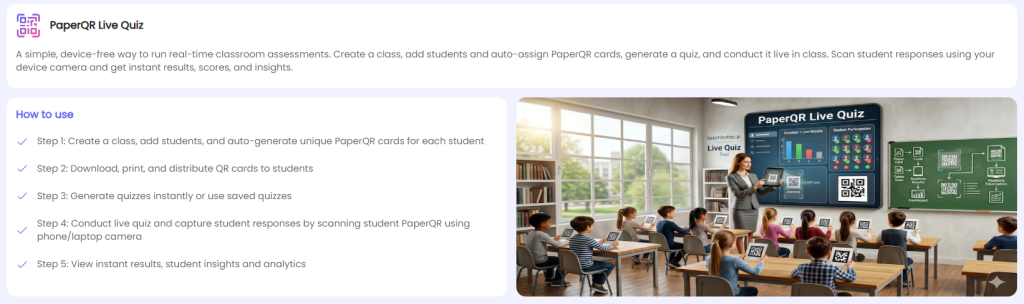
How PaperQR Live Quiz Works
Step 1: Create Your Class: Create a class and add student details. The platform automatically generates a unique PaperQR card for every student, ensuring responses can be captured accurately.
Step 2: Print and Distribute PaperQR Cards: Download and print the cards once. Students can reuse them throughout the academic year, making the process practical and cost-effective.
Step 3: Generate a Quiz: Create quizzes instantly by entering a topic, chapter, or learning objective. Teachers can also save and reuse quizzes whenever needed.
Step 4: Conduct a Live Assessment: Students respond using their assigned PaperQR cards while the teacher scans responses using a phone or laptop camera.
Step 5: Access Instant Results: Results, participation data, and learning insights are generated automatically, enabling immediate feedback and instructional adjustments.
The entire process takes only a few minutes, making it practical to conduct formative assessments regularly rather than occasionally.
How PaperQR Supports Continuous Formative Assessment
One of the most significant shifts recommended by NEP 2020 is the move away from assessment as a one-time event and toward assessment as an ongoing learning process.
PaperQR Live Quiz makes continuous formative assessment practical and sustainable. Instead of waiting until the end of a chapter or term to evaluate learning, teachers can conduct quick assessments throughout the teaching process.
Teachers Can Use PaperQR For:
- Lesson starters
- Mid-lesson understanding checks
- End-of-class reflections
- Weekly concept reviews
- Revision sessions
- Exam preparation activities
Because results are generated instantly, teachers can identify misconceptions before they become deeply embedded. Rather than discovering learning gaps during final examinations, educators can intervene at the moment when support is most effective.
This continuous feedback loop improves learning outcomes while helping teachers personalize support and instruction more effectively.
How PaperQR Live Quiz Aligns with NEP 2020
The National Education Policy 2020 envisions classrooms where learning is interactive, competency-based, inclusive, and focused on holistic development.
PaperQR Live Quiz directly supports several key pillars of NEP 2020 by making classroom assessment more engaging, participatory, and data-driven.
| NEP 2020 Recommendation | How PaperQR Supports It |
| Experiential Learning | Interactive classroom assessments |
| Competency-Based Learning | Measures understanding and application |
| Formative Assessment | Continuous learning checks with instant feedback |
| Student Participation | Every learner responds |
| Personalized Learning | Identifies learning gaps |
| Data-Driven Teaching | Provides real-time instructional insights |
The platform supports active learning by encouraging participation from every student. Teachers gain visibility into understanding levels, while students receive immediate opportunities to demonstrate learning.
Most importantly, PaperQR helps schools translate the vision of NEP 2020 into practical classroom action without increasing complexity or workload.
Benefits of PaperQR Live Quiz for Teachers
Key Benefits for Teachers
- Saves significant time on assessment and grading
- Provides instant classroom insights
- Encourages participation from every student
- Supports competency-based learning
- Makes formative assessment practical
- Eliminates dependency on student devices
One of the biggest advantages of PaperQR is the time it saves. Traditional assessments often require manual grading, score compilation, and report preparation. PaperQR automates these processes, allowing teachers to focus more on teaching and student support.
The platform also provides real-time insights into classroom understanding. Teachers can quickly identify learning gaps, monitor participation, and make informed instructional decisions based on actual student performance.
Because every student participates, teachers gain a more complete picture of classroom progress while reducing the risk of overlooked misconceptions.
By combining automation, analytics, and participation, PaperQR helps educators implement formative assessment more effectively without increasing workload.
Benefits of PaperQR Live Quiz for Students
Key Benefits for Students
- More engaging classroom experiences
- Equal opportunities for participation
- Immediate feedback on learning
- Increased confidence and motivation
- Reduced fear of making mistakes
- Greater ownership of learning progress
PaperQR Live Quiz creates a more engaging and inclusive learning environment by ensuring that every student has an opportunity to participate.
Unlike traditional questioning methods that often favor confident learners, PaperQR enables all students to respond simultaneously. This reduces participation barriers and encourages broader classroom involvement.
Students also benefit from immediate feedback, helping them identify strengths and areas for improvement while concepts are still fresh in their minds.
Over time, this continuous cycle of participation and feedback builds confidence, improves learning ownership, and encourages active engagement in the classroom.
Why PaperQR Live Quiz Is the Ultimate Student Engagement Solution
PaperQR Live Quiz stands out because it combines engagement, assessment, and analytics within a single classroom solution.
PaperQR Brings Together
- Active student participation
- Gamified classroom interaction
- Continuous formative assessment
- Real-time feedback
- Instant analytics and insights
- NEP 2020-aligned teaching practices
- Device-free accessibility
By integrating active participation, formative assessment, instant feedback, and classroom insights, the platform helps teachers maintain attention while continuously monitoring learning progress.
Unlike traditional assessments that occur after learning has taken place, PaperQR embeds assessment directly into the learning process. Students remain actively involved, and teachers gain immediate visibility into understanding.
Whether used for concept checks, revision sessions, exam preparation, or competency-based learning, PaperQR helps create classrooms where engagement and assessment work together to improve learning outcomes.
Conclusion
Keeping students attentive and engaged is one of the most important responsibilities of modern educators. Strategies such as inquiry-based learning, collaboration, gamification, real-world connections, and continuous formative assessment can significantly improve participation, motivation, and learning outcomes.
However, implementing these practices consistently requires practical solutions that fit naturally into classroom workflows.
PaperQR Live Quiz by TeachBetter.ai bridges this gap by enabling teachers to conduct engaging, device-free classroom assessments where every student participates, every response matters, and every learning opportunity is measurable.
More importantly, it supports the core principles of NEP 2020 by promoting active participation, competency-based learning, continuous assessment, personalized instruction, and data-driven teaching practices.
As schools continue to embrace learner-centric education, the need for engaging, inclusive, and effective assessment methods will only grow. PaperQR Live Quiz empowers teachers to move beyond passive instruction and create classrooms where learning becomes active, measurable, and meaningful.
The future of education is not simply about teaching more—it is about engaging more. And with PaperQR Live Quiz, every lesson becomes an opportunity to make learning more interactive, insightful, and impactful.

Vipin Kumar, Co-Founder, TeachBetter.ai
Vipin Kumar is building TeachBetter.ai to create intuitive AI tools that simplify teaching and enhance learning outcomes. With prior experience at global technology companies, he brings a deep understanding of scalable systems, user needs, and practical digital solutions. His mission is to make AI adoption in education easy, affordable, and truly impactful for teachers everywhere. He is committed to creating AI solutions that save time, boost creativity, and empower educators to focus on what matters most—teaching.
Read other articles authored by Vipin Kumar here.