Why AI is the Catalyst for the Next Educational Revolution
Binit Agarwalla
|
 6 August, 2026
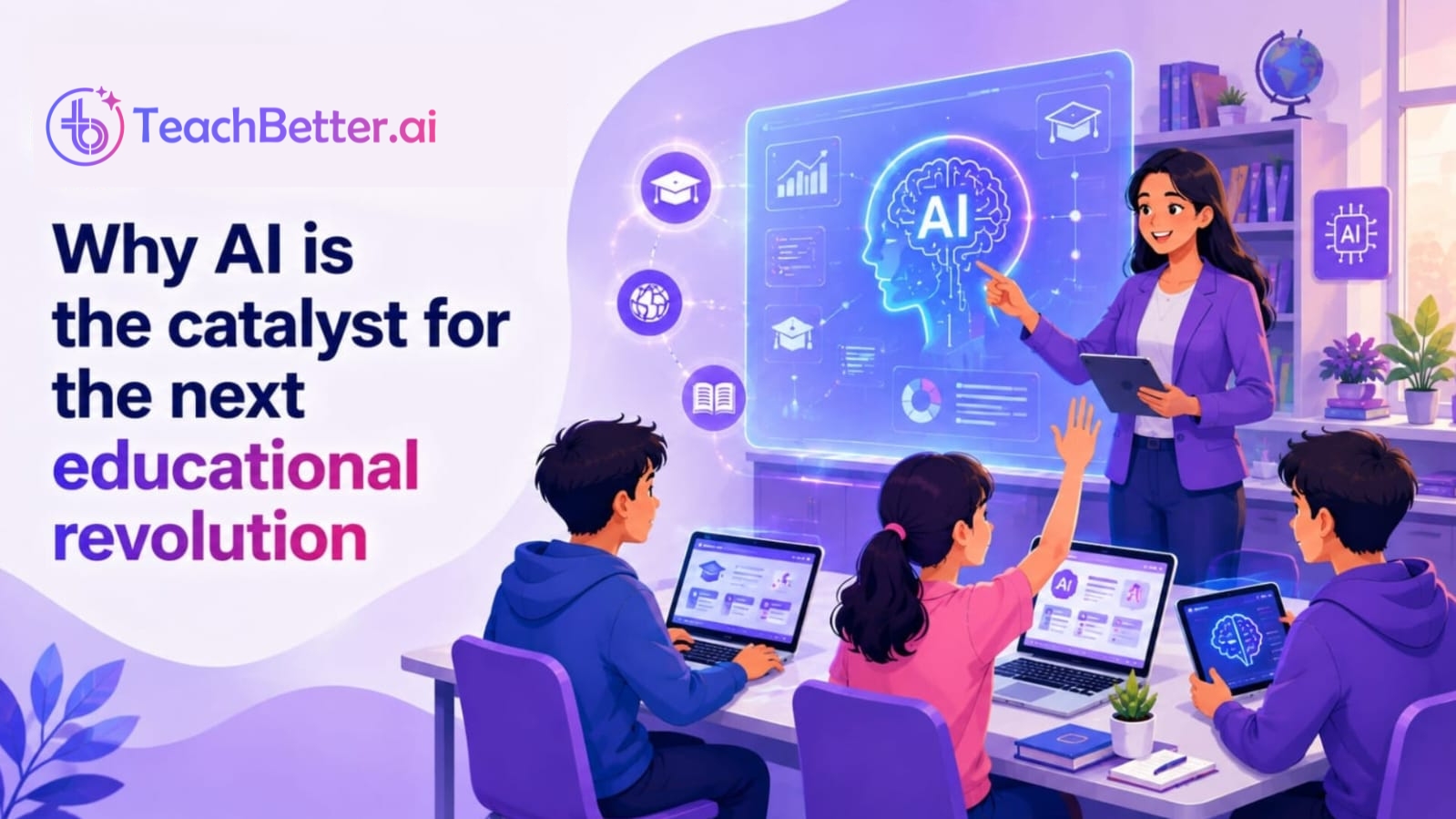
AI in education is driving the biggest transformation classrooms have witnessed in decades. The education system, as we know it, is standing at a pivotal crossroads. For decades, we have operated on a model born from an era of information scarcity. Success was defined by a student's ability to memorize facts, retain them, and reproduce them during examinations.
But look around. We no longer live in a world where information is hidden in dusty encyclopedias or reserved for the elite. We live in an era of information abundance. If our education system continues to prioritize rote memorization over critical thinking, it will fall behind the changing world. More importantly, it will fail the next generation.
As the founder of TeachBetter.ai, I spend every day talking to teachers. And the consensus is clear: the current model is broken. It is designed to serve the top 5% of students. The remaining 95% are often left to navigate an increasingly complex world without the necessary tools.
We need to shift our focus. The new mandate for education isn't "preparation for a job"—it is "preparation for a lifetime of application.
The "Memorization Trap" vs. Deep Understanding
The real challenge in our schools isn't a lack of effort; it's a focus on the wrong goals. We are still obsessed with "the test." But when a student spends 20 precious years of their life in an education system, the output cannot simply be a grade point average. Instead, students should develop lasting capabilities. They should understand concepts deeply, apply them to real-world problems, and build the resilience to create and adapt in an uncertain future.
When a teacher walks into a classroom today, the goal should not be to dictate notes that students copy blindly. The goal should be to ignite curiosity. Teachers should connect abstract concepts to real-life situations, such as Newton's laws in a cricket match. This approach leads to deeper understanding.
But here is the hard truth: Expecting teachers to do this manually for every student, in every class, is a recipe for burnout. This is where AI in education can help teachers shift the focus from memorization to conceptual understanding.
AI: The Transformational Engine, Not Just a Shortcut
There is a common misconception that AI is merely an automation tool—a way to save a few minutes on lesson planning or email drafting. While saving time is a wonderful byproduct of technology, it is not the purpose.
If you use AI solely to save time, you are using it as an automation tool. AI becomes transformational when it changes how you teach. It also changes how you assess learning and connect with every student in your classroom. The real promise of AI in education is not automation alone—it is enabling every teacher to deliver more personalized and engaging learning experiences.
AI allows us to do what was once humanly impossible:
- Continuous Assessment: Replace high-stakes exams with continuous, real-time feedback. Teachers can identify learning gaps early and intervene before students fall behind.
- Hyper-Personalization: Recognizing that every child is important. We can move beyond "teaching to the middle." Every student can receive resources tailored to their unique learning journey.
- Multimodal Engagement: Simulations, visuals, and interactive activities transform classrooms into laboratories of ideas. Learning becomes more engaging than traditional lectures based on rote memorization.
The "Superhuman" Teacher
There is a pervasive fear that AI will replace teachers. I argue the opposite. The teacher who uses AI will replace the teacher who doesn't.
AI removes much of the administrative burden. It can draft worksheets, format notes, and simplify grading. Teachers don't lose their jobs. You gain your profession back. More importantly, you gain the time and mental bandwidth to be a mentor, a guide, and a facilitator of deep learning.
Instead of being an information delivery system, you become a master architect of student growth.
A Call to Action for the Future
We are not building technology for the tech-savvy or the elite. We are building technology for the masses. Whether you use the tools we’ve built at TeachBetter.ai or you find another path, the imperative remains the same: You cannot ignore this technology.
We have a responsibility to our students. They are investing 20 years of their lives into this system. If that system cannot guarantee they are prepared to survive and thrive in a complex, chaotic world, then we have a moral obligation to change it.
The transformation won't come from putting more pressure on teachers. It will come from enabling them. It is time to stop expecting teachers to be superhumans and start providing them with the superpowers they deserve.
The future of AI in education is not about replacing teachers—it is about empowering every teacher to achieve better learning outcomes.
Binit Agarwalla is the Founder of TeachBetter.ai, dedicated to upskilling the global teaching community and driving real-world transformation in education, powered by AI - A Transformational Technology. See the 3-min video below to understand the real power of AI.
TeachBetter.ai - Version 5 Launch Video. 20+ AI tools, 100+ Simulations and now a unique PaperQR Live Quiz for in-class assessments without any student devices or hardware.

Binit Agarwalla, Founder, TeachBetter.ai
With over 15 years of seasoned expertise, Binit is a results-driven marketing leader specializing in B2B SaaS and B2C growth strategy - now channeling that experience into transforming education through TeachBetter.ai, an all-in-one AI platform built exclusively for teachers, students, and schools.
As the Founder of TeachBetter.ai, his mission is to simplify teaching and amplify learning by empowering educators with AI-driven tools that save time, enhance creativity, and make classrooms more engaging. TeachBetter.ai's vision is to make AI adoption in education simple, accessible, and affordable - helping every teacher leverage the power of AI without complexity or high cost.
Read other articles authored by Binit Agarwalla here.